

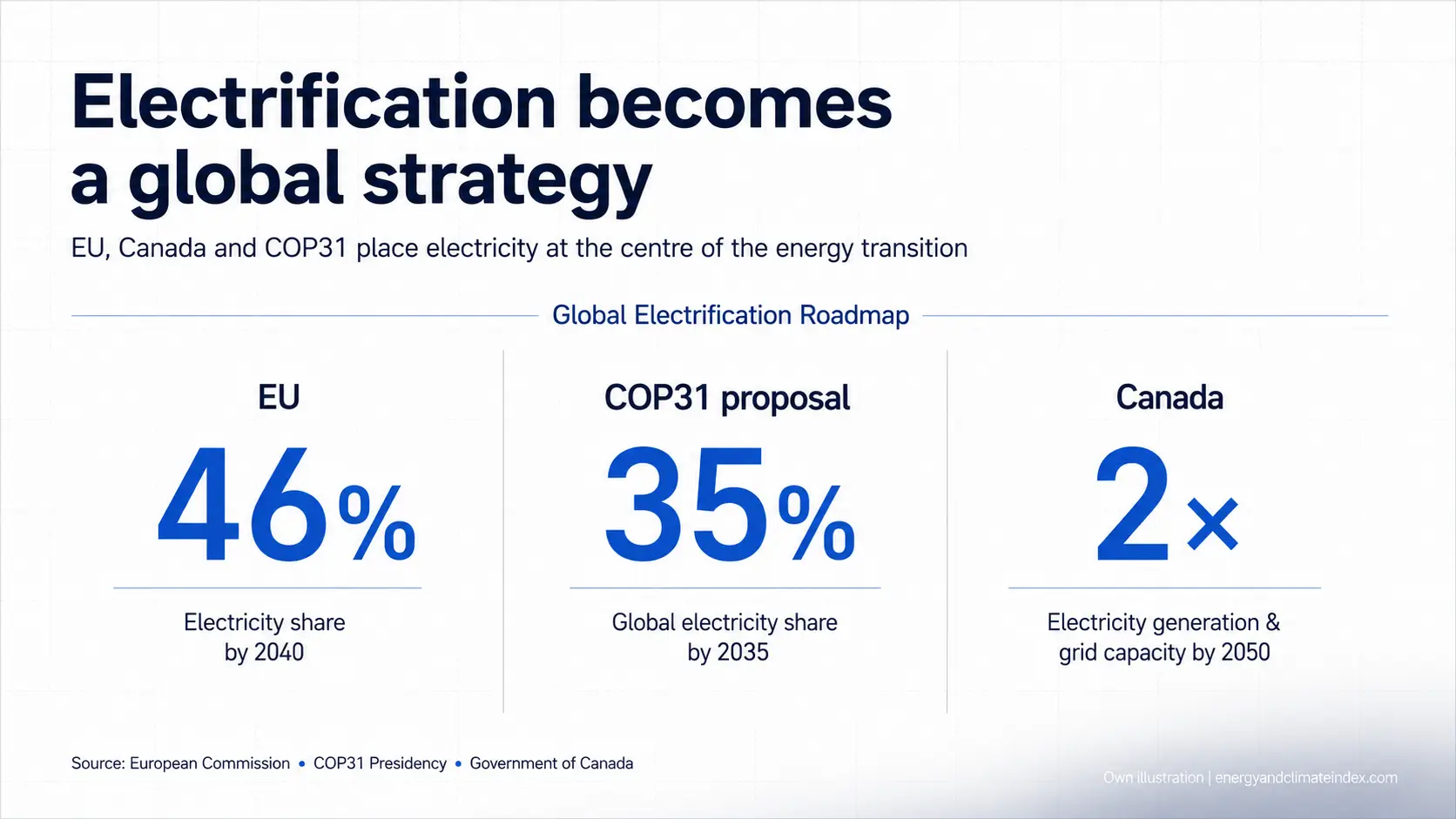
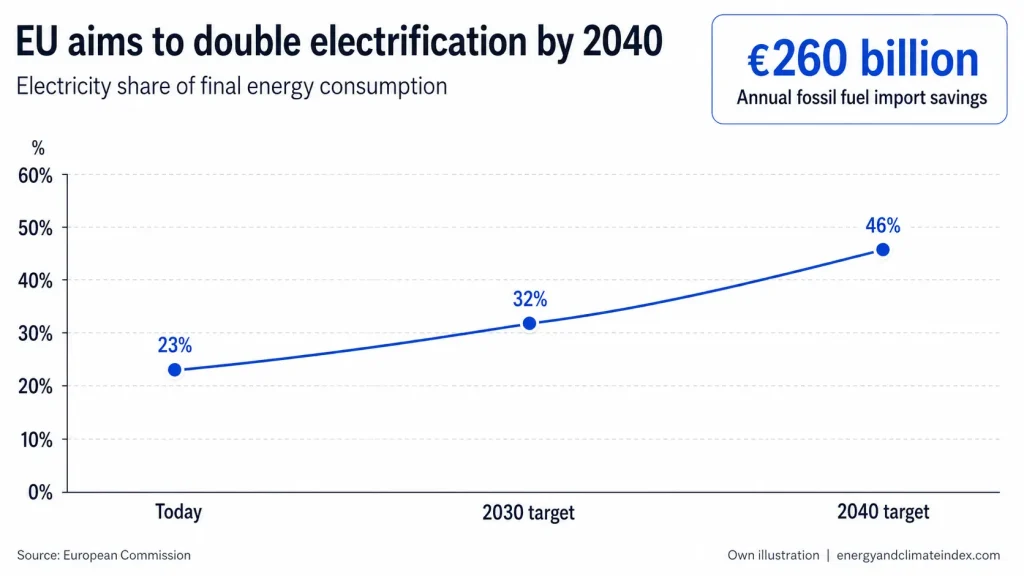
The European Commission has set a target to double electricity’s share of final energy consumption by 2040, from the current 23% to 46%.
According to Brussels, this could cut the European Union’s fossil fuel import bill by up to €260 billion a year, while strengthening competitiveness, energy security and decarbonization.
The European Commission has presented its Electrification Action Plan, aimed at making Europe the world’s first “electrified continent”. The document places electrification at the center of efforts to reduce dependence on imported oil, natural gas and coal, while also presenting it as a key instrument for lowering energy costs and improving the competitiveness of the European economy.
In parallel with the European plan, the upcoming COP31 Presidency in Antalya has proposed a global target for electricity to account for 35% of global final energy consumption by 2035, compared with just over 20% today, reinforcing electrification as one of the key pillars of the global energy transition.


Canada has also recently unveiled its National Strategy for an Electrified Economy, which aims to double the country’s electricity generation and grid capacity by 2050, placing electrification at the centre of its long-term economic and energy strategy.
€260 billion less spent on fossil fuel imports
The strongest message in the plan is its projected economic benefit. The European Commission estimates that, if electricity’s share of final energy consumption reaches 46% by 2040, the European Union could reduce its fossil fuel import bill by up to €260 billion a year.
The EU currently imports more than 80% of the natural gas it consumes and more than 90% of its oil, leaving the bloc highly exposed to geopolitical risks and price shocks.
Electricity is set to become the main energy carrier
Electricity currently accounts for only 23% of final energy consumption in the European Union, a share that has remained virtually stagnant for a decade.
Under the new plan, the Commission sets a reference target of 32% by 2030 and 46% by 2040, which would represent an almost twofold increase in the electrification of the European economy.
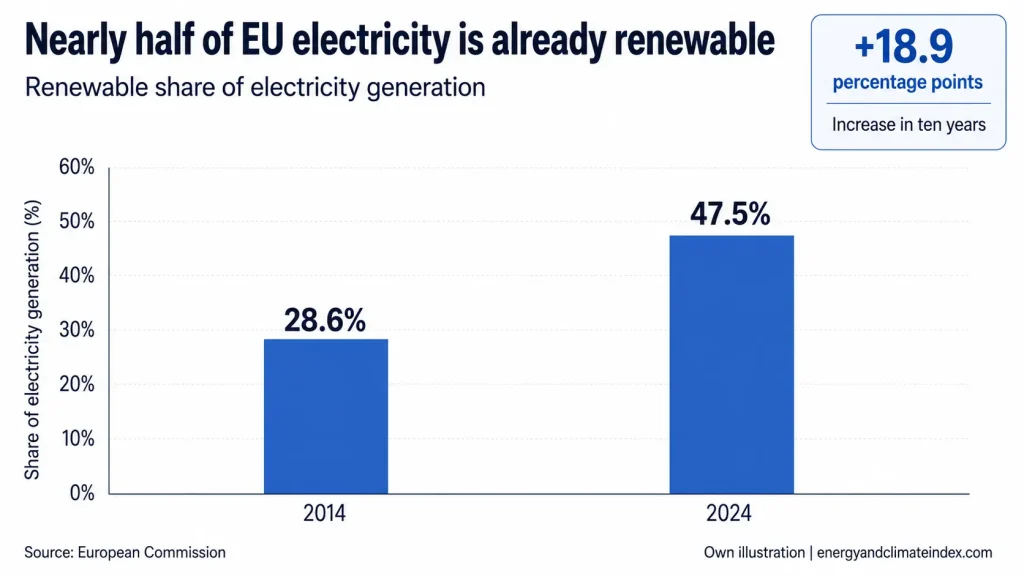
Nearly half of EU electricity is already renewable
The Commission argues that the foundations for this transformation are already in place. In 2024, 47.5% of the electricity generated in the European Union came from renewable sources, compared with 28.6% ten years earlier.
The next step, according to Brussels, is to use this increasingly clean electricity much more widely across transport, buildings and industry.
Electric cars, heat pumps and industrial electrification
The plan calls for accelerated electrification across all sectors of the economy. This includes faster deployment of electric vehicles, replacing gas boilers with heat pumps, electrifying industrial processes and accelerating the construction of charging infrastructure and electricity grids.
The document states that there are already more than 8 million battery-electric vehicles on European roads and around 28 million heat pumps in use.
The Commission says electrification could also deliver direct benefits for consumers. According to its analysis, operating a battery-electric vehicle can be up to 78% cheaper than using an equivalent internal combustion engine vehicle, while replacing a gas boiler with a heat pump can reduce household heating costs by up to 60%.
At the same time, the Commission warns that the success of the plan will depend on lowering electricity prices, accelerating the expansion of transmission and distribution networks, and mobilizing hundreds of billions of euros in electricity infrastructure investment over the coming years.
ECI