

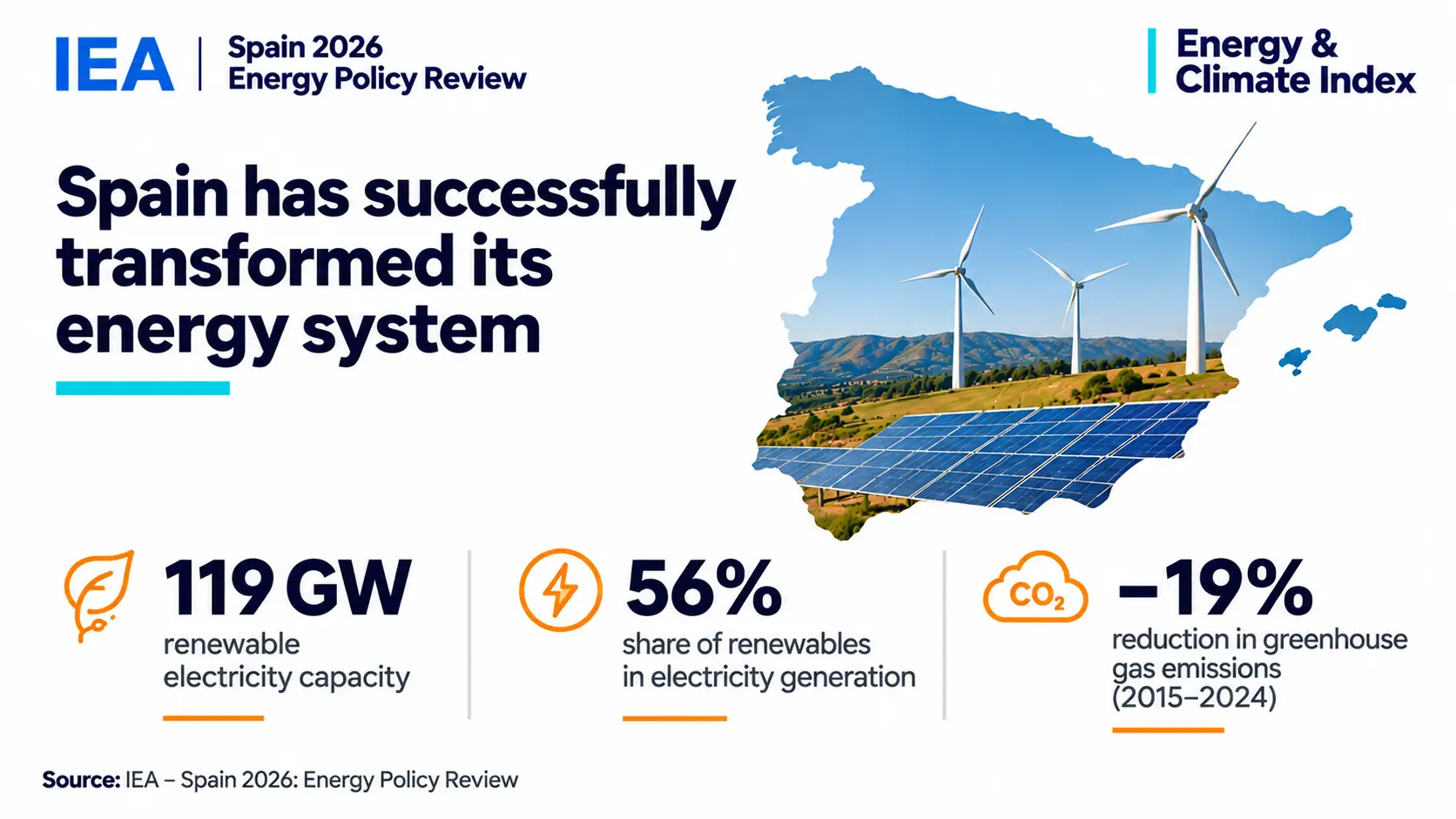
Spain has made impressive progress in transforming its energy system over the past decade. The country has more than doubled its renewable electricity generation capacity, almost completely phased out coal from its electricity mix, and significantly reduced greenhouse gas emissions.
This is the central assessment of the International Energy Agency (IEA) in its latest report, Spain 2026 – Energy Policy Review, published on 5 November 2026.
According to the IEA, these achievements are underpinned by an ambitious energy and climate policy framework, supported by the National Energy and Climate Plan, the Climate Change and Energy Transition Law, and institutional mechanisms designed to accelerate decarbonisation.


The Agency particularly highlights Spain’s approach to a just transition, which links clean energy investment with employment, regional development and social inclusion.
Renewable capacity reaches 119 GW as coal almost disappears
Between 2015 and 2025, Spain’s installed renewable electricity capacity increased from 51 GW to approximately 119 GW.
Over the same period, the share of renewables in electricity generation rose from 35% to 56%, while all low-emission sources, including nuclear power, accounted for around 75% of electricity generation in 2025.
The decline in coal-fired generation has been particularly significant. Coal’s share of electricity production fell from almost 20% in 2015 to just 0.7% in 2025.
During the same period, oil’s share declined from 6.2% to 3%, while natural gas accounted for 21% of electricity generation in 2025.
The transformation has also been accompanied by substantial improvements in energy efficiency. Spain’s energy intensity improved by an average of 2.4% annually between 2015 and 2025.
Greenhouse gas emissions declined by 19% between 2015 and 2024, with the largest contribution coming from electricity and heat production, where emissions fell by 64%.
The IEA finds that the expansion of domestic renewable energy generation has strengthened Spain’s energy security, reduced its exposure to volatile fossil fuel prices and contributed to lower wholesale electricity prices.
The next challenge is transforming the entire economy
Despite significant progress in the electricity sector, the IEA warns that Spain continues to face major challenges in transport, industry and heating.
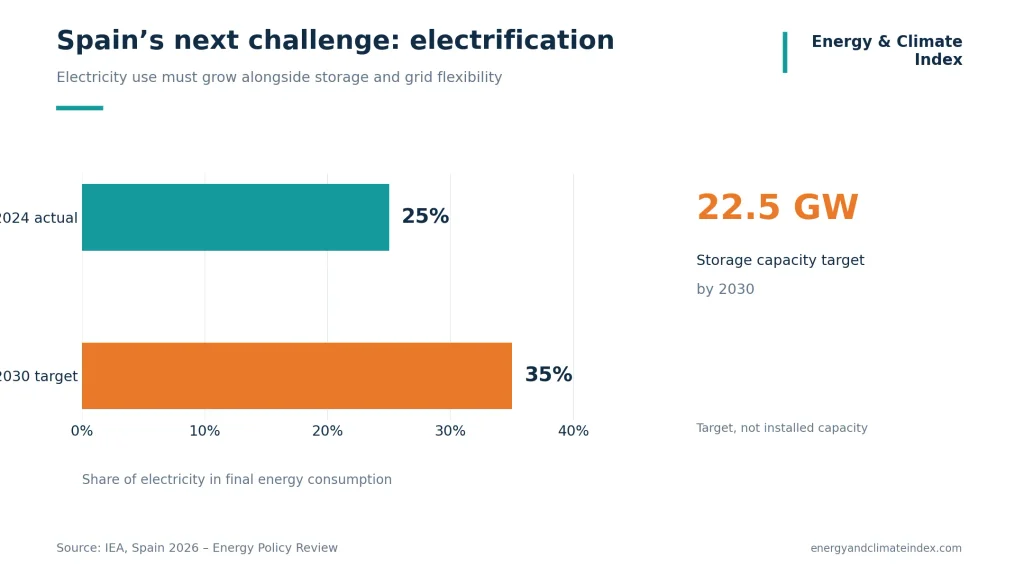
In 2024, electricity accounted for 25% of final energy consumption, compared with the national target of 35% by 2030.
Transport remains one of the most challenging sectors. Emissions from transport increased by 7.7% between 2015 and 2024, contrasting with substantial reductions in the electricity sector and industry.
The IEA notes that relatively high final electricity prices, driven by taxes, levies and network charges, continue to discourage the adoption of electric technologies, despite competitive wholesale electricity prices.
At the same time, the rapid expansion of renewable energy requires greater investment in electricity networks, energy storage and system flexibility.
Spain has set a target of 22.5 GW of energy storage capacity by 2030. In addition, its National Energy and Climate Plan envisages 76 GW of solar PV capacity and 62 GW of wind capacity, aiming for renewables to account for 81% of electricity generation.
The IEA also highlights the need for a more balanced renewable energy mix. Solar PV accounted for more than 90% of new renewable capacity additions in 2025, creating risks of generation curtailment and declining market prices during periods of high solar output.
Another challenge is the planned phase-out of nuclear power between 2027 and 2035. The Agency recommends carefully managing this process and considering extensions to the operating lives of existing reactors, subject to appropriate safety reviews.
Energy transition strengthens Spain’s competitiveness
The IEA assesses that Spain is entering the next phase of its energy transition from a position of strategic strength, supported by one of the largest renewable electricity fleets among IEA member countries and a well-developed institutional framework.
Nevertheless, dependence on imported energy remains high, accounting for 69% of total energy consumption in 2024. The Spanish government aims to reduce this dependence to 50% by 2030.
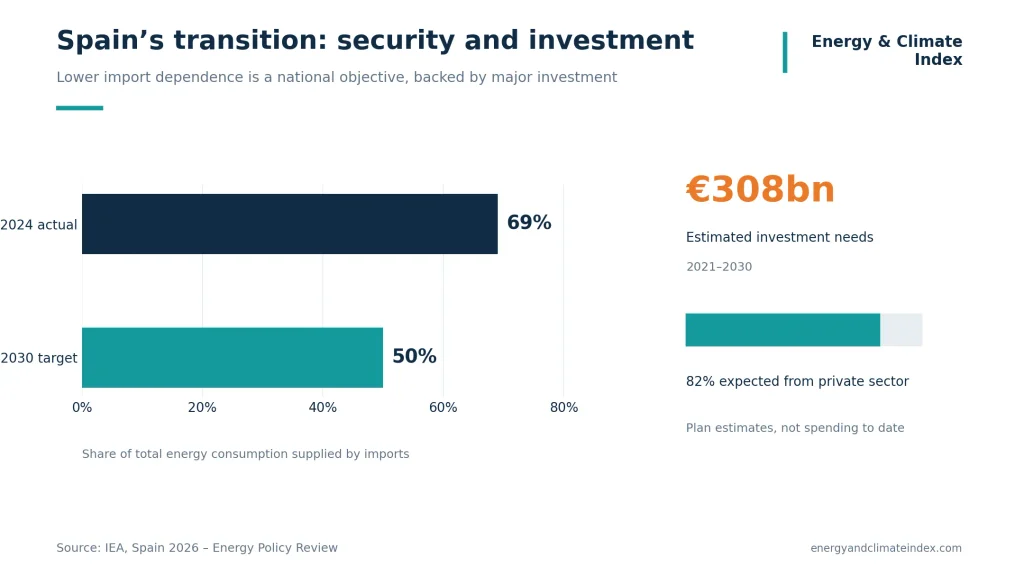
According to the National Energy and Climate Plan, total investment requirements for the energy transition are estimated at approximately €308 billion between 2021 and 2030, with around 82% expected to come from the private sector.
The economic benefits of Spain’s transformation are already evident. According to IEA estimates, the expansion of wind and solar power between 2011 and 2024 helped Spain avoid approximately $26 billion in cumulative natural gas import costs. Without the additional renewable capacity, natural gas imports in 2024 would have been almost 40% higher.
The IEA concludes that the next step is to extend the transformation achieved in electricity generation across the entire economy. Accelerating electrification, modernising electricity grids and expanding system flexibility will be essential if Spain is to become a model for a comprehensive, economy-wide energy transition.
Source: International Energy Agency, Spain 2026 – Energy Policy Review, November 2026.