

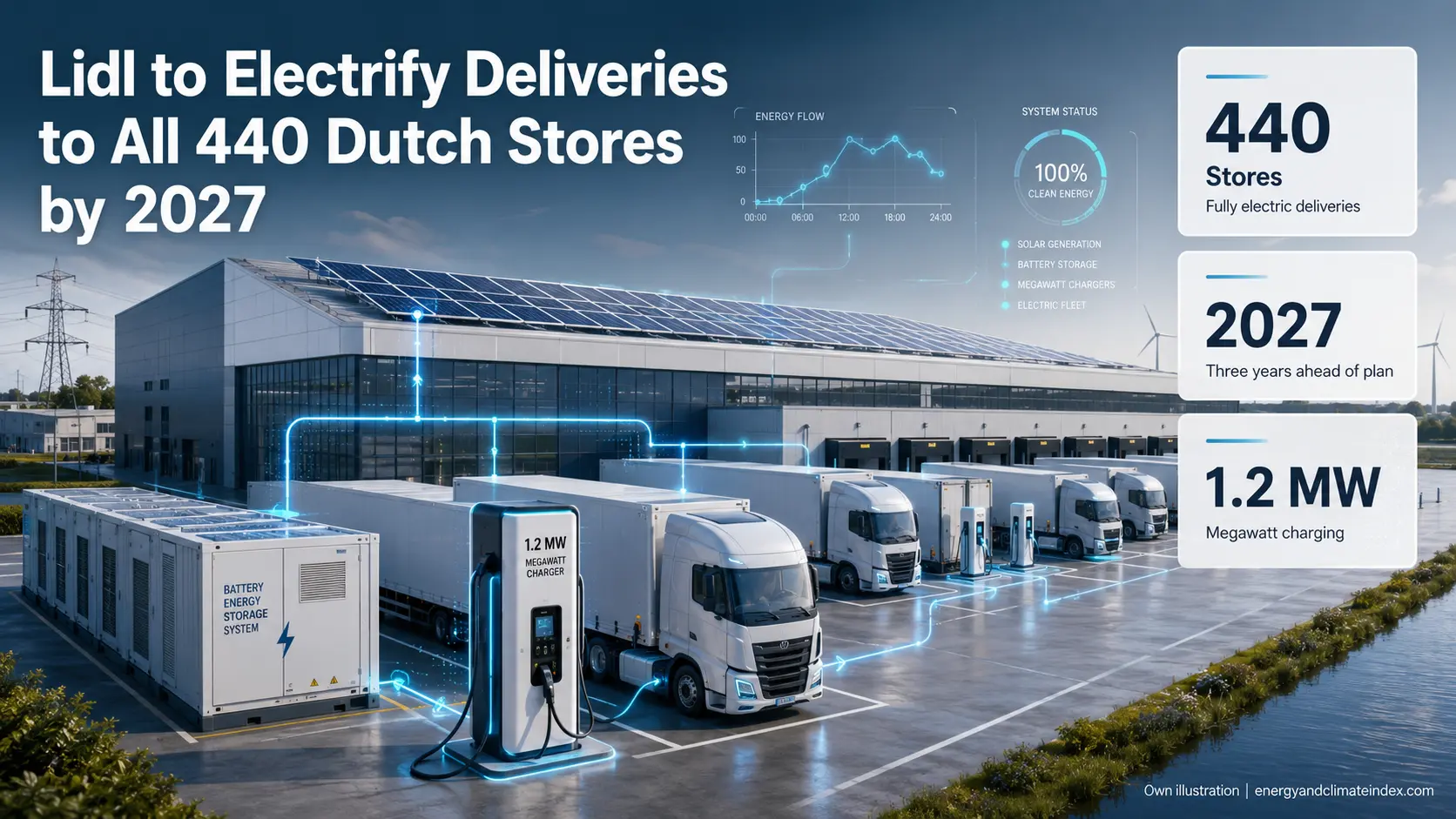
Retailer brings forward its full logistics electrification target by three years, backed by megawatt charging, battery storage and solar power investments
Lidl plans to supply all 440 of its stores in the Netherlands exclusively with electric trucks from 2027, achieving full electrification of its national logistics network three years earlier than originally planned.
Stores in the North Holland and Flevoland regions are already supplied entirely by electric trucks following the opening of a new high-power charging hub at Lidl’s distribution centre in Almere.


From biofuels to fully electric logistics
Since 2024, Lidl Netherlands has been operating its store deliveries without conventional diesel, relying on alternative fuels such as Bio-LNG and HVO100. However, the company considers these fuels only as a transitional solution on the path towards fully electric freight transport.
According to Lidl, the company chose to invest early in electrification rather than waiting for future regulatory requirements. The objective is not only to replace diesel trucks, but also to build an integrated energy system capable of supplying sufficient electricity for heavy-duty vehicle charging despite grid capacity constraints.
The retailer has not disclosed how many electric trucks will be required to serve all 440 stores nationwide.
Charging capacity of up to 1.2 MW
The new charging infrastructure at the Almere logistics centre includes multiple CCS fast chargers as well as a Megawatt Charging System (MCS) charger.
The MCS charger is expected to deliver up to 1.2 MW of charging power in the future, enabling rapid charging of heavy electric trucks during short operational breaks. Lidl has not released additional technical details regarding the number or power rating of the remaining chargers installed at the site.
Solar generation and battery storage reduce grid pressure
The electrification of transport is supported by broader investments in on-site renewable generation and energy storage.
Lidl is installing rooftop solar photovoltaic systems at its logistics centres, while battery storage systems are used to store locally generated electricity and reduce peak demand when several trucks are charging simultaneously.
The Almere distribution centre is equipped with a 1 MWh battery energy storage system. Using an intelligent energy management platform, Lidl forecasts the site’s energy balance on a minute-by-minute basis and optimises truck charging according to available renewable electricity.
When charging infrastructure is not fully utilised, part of the locally generated green electricity can also be made available to other companies. According to Lidl, this approach helps reduce pressure on the electricity grid while supporting the wider electrification of commercial transport.
Lower exposure to fuel costs and road charges
Lidl believes that early investment in electric freight transport will reduce the company’s exposure to volatile fuel prices and road toll costs for heavy-duty vehicles.
Peter de Roos, CEO of Lidl Netherlands, said the company aims to keep food prices affordable while demonstrating that sustainability and affordability can go hand in hand through smart investments in electric logistics.
Dutch Minister of Infrastructure and Water Management Vincent Karremans described the electrification of road freight transport as an important step towards greater energy independence, improved air quality and lower carbon emissions.
Lidl claims it will become the first supermarket chain and potentially the first retail chain worldwide to supply every store in a single country exclusively with electric trucks. Electrive notes that this claim is difficult to verify independently but considers the project one of the most advanced examples of retail logistics electrification currently underway.
ECI