

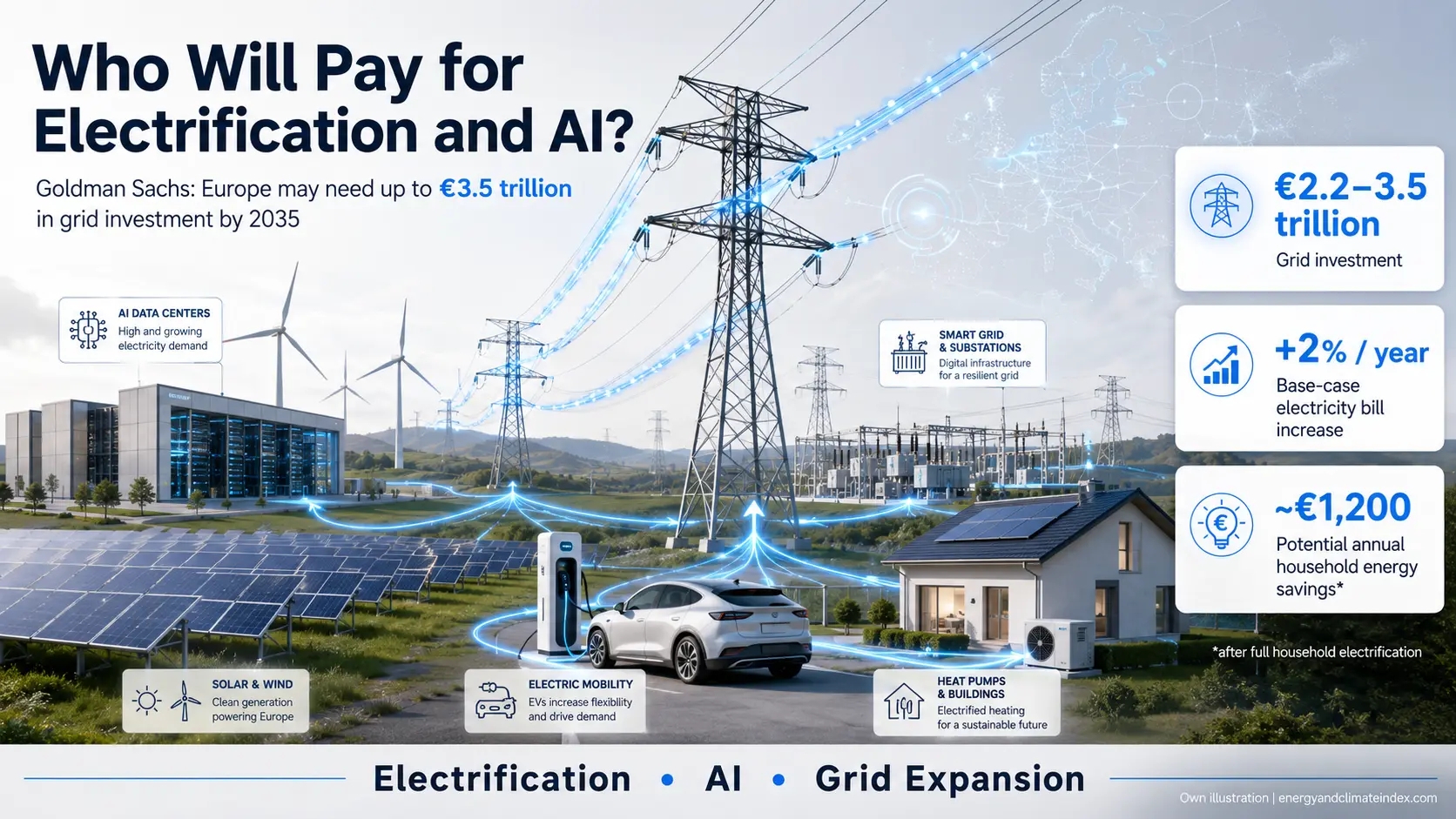
A Goldman Sachs analysis suggests that Europe will need to invest between €2.2 trillion and €3.5 trillion in its power system over the next decade, with part of the cost ultimately being borne by consumers through network tariffs.
Europe is facing one of the largest energy investment cycles in its history. The electrification of transport, heating and industry, the integration of renewable energy sources, and the rapid expansion of artificial intelligence data centres will require between €2.2 trillion and €3.5 trillion in investment in electricity infrastructure over the next ten years, according to a Goldman Sachs analysis reported by Yahoo Finance.
Consumers will pay more, but not dramatically
According to Goldman Sachs’ base-case scenario, household electricity bills across the European Union and the United Kingdom are expected to increase by around 2% per year until 2035. Under a faster electrification scenario, driven by even stronger growth in AI infrastructure, annual increases could reach around 4%, which would still remain below the average annual increase of approximately 5% recorded over the past decade.


Not all investments will be passed on to consumers
Goldman Sachs estimates that 35–40% of the planned investments are either unlikely to have a significant impact on electricity bills or could even help reduce them over time. This is because new renewable energy investments are expected to lower wholesale electricity prices, while part of the spending will be dedicated to the routine maintenance and modernisation of the electricity grid.
Higher electricity use, but lower overall energy costs
The analysis argues that rising electricity demand from electric vehicles, heat pumps, air conditioning and AI data centres will allow fixed grid costs to be spread across a larger volume of electricity consumption, improving the overall economics of the power system.
Goldman Sachs estimates that a typical European household switching to electric heating and electric mobility could reduce its total annual energy costs by around €1,200, thanks to lower spending on gasoline, diesel and natural gas.
Goldman Sachs believes that utilities, electricity network operators and manufacturers of power equipment are likely to be among the biggest beneficiaries of the coming investment wave, describing it as a potential “super cycle” for the sector.
The impact will not be the same across Europe
Goldman Sachs expects the impact on electricity bills to vary across European markets. According to the analysis, Germany and the United Kingdom could experience larger increases in network tariffs due to the scale of planned grid investments, while Italy and Spain may see a more moderate impact, supported by lower wholesale electricity prices and a different investment profile.
The analysis also highlights a potential upside. As electricity demand rises from electric vehicles, heat pumps, air conditioning and AI data centres, the fixed costs of the power grid will be spread across a larger volume of electricity consumption. This could help moderate the increase in network costs on a per-kilowatt-hour basis.
The energy sector is entering a new investment cycle
Goldman Sachs believes that the planned investments in electricity networks mark the beginning of a new multi-year investment cycle for the energy sector. Utilities, transmission and distribution network operators, and manufacturers of electrical equipment are expected to be among the main beneficiaries as investment in grid expansion and modernisation accelerates.
ECI