

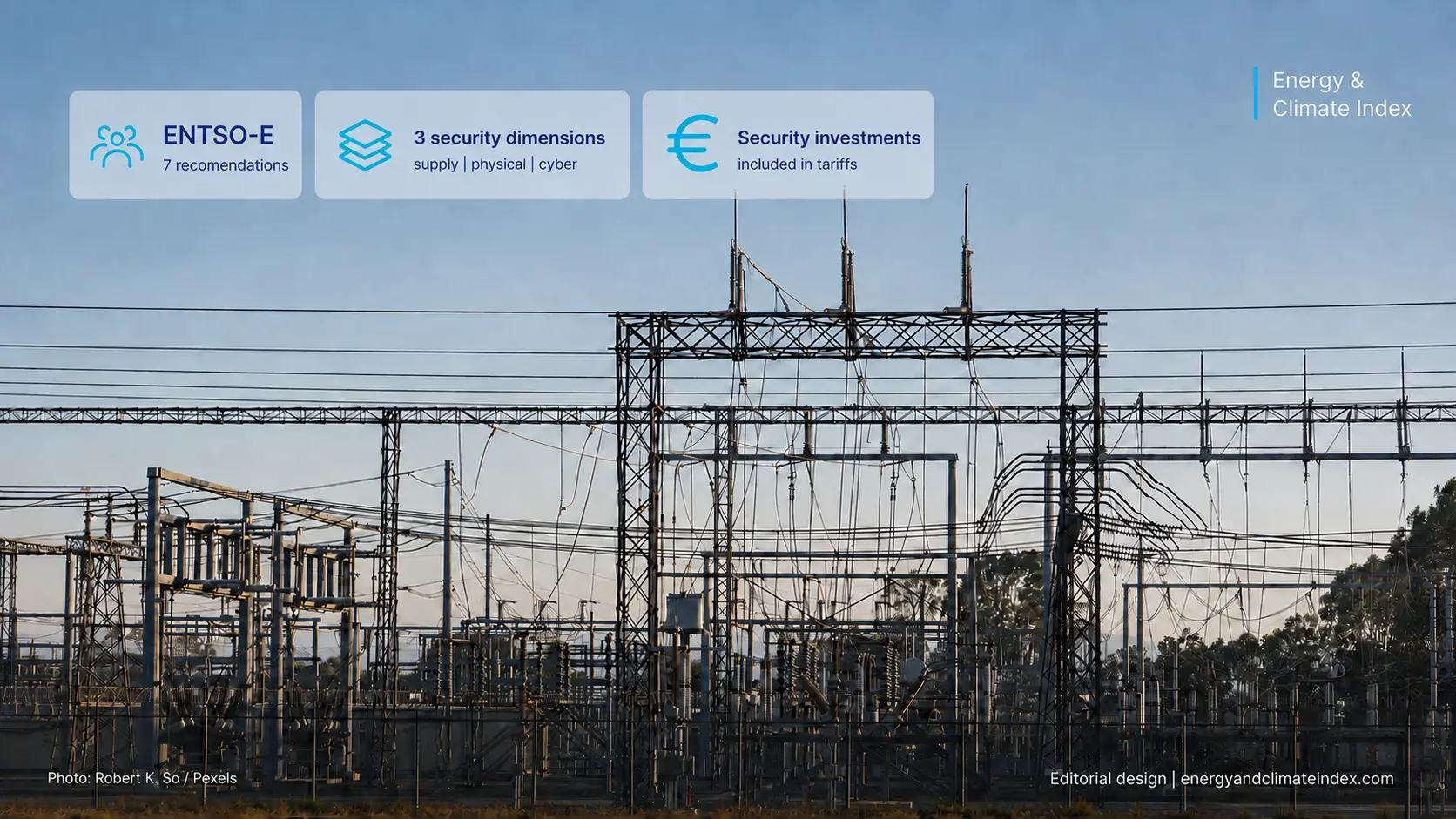
Minimum security standards, faster cross-border deployment of equipment and protection of sensitive information are among the European grid operators’ seven recommendations
Europe should establish a more coordinated system for protecting its electricity infrastructure from physical attacks, cyber threats, extreme weather events and other risks that could disrupt the supply of electricity.
This is the central message of a new position paper published by the European Network of Transmission System Operators for Electricity – ENTSO-E, which presents seven recommendations for strengthening Europe’s energy security.
According to ENTSO-E, electricity security can no longer be viewed solely through the availability of generation capacity. An integrated approach is required, covering security of supply, the physical protection of infrastructure and cybersecurity.


A common assessment of risks
The first recommendation is to introduce a harmonised risk assessment across the entire energy sector. Threats should be assessed according to their potential impact on the European electricity system, rather than only within national borders.
This would allow investments and protective measures to be directed towards infrastructure whose disruption could have the most serious regional consequences.
Minimum standards for critical grid assets
ENTSO-E proposes minimum standards for protecting critical grid assets. These should cover operational readiness, physical protection, redundancy, spare equipment and coordinated procedures for restoring the electricity system.
The association believes that ENTSO-E should develop the guidelines needed to implement these standards.
Who is responsible when a crisis occurs?
A particular concern is the insufficiently clear division of responsibilities between transmission system operators and public authorities.
It should be determined in advance who is responsible for detecting physical and hybrid threats, declaring a crisis, coordinating load shedding, implementing protective measures and restoring damaged infrastructure.
ENTSO-E is ready to propose a framework for cooperation between grid operators and national authorities on infrastructure protection and recovery.
Special protection for offshore infrastructure
European grid operators are calling for regional mechanisms to protect cross-border electricity infrastructure at sea. The framework should cover coordinated threat detection, secure communication and more effective implementation of protective measures.
ENTSO-E also proposes harmonising penalties for interference with or damage to critical maritime infrastructure.
Another weakness is the dependence on a limited number of specialised companies, often the original equipment manufacturers, to repair cables and other grid components. This can create bottlenecks and significantly extend recovery times.
Faster movement of equipment across borders
One of the more specific recommendations is to enable the rapid cross-border deployment of critical equipment and specialised services during emergencies.
Grid operators and public authorities could resell or exchange transformers, grid components and other equipment purchased through public procurement procedures. One authority could also transfer to another the right to order equipment directly under an existing framework contract, without launching a new procurement procedure.
The objective is to ensure that essential equipment reaches the area where it is most urgently needed without administrative procedures delaying system restoration.
Sensitive information should not be publicly available
ENTSO-E warns that transparency requirements may sometimes unintentionally expose information that is important for infrastructure security.
It therefore proposes clearer exemptions for sensitive data, particularly the locations and configurations of control centres and detailed geospatial information about critical grid assets.
This will be especially important for future projects funded by the European Union, which are subject to requirements for publishing detailed information.
Grid protection should be included in tariffs
The final recommendation concerns financing. Investments in physical and operational protection should be recognised as a core electricity system cost and included in national tariff frameworks.
According to ENTSO-E, security upgrades should also be eligible for support through European financial instruments, including the planned Cable Infrastructure Fund, the Connecting Europe Facility for Energy and the future European Competitiveness Fund.
The message from Europe’s grid operators is that protecting the electricity network is not an additional expense, but a prerequisite for reliable supply in an increasingly electrified, digitalised and interconnected Europe.
ECI