

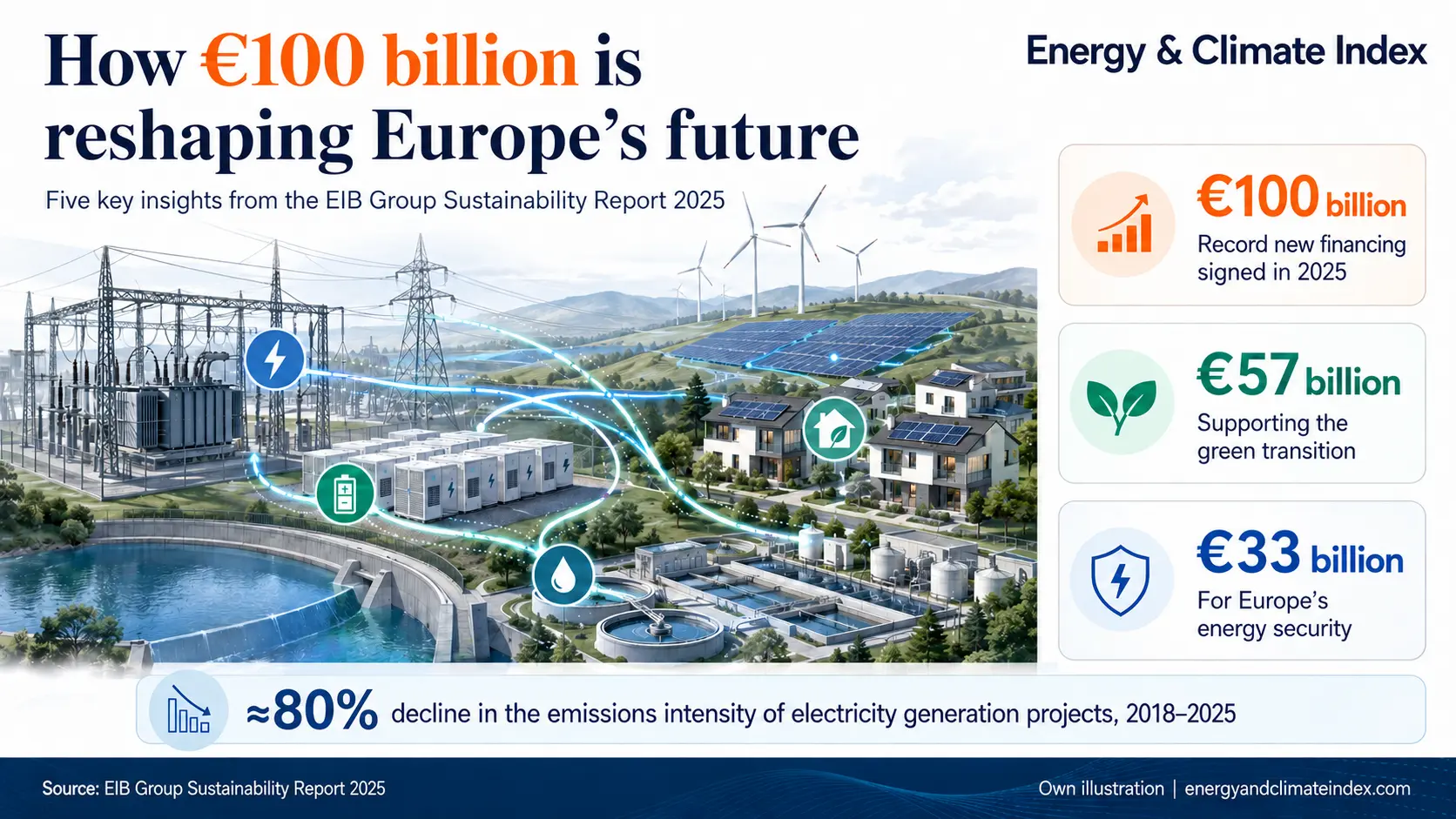
In 2025, the European Investment Bank Group signed a record €100 billion in new financing. However, the significance of this amount lies not only in its scale.
The allocation of capital shows how the European Union is redirecting its priorities towards the green transition, energy security, affordable housing, water resilience and defense autonomy.
The EIB Group’s new Sustainability Report 2025, shows that the institution is increasingly assuming the role of a strategic investment mechanism for the European Union, rather than operating solely as a traditional lender.


For the first time, the Group also conducted a double materiality assessment, examining both the effects of its activities on the environment and society and the financial risks and opportunities arising from sustainability-related issues.
A record €100 billion directed towards Europe’s new priorities
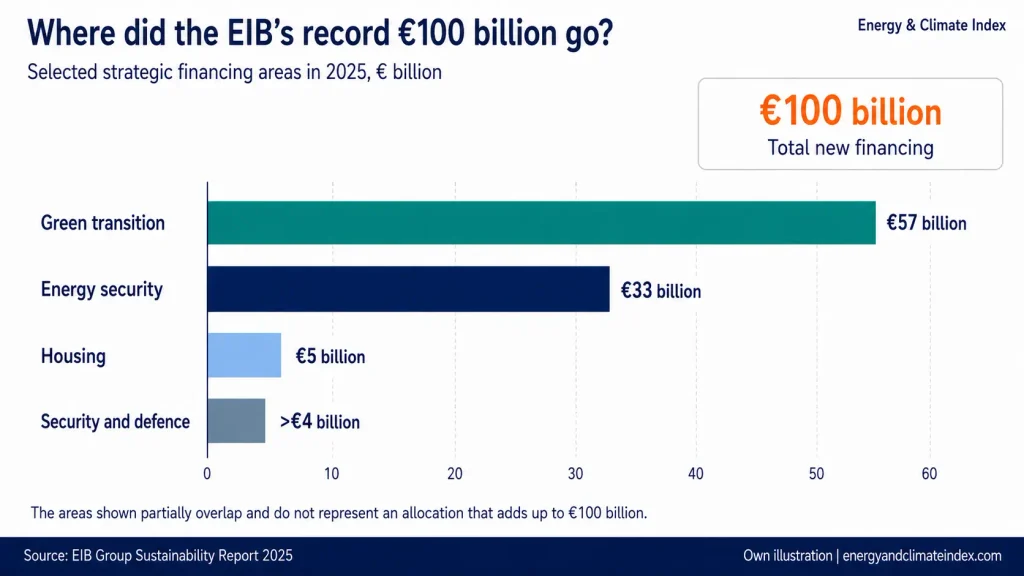
Of the total financing signed in 2025, €57 billion was allocated to supporting the green transition. Climate and environmental investment therefore accounted for approximately 57% of the Group’s total financing.
Since 2021, the EIB has supported an estimated €740 billion in investment, keeping the institution on track to meet its target of mobilising €1 trillion in green investment by 2030.
At the same time, the EIB provided a record €33 billion for Europe’s energy security. According to the report, this financing supported €108 billion in total investment in energy infrastructure, grids, storage and other projects designed to reduce dependence on fossil fuels.
In 2025, the Bank also issued the first supranational bond aligned with the European Green Bond Standard. Investor demand exceeded €40 billion, indicating that interest in credible and standardised green financial instruments remains exceptionally strong.
Emissions intensity of power generation projects fell by around 80%
One of the report’s strongest indicators is the transformation of the EIB’s energy portfolio.
The average greenhouse gas emissions intensity of electricity generation projects in the Group’s portfolio fell by approximately 80% between 2018 and 2025.
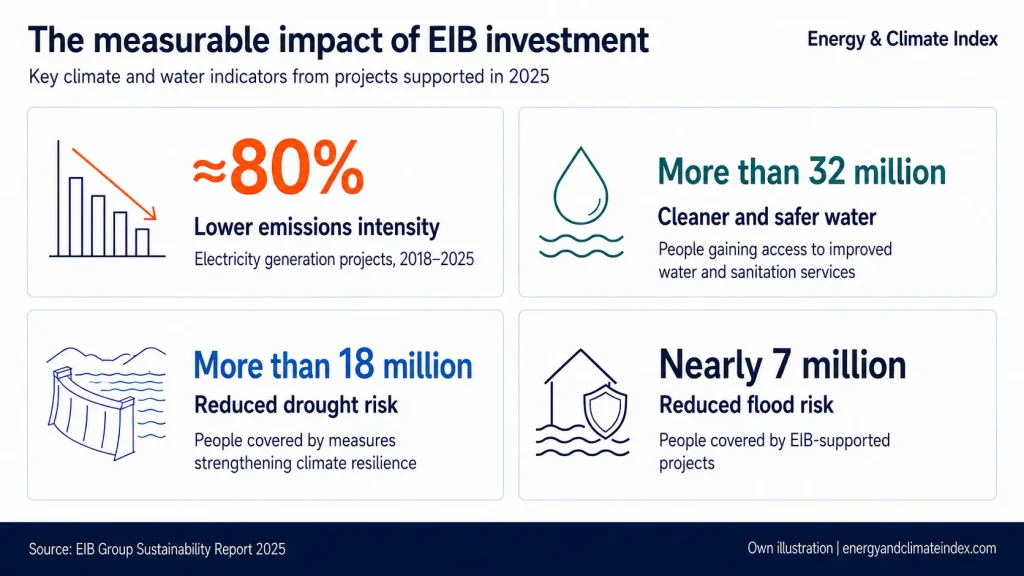
The decline followed the EIB’s decision to phase out support for unabated fossil fuel-based electricity generation from 2020 and significantly increase its financing for renewable energy.
This figure demonstrates how the policies of a major financial institution can fundamentally alter the profile of projects being implemented. Through its financing conditions, the EIB is not merely following the decarbonisation process but directly influencing its pace.
The next phase: more adaptation and simpler procedures
The second phase of the EIB Group’s Climate Bank Roadmap, covering the period until 2030, enters implementation in 2026.
The new phase envisages doubling current levels of climate adaptation finance, simplifying requirements for companies and accelerating investment in clean technologies, energy security and industrial decarbonisation.
The report’s central message is that Europe’s green transition is no longer being addressed in isolation. It is becoming part of a broader policy framework encompassing competitiveness, housing, water, security and strategic autonomy.
The record €100 billion demonstrates how much capital can be directed towards this transformation. The real test, however, will be how quickly the financing can be converted into new grids, production capacity, energy-efficient homes and infrastructure resilient to climate change.
ECI