

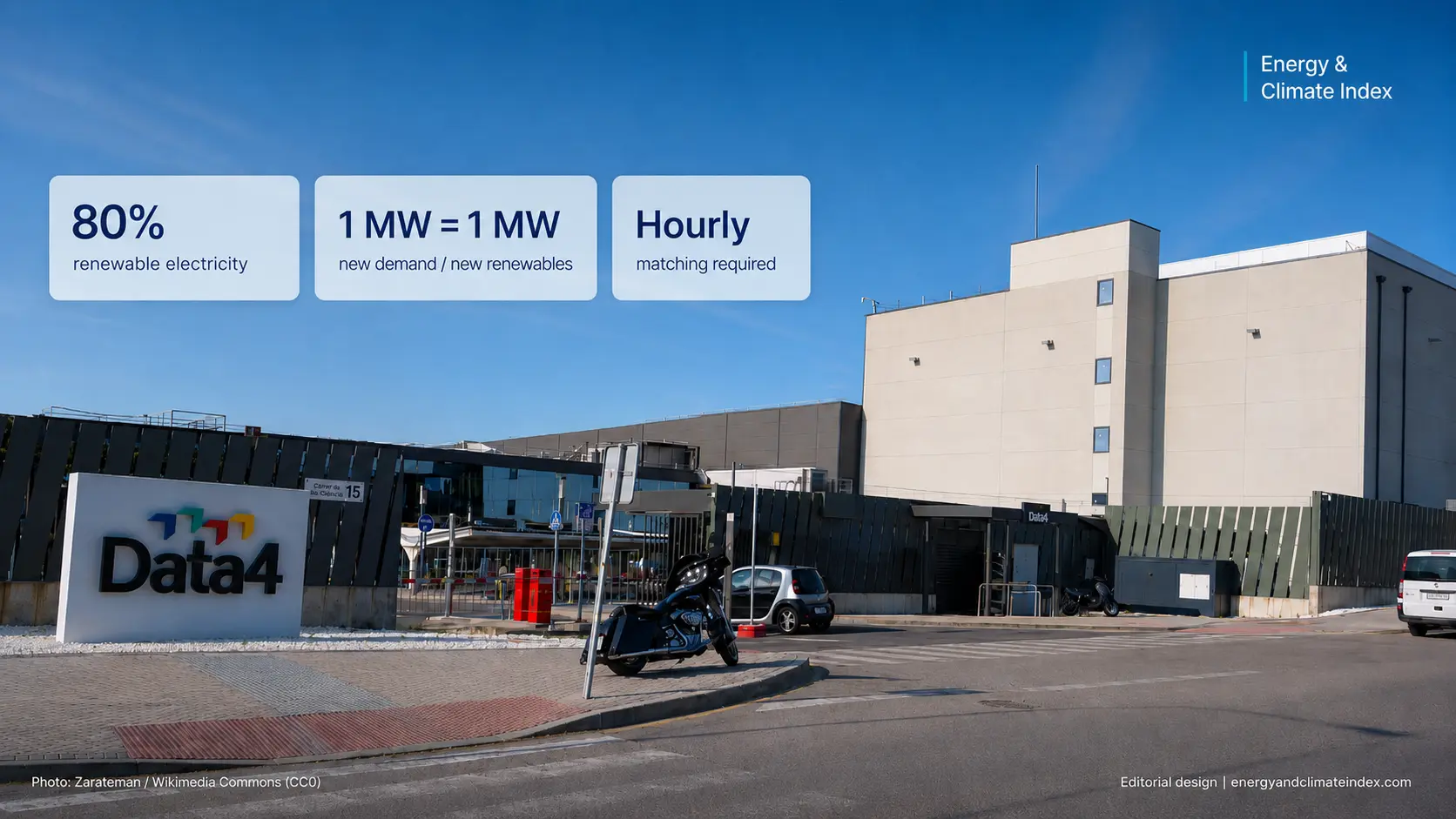
Every new megawatt of demand would have to be matched by a new megawatt of renewable capacity, with compliance checked on an hourly basis
Spain is preparing new rules for the development of data centres that would link their access to the electricity grid with the deployment of new renewable generation capacity.
On 27 August, the Spanish government launched a public consultation on a draft Royal Decree on the energy and environmental sustainability, resilience and digital sovereignty of data centres. The proposal would require at least 80% of the electricity consumed by larger data centres to be covered by new renewable generation.
However, the requirement would go well beyond simply purchasing green energy certificates.


Under the proposal, every new megawatt of electricity demand would have to be matched by one megawatt of new renewable generation capacity commissioned within the 18 months preceding the start of operations of the data centre. Compliance could be achieved through self-generation or long-term power purchase agreements – PPAs.
In addition, renewable generation and electricity consumption would have to be matched on an hourly basis. This means that during every hour of operation, at least 80% of a data centre’s electricity consumption would need to be covered by renewable electricity generated during the same hour.
The proposed 80% threshold would remain in place until renewable energy accounts for more than 90% of Spain’s electricity mix.
The rules would apply to data centres above 1 MW
The new requirements are aimed at data centres with an electricity grid access capacity of at least 1 MW, which the Spanish government considers large enough to have a significant impact on available grid capacity, water consumption and land use.
Spain is already experiencing strong investor interest in new digital infrastructure. The country’s national artificial intelligence strategy envisages around 2.5 GW of computing capacity by 2030, which would require approximately 3.5 to 4 GW of electrical capacity.
However, investor demand is considerably higher.
According to the Spanish government, more than 12 GW of grid access and connection rights have been granted to data centre projects since 2021.
Madrid therefore wants the expansion of data centres to be accompanied by a parallel increase in new electricity generation.
The government argues that a major increase in electricity demand without corresponding renewable capacity could lead to greater use of natural gas-fired generation and put additional upward pressure on electricity prices for other consumers.
Grid access would depend on compliance
The proposal goes a step further by directly linking energy and environmental requirements to access to the electricity grid.
Projects would have to demonstrate compliance with the new conditions in order to obtain grid access and connection rights. Failure to comply could result in progressively higher network charges and, ultimately, the loss of grid access rights.
Projects already under development would be given six months to adapt to the new requirements, while projects awaiting procedures for the allocation of grid capacity would have three months.
Stricter requirements for water consumption
The proposal does not focus only on electricity consumption.
Data centres would also be required to comply with the highest European standards for energy efficiency and water-use efficiency. Once the European data centre rating system enters into force in August 2027, the Spanish government plans to require the highest A rating for both energy and water efficiency.
Data centres with IT capacity above 500 kW would also be required to submit annual information on their energy efficiency and sustainability performance, with the data to be made publicly available.
With the proposed model, Spain is effectively establishing the principle that growth in digital infrastructure should not rely solely on existing electricity generation and existing grid capacity.
If the rules are adopted, new large data centres would have to secure new renewable generation capacity alongside the additional electricity demand they bring to the system.
The draft Royal Decree is open for public consultation until 4 September 2026.
ECI