

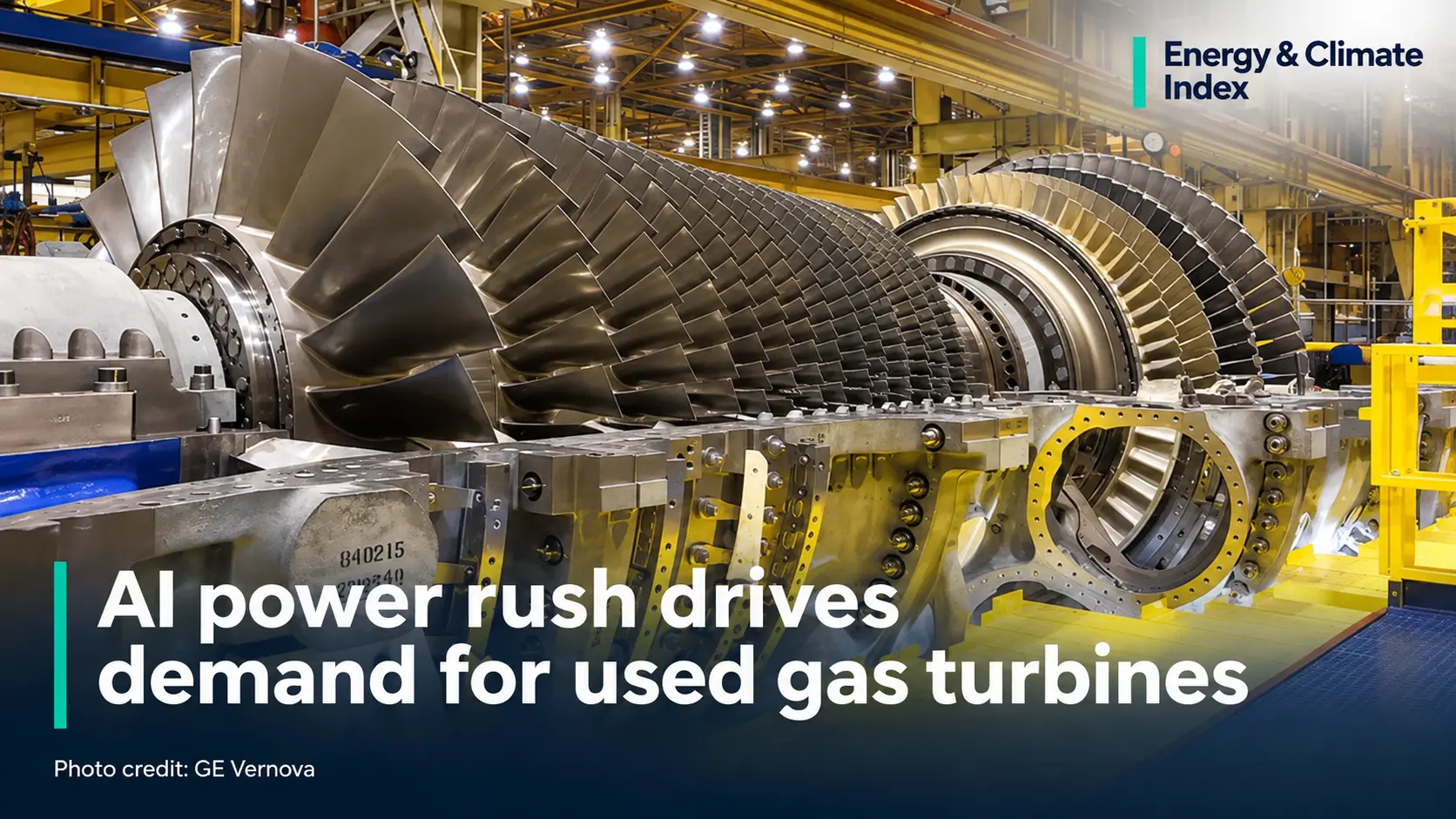
The rapid expansion of artificial intelligence is creating unprecedented pressure on the energy sector. With delivery times for new gas turbines stretching into several years, US data centre developers are increasingly exploring second-hand equipment, the refurbishment of older power plants and the conversion of aircraft engines to generate electricity.
Global orders exceed 100 GW as delivery times stretch to six years
According to a Reuters report published on 9 November, global orders for gas turbines exceed 100 GW, while estimated annual manufacturing capacity stands at between 60 and 70 GW.
This does not represent a direct annual shortfall of 30–40 GW, since orders and manufacturing capacity refer to different time periods. However, it clearly illustrates the growing pressure on equipment manufacturers.

Estimates from investment bank Jefferies indicate that US data centre demand for gas turbines will reach approximately 17 GW in 2026 and could more than triple by 2028.
Although global manufacturing capacity is expected to increase to around 87 GW by 2028, estimated demand for that year could reach 129 GW.
Major manufacturers, including Siemens Energy, GE Vernova and Mitsubishi Heavy Industries, are experiencing rapidly expanding order books. In the United States, delivery times for new gas turbines can extend to six years, with negotiations for new equipment already targeting deliveries in 2030 and 2031.
The pressure is also evident in GE Vernova’s official third-quarter results, published on 28 October. The company reported that its gas power equipment backlog and reserved manufacturing slots had reached 122 GW, with expectations of reaching at least 130 GW by the end of 2026.
These figures represent the company’s order pipeline and reserved production capacity, rather than annual global orders.
Used turbines and aircraft engines emerge as alternative solutions
Faced with extended delivery schedules, data centre developers are exploring alternative ways to secure dedicated electricity generation.
One option involves purchasing second-hand gas turbines, refurbishing them and returning them to operation. Another approach is to use turbines derived from aircraft engines, adapted for electricity generation.
According to Reuters, prices for new gas turbines have reached approximately $2–2.5 million per MW, while refurbished and second-hand units can offer a lower-cost alternative.
One example is US-based Crusoe, which ordered 13 gas turbines from ProEnergy in April, with a combined capacity of 650 MW. The turbines are based on GE Aerospace aircraft engine technology and are intended for US data centre projects.
However, second-hand equipment presents additional technical risks, particularly regarding remaining operational life, maintenance requirements and reliability under continuous operation.
Consequently, the secondary equipment market can only partially alleviate the shortage of new generation capacity.
At the same time, interest in gas engines as an alternative to conventional turbines is increasing.
Finnish technology company Wärtsilä has officially confirmed sales of more than 3 GW of generating capacity for US data centres.
In October, the company announced another agreement to supply 15 gas engines with a combined capacity of 282 MW. Equipment deliveries are scheduled for 2028, with full commissioning expected in 2029.
Energy infrastructure becomes a constraint on artificial intelligence expansion
The growing electricity requirements of data centres demonstrate that the development of artificial intelligence increasingly depends on the availability of energy infrastructure.
The challenge extends beyond electricity generation.
Lengthy procedures for connecting new facilities to transmission and distribution networks, permitting requirements and the construction of additional infrastructure are creating further delays for data centre projects.
Under these conditions, investors are increasingly considering dedicated power generation facilities located close to data centres to reduce their dependence on grid connection schedules.
This trend also raises important questions for the energy transition.
Greater reliance on gas-fired generation can provide reliable and dispatchable electricity, but it also creates additional demand for natural gas and potentially increases carbon dioxide emissions.
Furthermore, growing competition for gas turbines could increase investment costs for conventional electricity utilities, which require the same equipment to develop new generating capacity.
The expansion of artificial intelligence is therefore creating new competition for power generation equipment, energy resources and infrastructure capacity.
ECI