

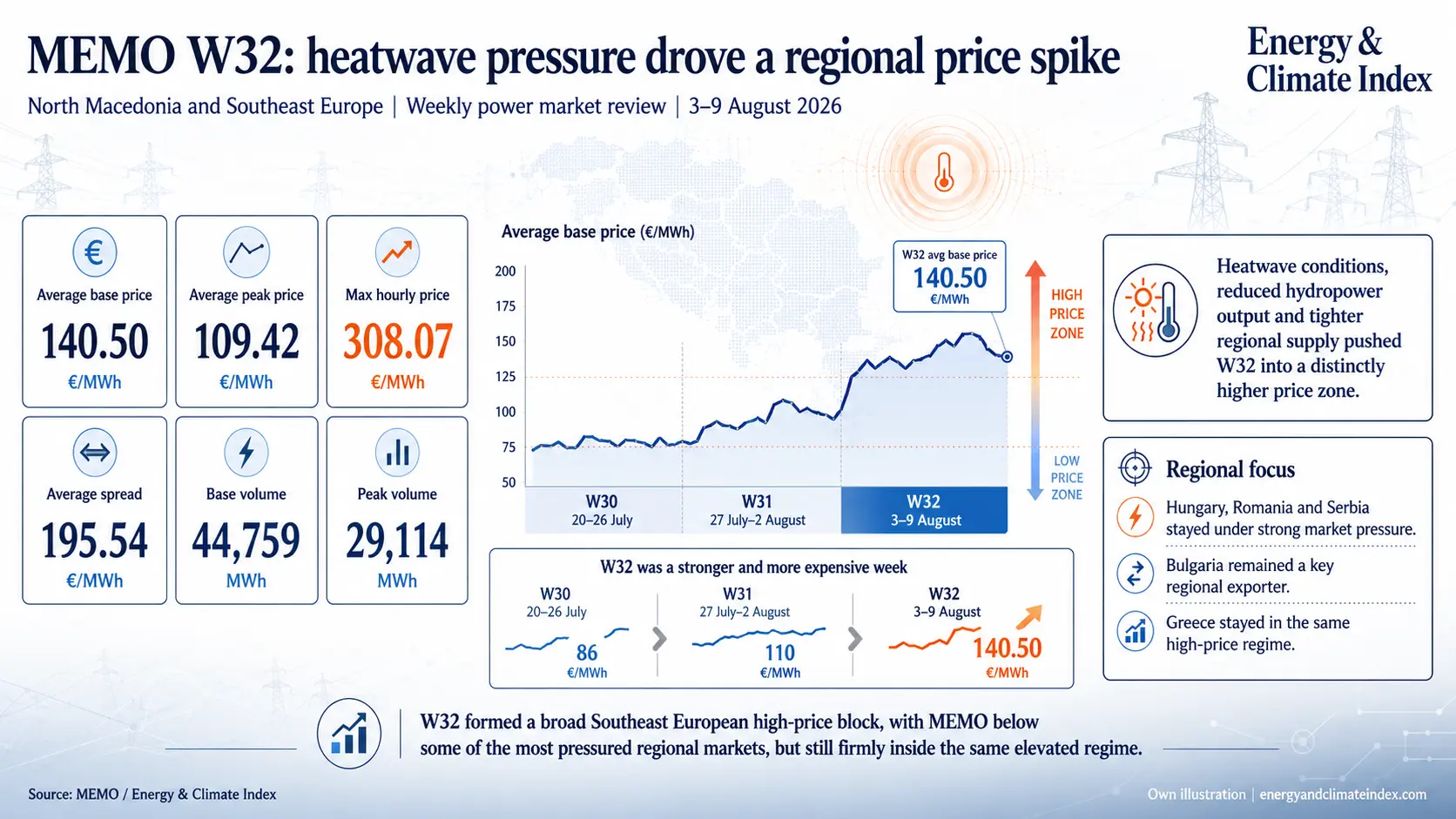
W32 was the week when climate risk entered the price of electricity directly. MEMO reached an average base price of 140.50 €/MWh and an average peak price of 109.42 €/MWh, while the regional average of the monitored day-ahead markets rose to 147.04 €/MWh. The key point is not only that electricity became more expensive, but that the price spike coincided with a record-low Danube, constrained nuclear output in Hungary and Romania, and reduced hydro and thermal flexibility in Serbia.
In previous weeks, prices had already shown summer sensitivity, but W32 was the clearest example so far of water becoming a market factor. When the Danube falls, the problem is not only hydrology. The room for cooling nuclear and thermal capacities narrows, hydropower output declines, the need for imports increases, and the value of flexibility rises.
MEMO entered a new price zone
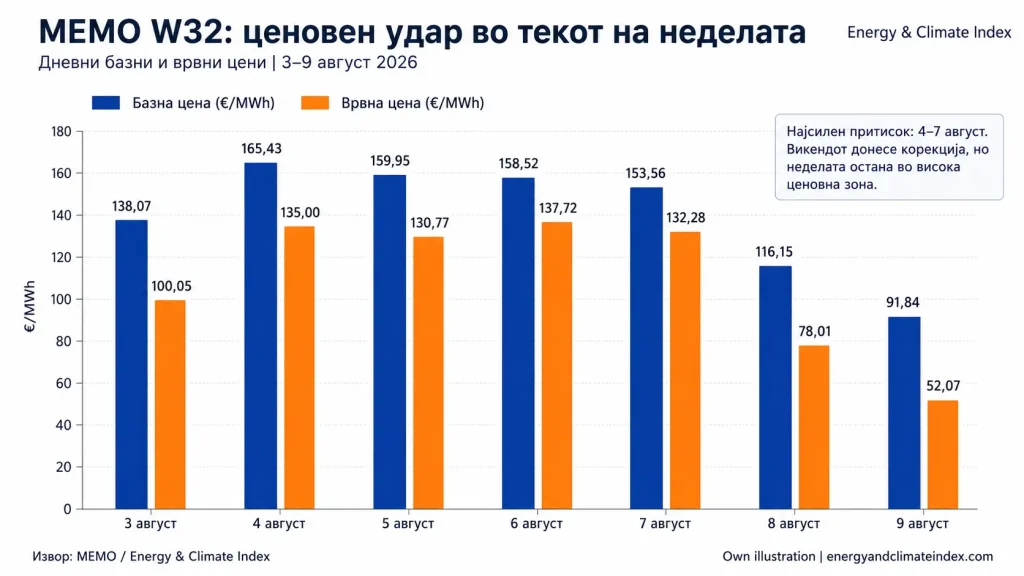
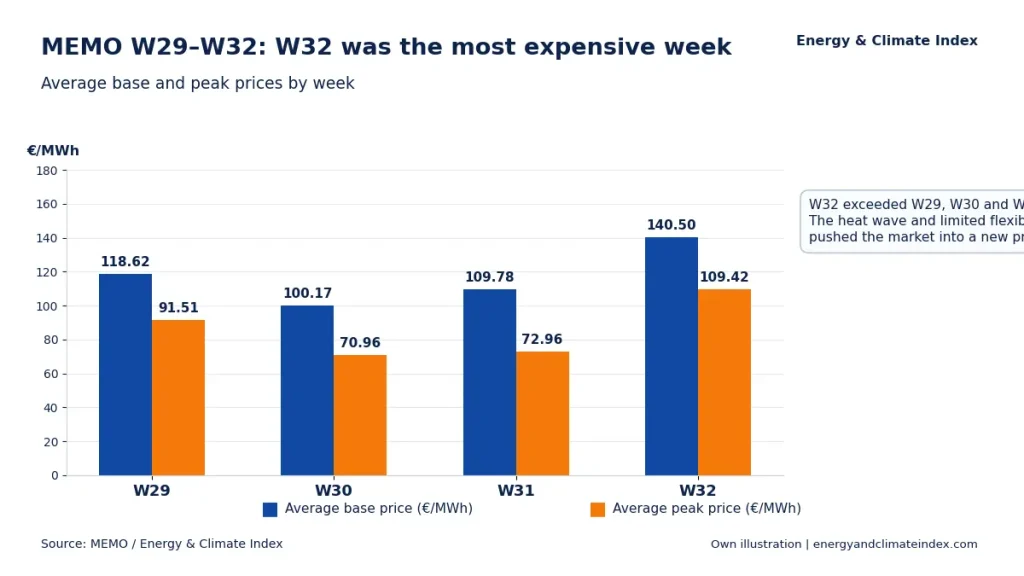
MEMO’s average base price increased from 109.78 €/MWh in W31 to 140.50 €/MWh in W32. The peak price rose even more sharply, from 72.96 €/MWh to 109.42 €/MWh. With this, W32 also surpassed the previous summer peak recorded in W29.


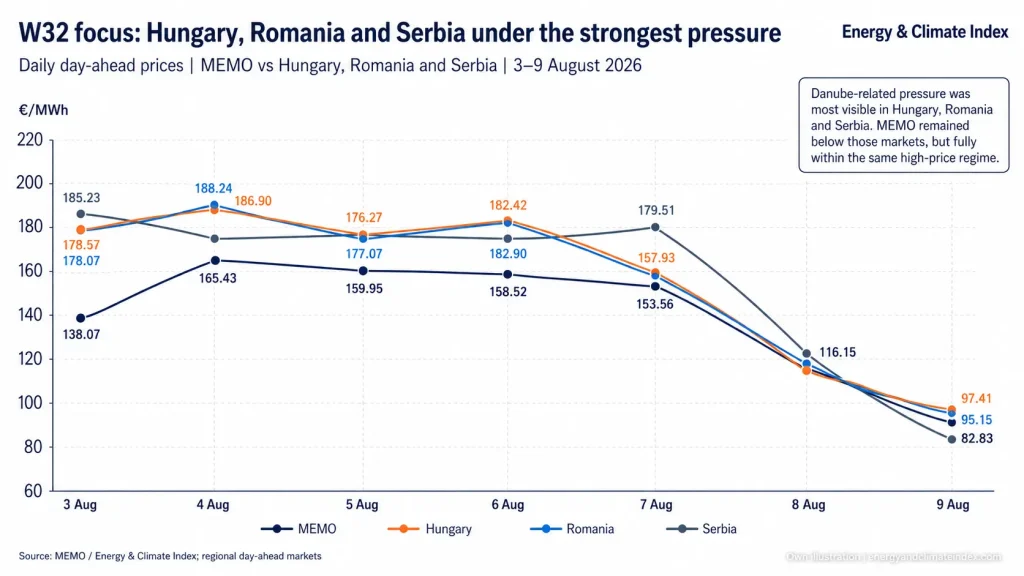
On a daily level, the strongest pressure was concentrated during the working part of the week. From 3 to 7 August, the base price remained in a high zone, with the highest daily level recorded on 4 August — 165.43 €/MWh. The weekend brought a correction, but not enough to change the weekly picture.
More important than the average itself was the hourly profile. The maximum hourly price reached 308.07 €/MWh, while the average spread climbed to 195.54 €/MWh. This means that W32 was not only an expensive week, but also an extremely volatile one.
The Danube was the central risk
In Hungary, the Paks nuclear power plant began bringing a turbine back online after the Danube water level rose. This is a direct signal that low water levels had previously constrained the operation of the plant, which supplies almost half of the country’s electricity.
In Romania, the situation was even more dramatic. Authorities redirected Danube water to secure the operation of Cernavodă, after low water levels had already led to a reactor shutdown and required emergency interventions in the river flow.
In Serbia, the problem was different, but had the same root: the low Danube. It reduced output at Đerdap 1 to around one third of the average daily level, while water shortages also affected the Kostolac thermal power plants, where cooling was disrupted and production reduced.
This explains the core of W32. Prices did not rise only because it was hot. They rose because heat coincided with limited water availability, constrained cooling and a weaker production response.
Regional pressure was broader than the Danube
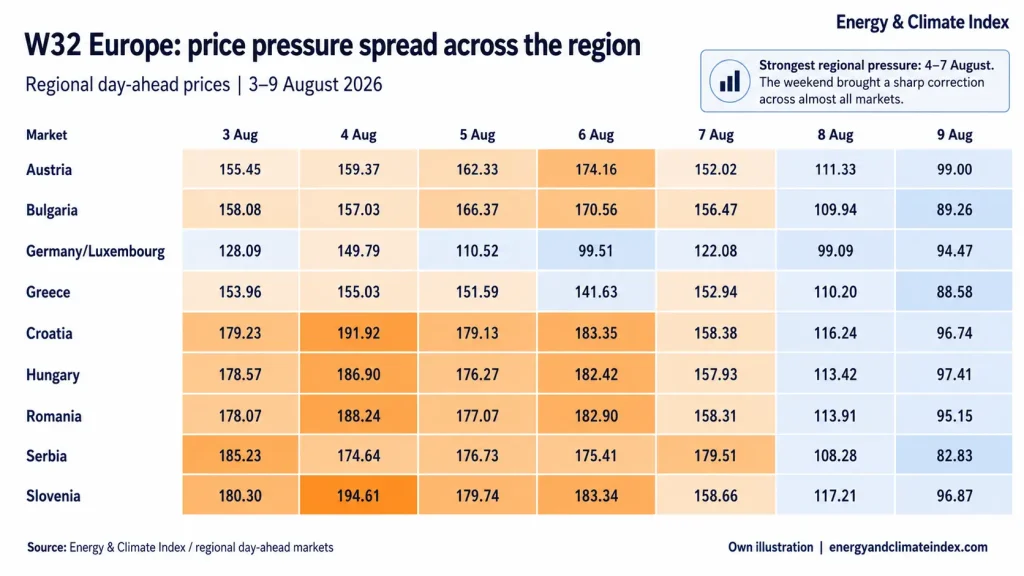
Hungary, Romania and Serbia are at the centre of the story because the physical constraints were most visible there. But the price pressure spread across a broader Southeast European block.
Bulgaria has to be read as an important export and balancing market for the region. It is not a secondary country in this analysis, because its price and availability influence regional flows. Greece, meanwhile, shows the southern side of the same summer pressure: although it was not at the very top of the weekly regional average, it remained in a high zone during the working part of the week.
MEMO was below the region, but in the same regime
The regional average in W32 was 147.04 €/MWh, around 6.54 €/MWh above MEMO. This means that the Macedonian market was not the most expensive in the group, but it was fully part of the same high-price regime.
The strongest pressure was visible during the working days. That was when Danube-related risk, high demand and the need for regional balancing overlapped. The weekend brought relief, but it did not erase the weekly signal.
Conclusion
W32 was the strongest summer price signal so far. MEMO reached 140.50 €/MWh in base price, while the regional average was even higher. But the essence is not only in the numbers.
The Danube became an operational and market risk. Paks, Cernavodă, Đerdap and Kostolac showed that in a summer marked by drought and a heatwave, water is not a secondary factor in energy. It determines how much capacity is available, how much import is needed and how expensive flexibility becomes.
W32 should therefore not be read as an ordinary weekly anomaly. It is a warning that Southeast Europe is entering a period in which electricity prices will increasingly depend on water, cooling, hydrology and regional flexibility.
ECI