

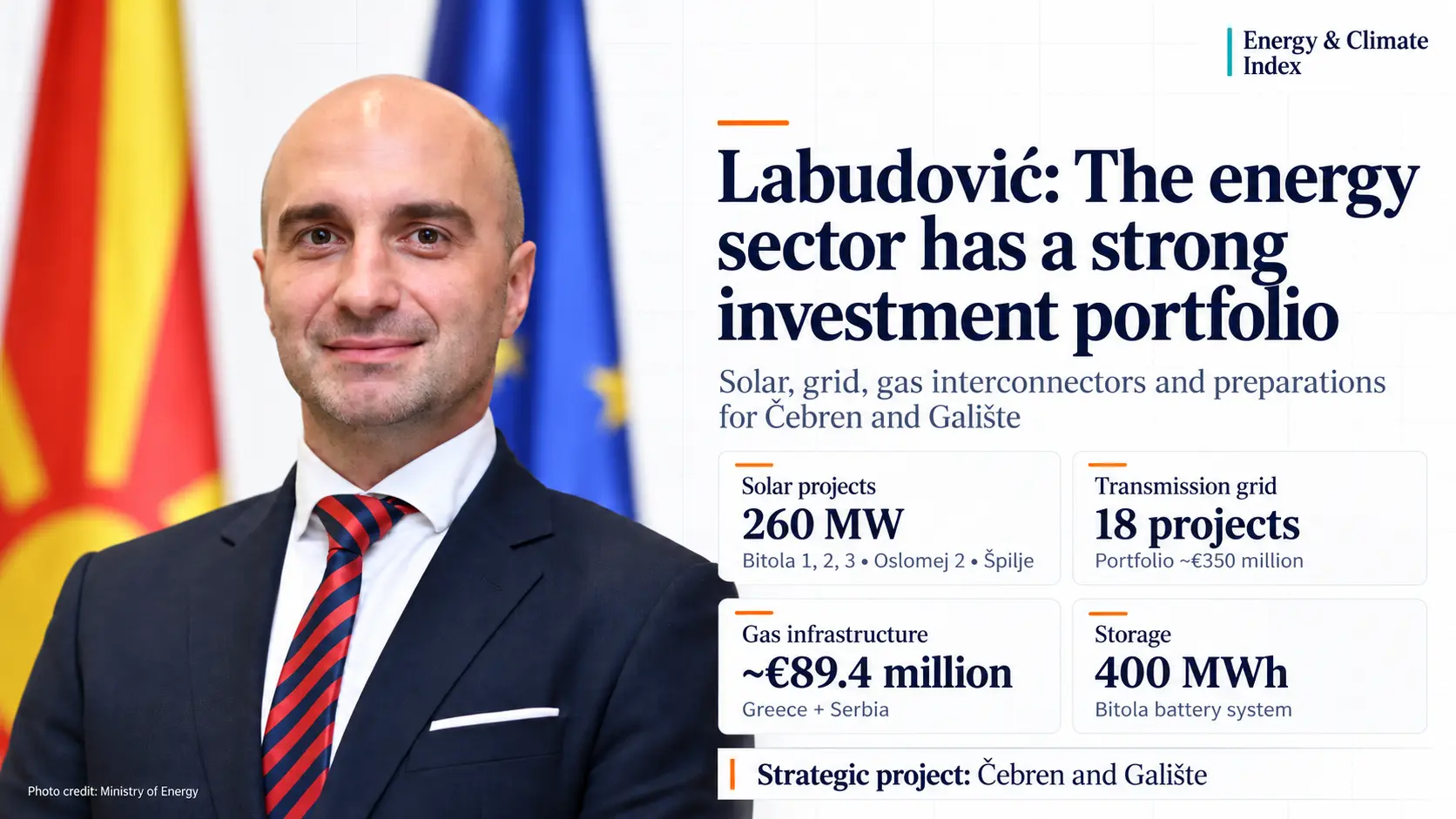
North Macedonia has a substantial portfolio of energy investments covering new renewable electricity generation capacity, battery energy storage systems, transmission grid modernisation and the construction of gas interconnectors with neighbouring countries. Some projects have already secured financing from international financial institutions, others are under implementation, while technical studies and financing models are being prepared for the remaining investments.
This was highlighted by Miroslav Labudović, Deputy Minister of Energy, Mining and Mineral Resources, in an interview with Energy & Climate Index. He emphasised the importance of distinguishing between projects that are still in the planning stage, those with secured financing and investments for which construction contracts have already been signed.
“Having a project idea is not the same as having secured financing, nor is it the same as having a project for which a contractor has already been selected. That is why it is important to explain precisely what stage each investment has reached,” Labudović stated.


New solar power plants in Bitola and Oslomej with more than 220 MW capacity
One of the most significant components of the investment portfolio is the development of new solar photovoltaic power plants by ESM, directly linked to the transformation of existing coal-based energy complexes.
For the Bitola 3 solar photovoltaic power plant, with a planned capacity of 130 MW, financing agreements totalling €87 million have already been signed. This includes €50 million from the German development bank KfW and €37 million from the European Bank for Reconstruction and Development (EBRD).
For Bitola 2, with a planned capacity of approximately 60 MW, a €47.3 million loan agreement has been signed with KfW.
For the Bitola 1 and Oslomej 2 solar photovoltaic projects, with a combined capacity of 30 MW, a contractor has already been selected and implementation activities have begun. According to the current schedule, commissioning is planned by the end of 2027.
Importantly, all new solar photovoltaic power plants in Bitola and Oslomej will be developed on former open-pit coal mining sites, giving existing industrial land a new role in electricity generation.
Wind farms, floating solar and a 400 MWh battery storage system in Bitola
ESM’s investment portfolio also includes wind energy, hydropower and electricity storage projects.
Financing has been secured for the second phase of the Bogdanci wind farm, an investment of approximately €38 million, as well as for the rehabilitation of six hydropower plants, a project worth around €46 million supported by KfW and the European Union.
At the same time, new projects are being prepared, including the Miravci wind farm, with a planned capacity of approximately 100 MW, and a 40 MW floating solar photovoltaic power plant on the Špilje reservoir.
A particularly important investment is the planned battery energy storage system in Bitola, with a storage capacity of approximately 400 MWh and an estimated investment value of €98 million. The project is being prepared in cooperation with the EBRD.
According to Labudović, battery storage systems will play an important role in improving the utilisation of electricity generated from renewable sources and increasing the flexibility of the electricity system.
A gas-fired combined heat and power plant is also being considered as part of the long-term transformation of the Bitola energy complex. The World Bank has already provided $2.4 million in support for project preparation, while the final investment model and financing structure have yet to be determined.
MEPSO’s €350 million investment portfolio includes 18 projects
Alongside new generation facilities, a substantial share of energy investment is focused on modernising and strengthening the electricity transmission network.
According to Labudović, MEPSO has a development portfolio comprising 18 projects with a total estimated value of approximately €350 million. These are planned and ongoing investments for which financing has not yet been fully secured.
Among the most important projects is the resumption of construction of the 400 kV electricity interconnection with Albania. Following an earlier suspension, construction activities resumed in April this year.
Another major investment is the construction of the new Miletkovo substation and the reinforcement of the transmission network in the southeastern part of the country. The project is valued at €34.7 million, of which €26.4 million has been secured through an EBRD loan, while the remaining amount is expected to be covered by grants.
This investment is expected to create the technical conditions required to connect significant new renewable electricity generation capacity to the network.
In addition, a project worth approximately €21 million is being prepared in cooperation with the EBRD to modernise transmission network management systems, advance digitalisation and strengthen cybersecurity.
“Building new power plants alone is not enough. We must also have a transmission network capable of accommodating that electricity, transporting it securely and ensuring the stable operation of the entire system,” the Deputy Minister emphasised.
Gas interconnectors with Greece and Serbia – investments of approximately €90 million
Another important component of the energy investment portfolio is the diversification of natural gas supplies.
The gas interconnector with Greece, an investment of approximately €60 million, is already under construction by a domestic Macedonian company. The new connection is expected to provide an additional natural gas supply route and access to different sources and markets.
Meanwhile, in September this year, NOMAGAS signed a €29.4 million contract for the design and construction of the Macedonian section of the gas interconnector with Serbia.
The section will extend 22.4 kilometres from Klečovce to the Serbian border. According to the agreed schedule, completion is planned for the final quarter of 2028.
With the implementation of both interconnectors, North Macedonia is expected to become part of the Vertical Gas Corridor, enabling bidirectional natural gas transportation, stronger regional connectivity and greater diversification of supply.
According to Labudović, these investments also have broader regional significance, as they could strengthen North Macedonia’s role in connecting energy markets across Southeast Europe.
Tomorrow on Energy & Climate Index: Full interview with Miroslav Labudović
In the full interview, to be published tomorrow on Energy & Climate Index, Deputy Minister Miroslav Labudović also discusses North Macedonia’s preparedness for the coming winter, the potential consequences of renewed price shocks in European energy markets and the operational readiness of ESM’s electricity generation facilities.
Particular attention is given to the strategic Čebren and Galište hydropower project, ongoing discussions with international financial institutions and the possibility of implementing the project through ESM while retaining Macedonian ownership.
The interview also examines the role of private capital and public-private partnerships, as well as the challenges associated with connecting new solar, wind and battery storage facilities to the electricity grid.
Read the full interview tomorrow on Energy & Climate Index.
ECI