

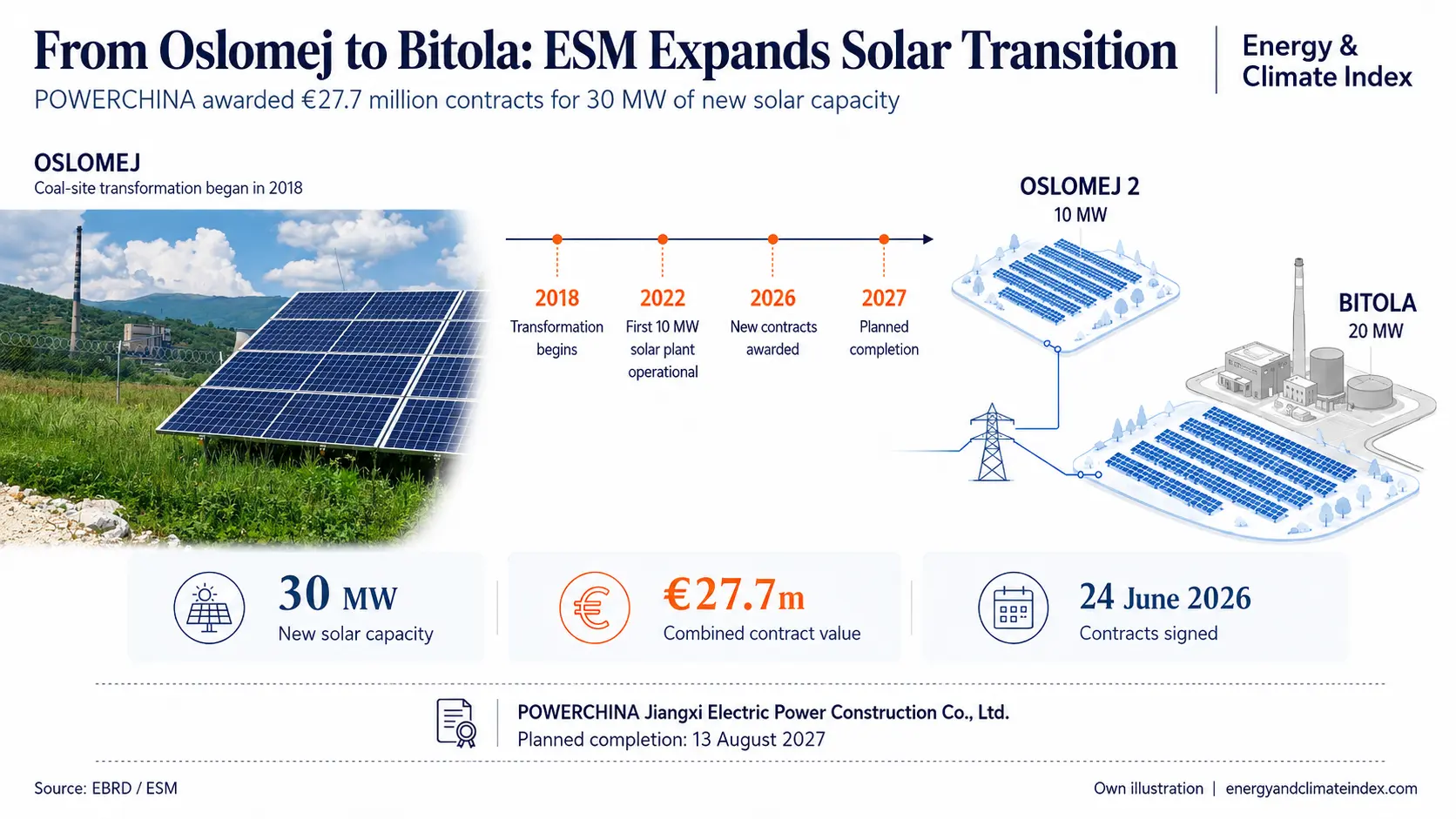
The contracts with the Chinese company are worth a combined €27.7 million, while the projects continue the transformation of former coal sites that began in Oslomej in 2018
North Macedonia’s state-owned power utility ESM has selected POWERCHINA Jiangxi Electric Power Construction Co., Ltd. to build two new solar power plants with a combined installed capacity of 30 MW in Oslomej and Bitola, according to contract award notices published on the European Bank for Reconstruction and Development’s procurement platform.
The project is divided into two lots. The first covers the construction of Oslomej 2, with a capacity of 10 MW, expanding solar generation at the site of the former coal mine within the Oslomej energy complex. The contract is valued at €12,048,433.76.
The second contract covers the construction of a 20 MW photovoltaic power plant in Bitola, close to the Bitola thermal power complex, with a value of €15,652,222.48.


Together, the two contracts are worth approximately €27.7 million. Both contracts with POWERCHINA Jiangxi were signed on 24 June 2026, while EBRD procurement data lists 13 August 2027 as the planned completion date.
The new power plants are part of the ESM Solar PV Transition project. The EBRD has provided a €25 million loan, while the European Union is supporting the investment with an additional €5 million grant through the Western Balkans Investment Framework – WBIF.
Under the project, 10 MW of new solar capacity will be built on part of the depleted Oslomej mine, while another 20 MW will be developed near the Bitola thermal power complex.
Oslomej Started the Transformation of Former Coal Mines in 2018
The additional 10 MW in Oslomej represents another stage in a process that began more than eight years ago.
The first concrete steps towards transforming the former Oslomej coal mine began in 2018, when the then ELEM presented plans to build a large photovoltaic plant on degraded mining land. On 10 January 2018, the company publicly presented the concept of converting part of the former coal site into a location for solar electricity generation.
Later that year, the project entered the EBRD process. The Bank published information on the project in September 2018, followed by a general procurement notice in November for the construction of a 10 MW photovoltaic power plant at the depleted Oslomej mine. The project was approved in December 2018, while the EBRD loan agreement was signed on 4 January 2019.
An international tender for construction was launched in April 2019, and in November 2019 ESM signed the construction contract with Turkish company Girişim Elektrik.
The first 10 MW Oslomej 1 photovoltaic power plant started generating electricity in April 2022. It became ESM’s first utility-scale solar power plant and was built directly on the site of the depleted lignite mine.
The EBRD described the project as a pioneering example with the potential to demonstrate how coal regions in the Western Balkans can gradually be transformed towards renewable electricity generation.
In parallel, ESM launched a much larger second phase of Oslomej’s transformation through a public-private partnership for an additional 100 MW of solar capacity.
On 16 June 2021, agreements were signed with Turkey’s Fortis Energy Electric and Bulgaria’s Solarpro for the construction of two photovoltaic plants of at least 50 MW each on the former mine site.
The EBRD has highlighted the Oslomej model as one of the pioneering approaches in the region. In 2022, the Bank noted that the solar tenders were among the first projects in the Western Balkans developed with exposure to wholesale electricity market prices, including the PPP tender for 100 MW of solar capacity at Oslomej.
The new 10 MW Oslomej 2 project, now awarded to POWERCHINA Jiangxi, adds another phase to this transformation.
At the same time, the development of 20 MW of new solar capacity in Bitola means that the concept first implemented in Oslomej, developing renewable generation on or next to traditional coal-based energy complexes is now being extended to ESM’s largest generation hub, the Bitola thermal power complex.
ECI