

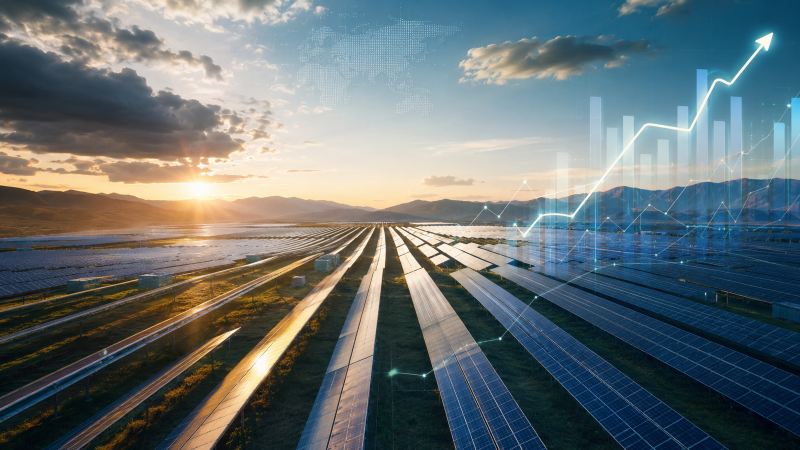
Investment in solar energy remains the strongest driver of the global energy transition, according to the World Energy Investment 2026 report by the International Energy Agency (IEA).
Solar Investment Reaches USD 400 Billion Per Year
According to the World Energy Investment 2026 report, global investment in solar energy for the 2025 period was around USD 400 billion, meaning that approximately USD 1 billion is invested in solar technologies every day.
This investment growth confirms a major shift in the global energy economy. Solar energy is no longer only part of climate policy. It is becoming one of the most important investment categories in the energy sector.


The main driver of this trend is the sharp decline in the cost of photovoltaic panels. Their cost has fallen by around 80% over the past decade.
A Record Year for Global Energy Investment
At the same time, the report shows that global energy investment in 2026 is expected to reach a record USD 3.4 trillion.
Of this amount, around USD 2.2 trillion is directed toward clean energy and related infrastructure. This includes renewables, nuclear energy, electricity grids, storage, energy efficiency and electrification.
By comparison, investment in fossil fuels and oil, natural gas and coal amounts to around USD 1.2 trillion.
This shows that capital is increasingly moving toward technologies that reduce dependence on imported fuels and strengthen energy security.

Why Solar Energy Is Attracting Capital
Solar energy stands out because it combines three key advantages: lower costs, wide availability and fast project development.
For this reason, it is becoming a central technology in the new global investment cycle.
This investment boom also confirms the broader European and global direction. The energy future is increasingly being built around solar energy, electrification and new energy infrastructure.
The Next Challenge: Grids, Storage and Flexibility
However, the growth of solar energy also creates new challenges.
Higher production from renewable sources requires significantly greater investment in electricity grids, storage and system flexibility.
Without this infrastructure, new solar capacity cannot fully deliver its value to power systems.
Editorial Office