

This analysis is based on the official report by SolarPower Europe (May 2026) titled: Solar+: An EU pathway to achieve renewable targets, price affordability, and energy security.
The 2030 Countdown
The European Union stands at a decisive moment in its energy transition. With less than five years remaining to achieve its 2030 climate and energy targets, the gap between political ambition and actual delivery is widening. As of May 2026, greenhouse gas emissions have decreased by only 37% compared to 1990 levels leaving a daunting 18-percentage-point gap to close before the end of the decade.
Compounding this challenge is a persistently high exposure to fossil fuels, a vulnerability laid bare by the ongoing crisis in the Middle East. This exposure continues to undermine industrial competitiveness and energy security. The question is no longer whether we must accelerate, but how. The “Solar+” scenario a strategic pairing of massive solar PV expansion with large-scale battery storage provides the evidence-based answer. It is the only immediate pathway capable of addressing all three pillars of the Energy Trilemma: sustainability, affordability, and security.


Why 33% of Solar Power is “Missing”
In the quest for data-driven policy, one of the most startling revelations is the missing generation from rooftop solar. While large-scale utility solar is easily tracked at the transmission level, distributed rooftop systems remain largely hidden from official grid operator statistics due to registration delays and high self-consumption.
The scale of this data gap is massive. In 2025, the EU reached 406 GW DC of installed solar capacity, 61% of which was on rooftops. However, the generation reported by grid operators was 135 TWh lower than the theoretical output meaning 33% of solar generation effectively went uncounted.
The Netherlands serves as the extreme case of this statistical blind spot. Despite hosting more than 20 GW of solar capacity (75% of which is rooftop), the reported solar contribution to the Dutch electricity mix remains minimal. This invisibility matters; when policy-makers cannot see the full contribution of domestic solar, they risk under-estimating the technology’s power to stabilize the grid.
EU grid operators report 135 TWh (33%) less solar generation than the theoretical generation. That difference is most likely attributed to an underrepresentation of rooftop solar.
The €223 Billion Shield
The Solar+ transition is not just a climate objective, but rather it is a primary defense against geopolitical volatility. By replacing imported natural gas with domestic renewable power, the EU is building a financial shield.
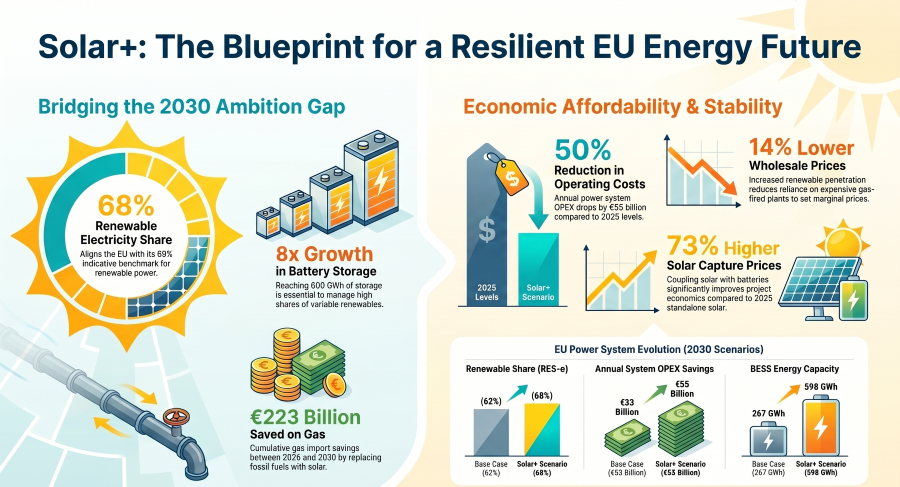
The impact is already tangible. Since the beginning of the Middle East crisis (as of May 2026), solar alone has saved the Union 8.5 billion EUR in fossil gas import costs. In 2025, solar PV saved an estimated 27.4 billion EUR. Looking ahead to 2030, the “Solar+” scenario projects that these annual savings will rise to 53.3 billion EUR.
Cumulatively, between 2026 and 2030, the Solar+ pathway would avoid 223 billion EUR in gas imports for power generation. This is 15% more than the business-as-usual “Base Case” and represents a strategic imperative to move away from expensive, unreliable energy imports.
Solar+ is not only a climate solution; it is an economic and strategic imperative for the EU.
The Radical Decline in Operating Costs
A renewable-led system radically alters the financial landscape of power generation by slashing operational expenditures (OPEX). In 2025, the EU power system was burdened by 112 billion EUR in operating costs, with fossil-fired plants accounting for a staggering 78% of that total.
Under the Solar+ scenario, this bill is effectively cut in half:
| Scenario | Annual Power System OPEX (2025 Real Prices) |
| 2025 Baseline | 112 Billion EUR |
| 2030 Solar+ Pathway | ~57 Billion EUR (49% Reduction) |
This reduction is driven by a fundamental shift in the “merit order” the system that determines which power plants run based on cost. Currently, expensive gas and thermal assets set the marginal price 82% of the time. In the Solar+ scenario, the share of hours where variable renewables set the price increases from 14% to 19%, while the price-setting role of gas drops to 76%. This 6% delta is the primary engine behind the 49% cost reduction, lowering wholesale electricity prices by an average of 14% across the Union.
Solving the Negative Price Paradox
A common critique of high renewable penetration is the “negative price paradox,” where abundant solar generation during midday peaks causes prices to crash, hurting project economics. Indeed, in 2025, capture prices in mature markets hit historic lows of 37 EUR/MWh, threatening future investment.
The Solar+ scenario proves that more renewables do not require more negative price hours if they are paired with storage. Battery storage is the “game-changing technology for flexibility,” allowing the system to shift solar power across time. To stabilize the market, the Solar+ scenario targets 171 GW of power capacity and 598 GWh of energy capacity by 2030.
Crucially, the average storage duration must shift from 1.9 hours to 3.5 hours. This increased duration is the mechanical fix for the paradox, it enables “energy shifting” (moving midday peaks to evening or morning demand), which prevents price crashes and improves the business case for Battery Energy Storage Systems (BESS) by providing longer-duration flexibility.
Why Solar Wins the Deployment Race
While wind energy remains a vital pillar, it currently faces a 19% projected shortfall against 2030 targets due to permitting bottlenecks and supply chain issues. Solar, however, possesses a distinct “speed advantage” and is only projected to miss its target by 4% under current conditions.
Solar is the EU’s highest “upside” technology. Its lower lead times allow it to respond rapidly to policy shifts. The Solar+ ambition seeks to reach 732 GWAC by 2030, significantly over-shooting official targets to compensate for shortfalls in other technologies and ensuring the EU meets its indicative benchmark of 69% renewable electricity.
A Choice of Pathways
The “Solar+” vision offers a future where the European energy system is cleaner, cheaper, and inherently more secure. However, the barriers to this 223-billion-EUR saving are no longer technological but they are structural and regulatory.
To unlock this potential, two policy hurdles must be cleared:
- EU Flexibility Strategy: A “flexibility-first” approach is required to integrate storage into grid planning and market design, supported by a dedicated Battery Storage Action Plan.
- Electrification Action Plan: The EU’s share of electrification has remained stagnant for several years. We must jumpstart this metric to ensure industry, transport, and buildings can absorb the influx of home-grown clean power.
As Europe faces continued economic and geopolitical pressure, we are left with a fundamental choice: do we remain structurally vulnerable to the price shocks of imported fossil fuels, or do we commit to the rapid, evidence-based potential of Solar+?
Viktor Andonov, M.Sc in electrical engineering
Former energy advisor to the Prime Minister of the Government of North Macedonia