

Electricity prices for households across the European Union remained at high levels in 2025, according to the latest data published by Eurostat.
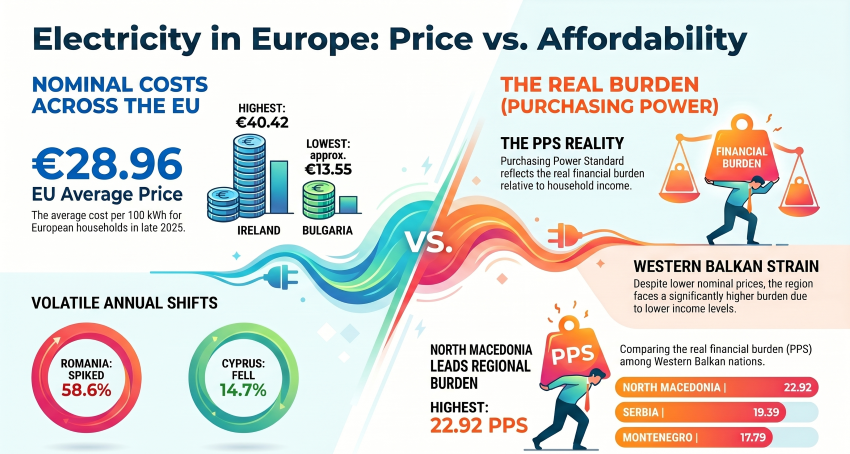
According to the statistics, the average household electricity price in the EU during the second half of 2025 amounted to €28.96 per 100 kWh, meaning that European households paid on average:
- around €0.29 per 1 kWh,
- or approximately MKD 17.8 per kilowatt-hour.
Although the European energy market has gradually stabilized following the energy crisis of previous years, prices remain significantly higher compared to the period before 2022.


Ireland and Germany Recorded the Highest Electricity Prices in Europe
The highest household electricity prices were registered in:
- Ireland – €40.42 per 100 kWh,
- Germany – €38.69 per 100 kWh,
- Belgium – €34.99 per 100 kWh.
This means that households in Ireland paid:
- around €0.404 per 1 kWh,
- or approximately MKD 24.9 per kilowatt-hour.
In Germany, the price reached:
- around MKD 23.8 per kWh.
Lowest Electricity Prices in Hungary and Parts of Eastern Europe
The lowest household electricity prices in the European Union were recorded in:
- Hungary,
- Malta,
- Bulgaria.
In Hungary, the average price amounted to:
- €15.10 per 100 kWh,
which equals: - around €0.151 per 1 kWh,
- or approximately MKD 9.3 per kWh.
In Bulgaria, the price stood at:
- around €13.55 per 100 kWh,
which equals: - around MKD 8.3 per kWh.
According to analysts, these differences are the result of varying market regulation models, state subsidies, production structures, and household protection policies.
Significant Price Changes Across Individual Countries
The highest annual increases in electricity prices were recorded in:
- Romania (+58.6%),
- Austria (+34.3%),
- Ireland (+32.7%).
On the other hand, price decreases were observed in:
- Cyprus (-14.7%),
- France (-12.5%),
- Denmark (-11.9%).
Experts note that these differences indicate that the European energy market has still not fully stabilized following the crisis caused by high natural gas prices, energy market volatility, and geopolitical tensions in recent years.
The Eurostat data refer to final prices paid by households and include:
- the electricity supply price,
- network charges,
- VAT,
- as well as other fees and levies.
PPS Analysis Shows a Different Picture of the Burden on Citizens
In addition to nominal prices, Eurostat also publishes an analysis based on PPS (Purchasing Power Standard), reflecting the purchasing power of the population.
This indicator shows the real financial burden of electricity bills relative to household income levels.
According to the PPS analysis:
- Romania,
- Czechia,
- Poland
are among the countries where electricity represents the highest burden on households.
This means that even if some countries have lower nominal electricity prices in euros, lower income levels and living standards may result in a significantly heavier burden on citizens.
Conversely, countries with higher wages and living standards are better able to absorb higher electricity prices.
PPS Analysis for the Western Balkans: North Macedonia Records the Highest Household Burden in the Region
Besides nominal prices, Eurostat also provides a PPS-based analysis for the Western Balkans.
This indicator does not represent the direct electricity price in euros, but rather the financial burden of electricity bills relative to citizens’ purchasing power.
According to the PPS analysis for the Western Balkans, the highest burden on households was recorded in:
- North Macedonia – 22.92 PPS per 100 kWh,
- Serbia – 19.39,
- Montenegro – 17.79,
- Bosnia and Herzegovina – 16.37.
This indicates that although nominal electricity prices in the region remain below the European Union average, the burden on household budgets is considerably higher due to lower income levels and living standards.
The PPS analysis enables comparisons of the real affordability of electricity between countries, rather than only comparing nominal electricity prices in euros.
Editorial Staff