

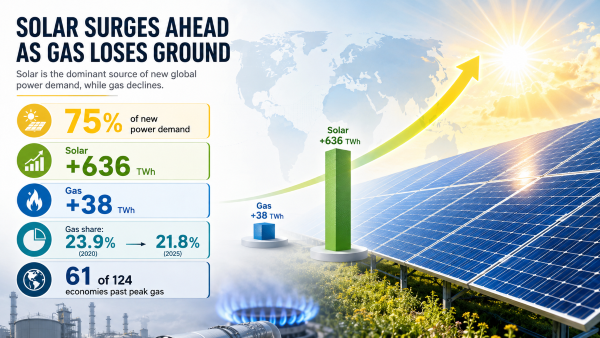
Solar energy pushes gas out of the global electricity market, according to an analysis by Ember, an independent energy think tank that tracks global power generation data.
According to the analysis, gas has lost market share for the fifth consecutive year. At the same time, solar energy is becoming the main source for covering new electricity demand.
The share of gas in global electricity generation fell from 23.9% in 2020 to 21.8% in 2025. Although gas-fired generation is still rising in absolute terms, its market space is shrinking because solar energy is growing much faster.


In addition, solar power generation increased by 636 TWh in 2025. Gas-fired generation, meanwhile, increased by only 38 TWh. Therefore, the growth of solar energy was 17 times higher than the growth of gas.
This trend also aligns with the report by the International Energy Agency, which highlights investment in solar energy as a driver of the energy transition.
Solar Energy Pushes Gas Out for the Fifth Consecutive Year
According to Ember, gas has lost share in the global electricity mix for five years in a row. This no longer looks like a short-term movement. Instead, it points to a structural market change.
Electricity demand continues to grow. However, new consumption is increasingly being covered by solar energy and other renewable sources.
This is also important because of the price risk linked to gas. European examples show that clean energy can directly reduce exposure to expensive fuels.
Solar Covered 75% of New Electricity Demand
The most important figure in the analysis is that, in 2025, solar energy covered around 75% of the growth in global electricity demand. Gas, by contrast, covered less than 5% of the growth in global demand.
A similar logic is already visible in Europe, where higher solar generation reduces the need for fossil fuel imports.
This shows that solar power plants are no longer a secondary source in the electricity system. They are becoming the main source of new electricity generation.
Gas Is Growing More Slowly Than the Market
Gas-fired power plants still play an important role in many electricity systems. However, their share is falling because they are growing more slowly than total electricity demand.
That is exactly why this change matters. Gas is not disappearing from the system, but it is losing its position as the main source of new growth.
Solar energy pushes gas out because it can be built faster, enter production faster and increasingly cover new electricity consumption.
Almost Half of Gas-Using Economies Have Passed Their Peak
Ember states that 61 of the 124 economies that use gas for electricity generation have already passed their historical peak in gas-fired power generation.
This means that almost half of these economies are no longer increasing gas-fired generation as they did before.
The figure also shows that the trend is not limited to Europe or to a few developed markets. The shift is broader and is visible at global level.
What This Means for North Macedonia
The global trend described by Ember already has a clear local confirmation. Over the past decade, North Macedonia has recorded historic growth in solar energy, with a 50-fold increase in electricity generation from photovoltaic power plants.
This means that the domestic electricity system is already moving in the same direction as the global market. New energy is increasingly coming from solar power. However, the key challenge is no longer only the construction of new photovoltaic power plants. It is also their integration with battery storage systems, flexibility, grid investments and market mechanisms.
Therefore, the message for North Macedonia is clear. Solar energy can become the driver of new electricity growth. However, a stable system will require storage, hydropower, balancing and a stronger grid.
Solar Energy Is Changing the Global Market
Solar energy pushes gas out because it is already taking over the role of the main source for covering new electricity demand.
Ember’s analysis shows that the global electricity system is entering a new phase. In that phase, growth will increasingly come from solar energy and other renewable sources, not from fossil fuels.
Editorial Team