

Germany’s Federal Network Agency, Bundesnetzagentur, has presented its latest proposals for reforming the electricity grid tariff system. The objective is to adapt the tariff model to the new reality of the power sector, where renewable energy sources, battery storage systems, flexible consumption and decentralised generation are playing an increasingly important role.
According to the agency, the existing system no longer reflects today’s electricity supply structure or the needs of the future power system. The new model is intended to ensure a fairer distribution of costs, higher efficiency, lower congestion management costs and stronger incentives for flexibility.
Prosumers Will Pay a Higher Fixed Charge
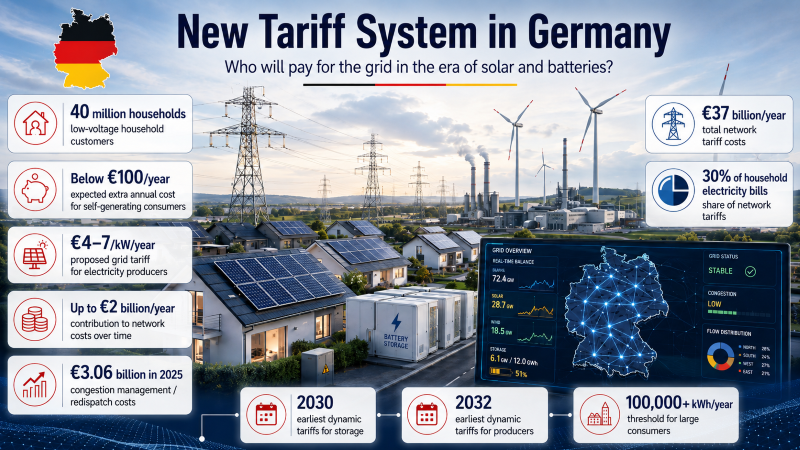
For around 40 million households connected to the low-voltage grid, no major changes are expected. The grid tariff will continue to consist of a fixed annual charge and a price per kilowatt-hour consumed.


However, households and companies that generate their own electricity, for example through solar systems, are expected to pay a higher fixed charge in the future. The reason is that these users draw less electricity from the grid, but still rely on it when they do not have their own generation or when their battery is empty.
The additional cost for these users is expected to remain below EUR 100 per year, with local differences. Small plug-in solar systems will not be covered by this higher charge.
Generators and Batteries Will Contribute to Grid Financing
Bundesnetzagentur also proposes that electricity generators should contribute to grid financing in the future through a limited annual tariff based on installed capacity. The initial tariff is expected to range between EUR 4 and EUR 7 per kilowatt per year.
Existing plants will be protected for a period of 20 years from their commissioning date. Over time, this measure could contribute up to EUR 2 billion per year towards covering grid costs.
Battery storage systems and pumped-storage hydropower plants will also pay a moderate capacity-based tariff. The agency emphasises that electricity storage remains essential for the future power system, which is why batteries will not be subject to a tariff based on electricity withdrawal with a financing function.
Dynamic Tariffs for Greater Flexibility
Germany plans to gradually introduce dynamic grid tariffs. The aim is to create financial signals that encourage market participants not to burden the grid during critical periods.
Dynamic tariffs for storage systems could be introduced no earlier than 2030, while for generators they could apply no earlier than 2032. For consumers connected to the low-voltage grid, a voluntary participation model is being considered, particularly for home batteries and electric vehicles.
The Grid Is Becoming a Central Issue in the Energy Transition
The reform comes at a time when congestion management costs in Germany have increased significantly. In 2025 alone, these costs amounted to around EUR 3.06 billion, while grid tariffs cover around EUR 37 billion annually and account for approximately 30% of household electricity bills.
The German example shows that the next phase of the energy transition will not be only about building new solar and wind capacities. The key question will be who should pay for the grid that enables this transition, when they should pay, and how much they should contribute.
North Macedonia: Tariff System Analysis Should Open Space for Dynamic Tariffs
The announcement by the President of the Energy Regulatory Commission that the tariff system will be analysed comes at the right time for Macedonia. With more than 1,500 MW of installed solar capacity, the country is already entering a phase in which daytime generation, especially during sunny periods, can significantly reduce the market price of electricity.
For this reason, the future tariff model should also consider dynamic tariffs for households, with cheaper electricity during hours of high solar production and, in certain periods, prices close to zero. This would encourage citizens to use electricity more intelligently for water heaters, heating, cooling, electric vehicle charging and household appliances during periods when the system has surplus generation.
Such an approach would not only reduce electricity bills, but also support better use of domestic solar energy, reduce pressure on the grid and help create a more flexible power system.
Editorial Office