

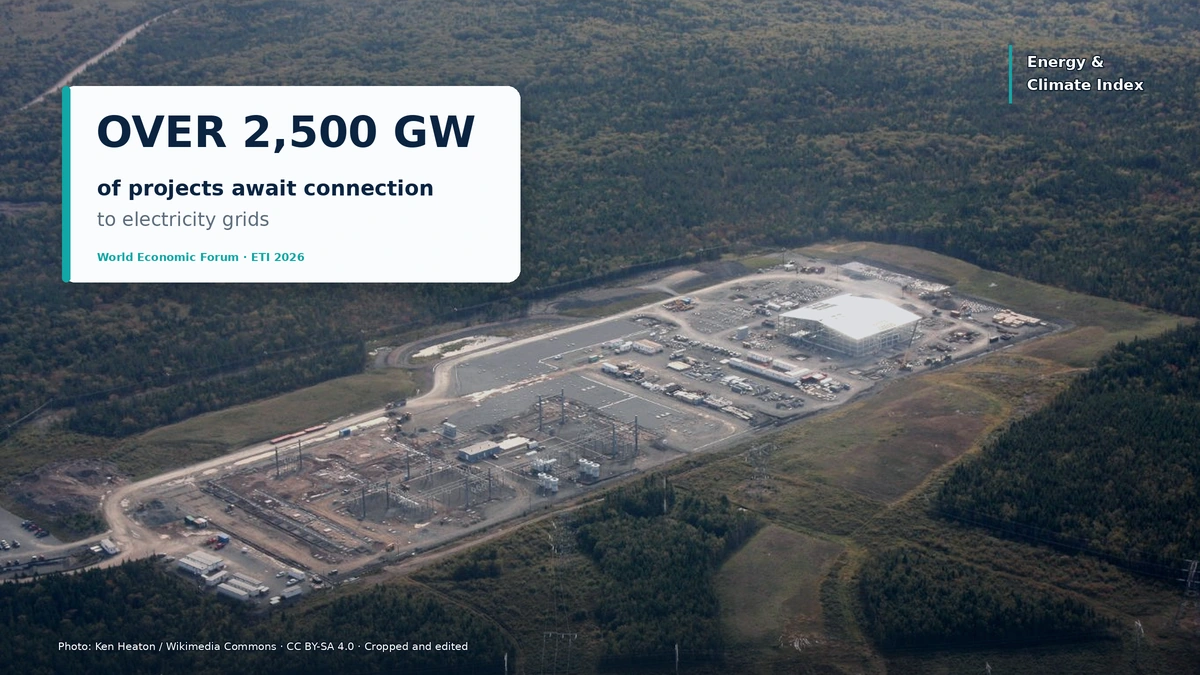
More than 2,500 GW of new energy projects worldwide are stuck in grid-connection queues. These include renewable energy projects, utility-scale battery systems and new large consumers with high electricity demand, according to the World Economic Forum’s Energy Transition Index 2026.
The data point to a profound shift in the energy transition. The main challenge is no longer simply building new generation capacity, but connecting and integrating it into the system on time.
Projects are being developed faster than grids
Renewable energy projects and utility-scale battery systems alone account for 2,323 GW of capacity waiting for grid connection.


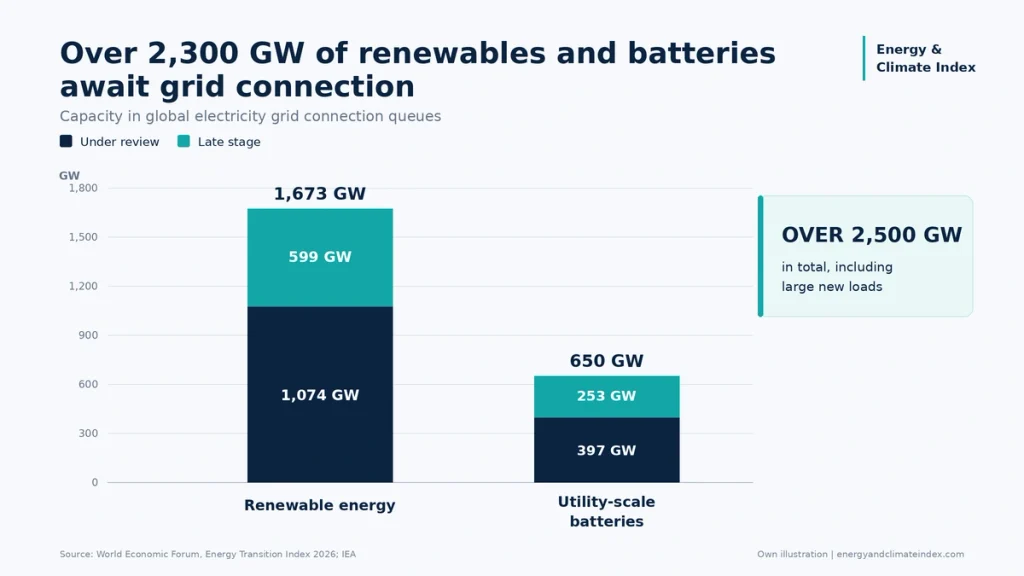
Renewable energy projects represent 1,673 GW of that total. Around 1,074 GW remains under review, while 599 GW is at a more advanced stage of the connection process.
For battery systems, the total capacity awaiting grid connection stands at 650 GW. Of this, 397 GW is under review and 253 GW is in the late stage of the process.
The broader estimate of more than 2,500 GW also includes large new electricity consumers, such as data centres.
Investment in electricity grids is not keeping pace with the addition of new generation capacity. The consequences are already visible through growing transmission constraints, the forced curtailment of electricity generation and longer connection timelines.
In many systems, existing transmission infrastructure is ageing or was not designed to manage larger volumes of variable solar and wind generation. Insufficient cross-border capacity further limits the ability to balance generation and consumption between neighbouring markets.
Lengthy procedures deepen the bottleneck
The problem is not limited to the physical capacity of electricity grids. The World Economic Forum also identifies lengthy permitting processes, complex regulatory procedures and multi-year approval timelines as additional barriers to project development.
As a result, some planned investments cannot move into operation even though the necessary technology and financing have already been secured.
The report concludes that the energy transition is entering a phase in which its pace will increasingly be determined by available infrastructure. Without parallel investment in transmission and distribution networks, new capacity will not automatically deliver greater security or better outcomes for the energy system.
New demand is increasing the pressure
Electricity demand is also growing rapidly alongside the expansion of renewable energy. Global electricity consumption increased by 3% in 2025 and is expected to grow by an average of 3.6% annually through 2030.
Electric vehicles, heat pumps, air conditioning, industrial electrification and digital infrastructure are creating new pressures on electricity grids.
Electricity consumption by data centres is growing particularly rapidly. It stood at approximately 486 TWh in 2025 and is expected to reach around 945 TWh by 2030. Under a scenario of accelerated artificial intelligence adoption, consumption could exceed 1,700 TWh by 2035.
In advanced economies, data centres could account for more than 20% of total electricity demand growth by the end of the decade.
The next phase depends on infrastructure
Reducing grid-connection queues will require faster network expansion, greater storage capacity, digital grid management and market mechanisms that properly value flexibility.
Alongside new transmission lines and substations, the report highlights the importance of battery systems, demand-side management, smart grids and stronger cross-border interconnections.
The figure of more than 2,500 GW shows that the world does not lack planned energy projects. The real question is whether electricity systems can accommodate them in time.
ECI