

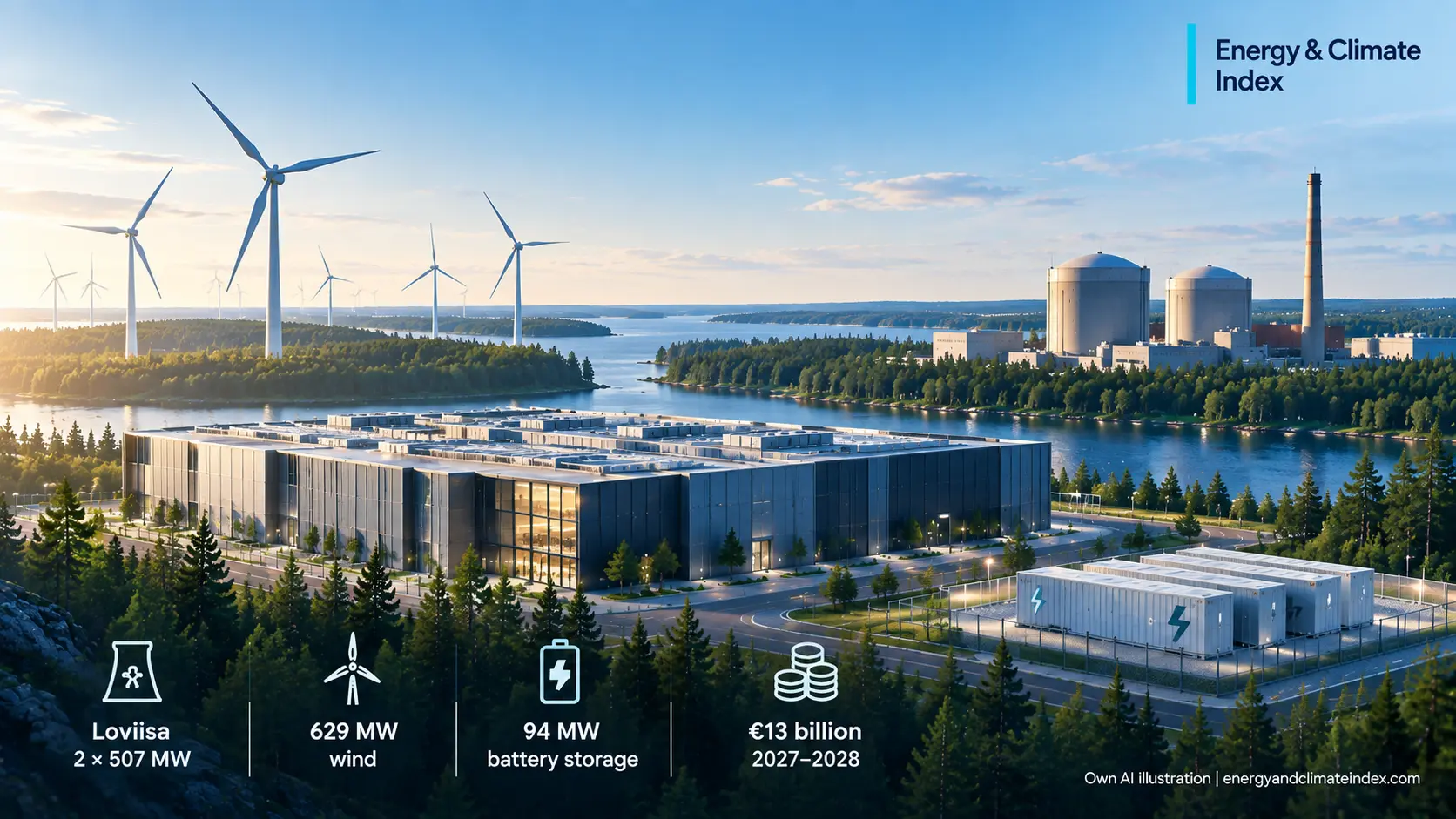
Google plans to invest at least €13 billion in digital infrastructure in Finland during 2027–2028, marking one of Europe’s largest investment programmes linked to the rapid expansion of artificial intelligence and data centres.
The investment will cover data centres and related infrastructure in Hamina, Kajaani, Muhos and Vaala. But the programme extends well beyond digital infrastructure. As electricity demand increases, Google is simultaneously securing long-term nuclear power, supporting new wind generation and contracting battery storage capacity.
Finland is therefore emerging as an important example of how the expansion of AI and data centres can directly influence investment decisions and the structure of the electricity system.


22-year agreement for the Loviisa nuclear power plant
One of the central elements of the programme is a long-term power purchase agreement between Google and Finnish energy company Fortum for electricity generated by the Loviisa nuclear power plant.
The agreement is linked to the extension of the plant’s operating lifetime and will run for 22 years. From 2030 through 2049, Google will contract up to 50% of Loviisa’s generation capacity.
The nuclear power plant consists of two 507 MW units and produces around 8 TWh of electricity annually, equivalent to approximately 10% of Finland’s electricity generation.
Fortum is implementing an investment programme of around €1 billion to extend the plant’s operating lifetime until 2050. According to the company, the long-term agreement with Google provides revenue certainty that supports continued investment in the facility.
The agreement is also expected to enable an additional 10 MW increase in Loviisa’s capacity, on top of a previously planned 38 MW increase expected in 2028.
Google and Fortum have also signed a memorandum of understanding to explore new nuclear, renewable and flexible generation capacity. This includes examining business models that could improve the economics of potential new nuclear reactors at the Loviisa site.
629 MW of wind and a new 94 MW battery
Nuclear power represents only one part of the broader energy package.
Google has signed additional power purchase agreements for onshore wind projects with Valorem and Suomen Hyötytuuli. Together, the agreements bring the total amount of new wind capacity supported by Google in Finland to 629 MW.
The company is also working with its partners to bring the wind portfolio into the ancillary services markets operated by Finnish transmission system operator Fingrid, allowing the assets to contribute to balancing the electricity system.
A 94 MW battery storage system has also been contracted near the new Kajaani data centre and is expected to connect to the grid by the end of 2027. Fortum will optimise the battery’s operation.
The storage facility is expected to provide additional flexibility to the electricity system, particularly during periods of low wind generation.
AI infrastructure becomes part of energy planning
Google and Fingrid will also cooperate on the location of the new infrastructure. Some of the new data centres will be developed in northern Finland, closer to existing grid infrastructure and carbon-free electricity generation.
According to Google, this approach should reduce the need for additional grid investment and limit the impact of new large-scale electricity demand on overall system costs.
The €13 billion investment is expected to contribute an average of approximately €3.6 billion annually to Finland’s GDP during the construction phase in 2027 and 2028 and support more than 37,000 jobs.
The energy implications, however, may be equally significant.
Finland’s approach illustrates how the next generation of large AI data centres can no longer be considered separately from electricity generation, flexibility and grid development.
In this case, the expansion of digital infrastructure is directly linked to extending the operating life of more than 1 GW of nuclear capacity, supporting 629 MW of new wind generation and adding a new 94 MW battery storage system.
ECI