

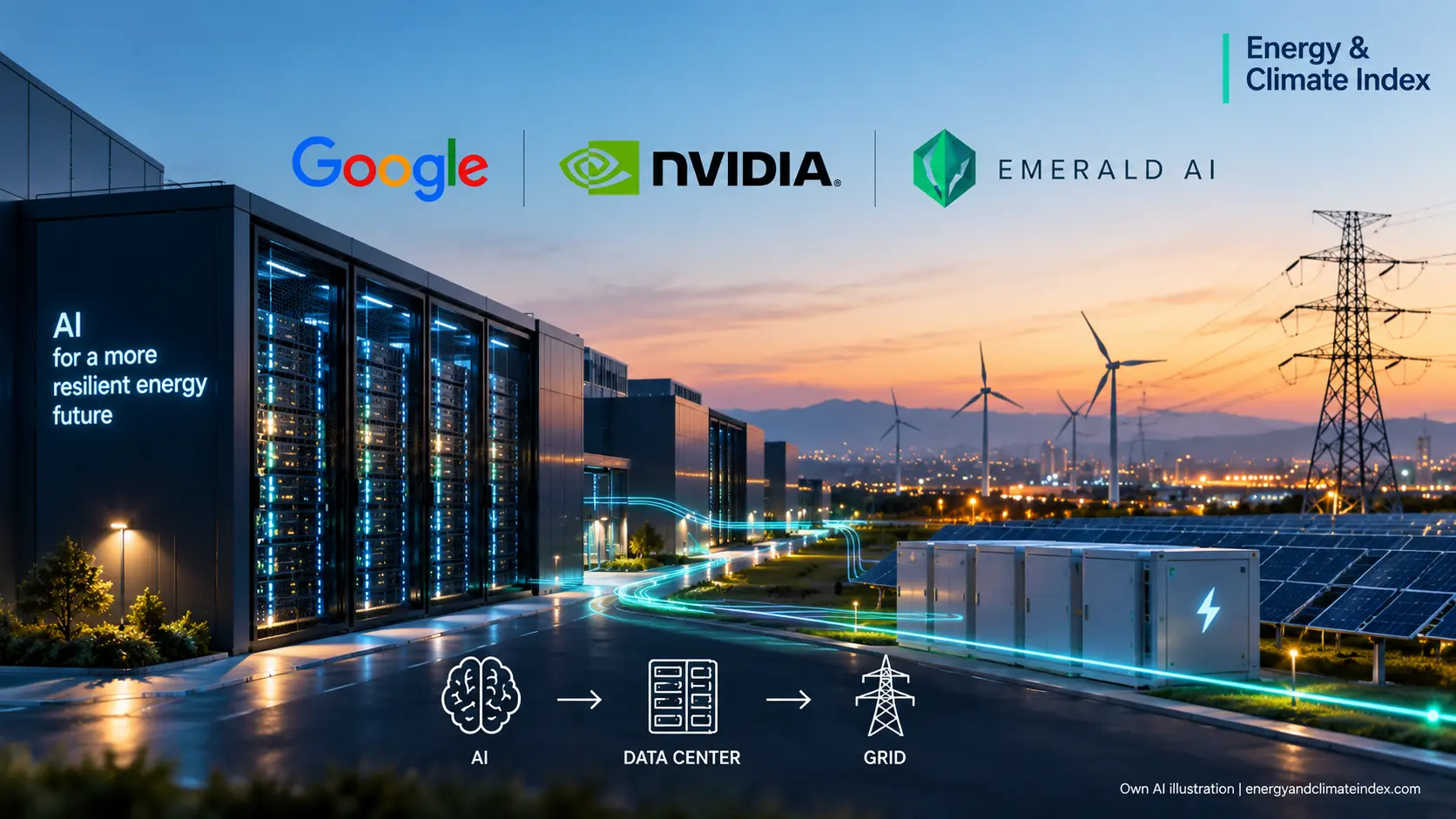
Google, NVIDIA and Emerald AI have launched the AI Energy Management Alliance (AEMA), a new initiative aimed at making rapidly expanding AI data centers more flexible electricity consumers and enabling them to play a more active role in power system management.
The initiative, announced on September 16, comes as the rapid expansion of AI infrastructure creates new pressure on electricity grids and makes connecting large new loads increasingly challenging.
Instead of operating as constant electricity consumers, data centers could dynamically adjust their demand according to conditions on the grid.


From major consumer to flexible grid resource
AEMA brings together companies from the AI, data center and energy sectors to develop common technical and operational models for flexible AI infrastructure.
The concept would allow data centers to temporarily reduce or shift part of their electricity consumption during periods of grid stress. Flexibility could come from adjusting AI computing workloads, battery storage and on-site power generation.
Such an approach could simultaneously reduce pressure on electricity networks and enable faster connections for new AI capacity, an increasingly important issue in parts of the United States where data center electricity demand is growing rapidly.
The alliance includes 18 launch partners from the AI, data center and energy sectors, including Google, NVIDIA, Emerald AI, Anthropic, AES, Constellation, National Grid, NRG and RWE.
Nearly 100 MW demonstration planned
The next step will be to demonstrate the concept under real operating conditions.
NVIDIA, Emerald AI and Digital Realty plan to demonstrate a nearly 100 MW power-flexible AI facility in Virginia that will be capable of adjusting its electricity consumption according to the needs of the power system.
NVIDIA has already been developing the concept of “flexible AI factories”. In March, the company announced cooperation with AES, Constellation, Invenergy, NextEra Energy, Nscale Energy & Power and Vistra to develop AI data centers that could operate not only as computing infrastructure but also as flexible grid resources.
The emerging model shows that the energy challenge created by AI is no longer simply about where the additional electricity will come from. An increasingly important question is whether data centers themselves can adapt their consumption to conditions within the electricity system.
If demonstrated successfully at scale, demand flexibility could become an important factor in the planning of new AI data centers and their connection to electricity grids.
ECI