

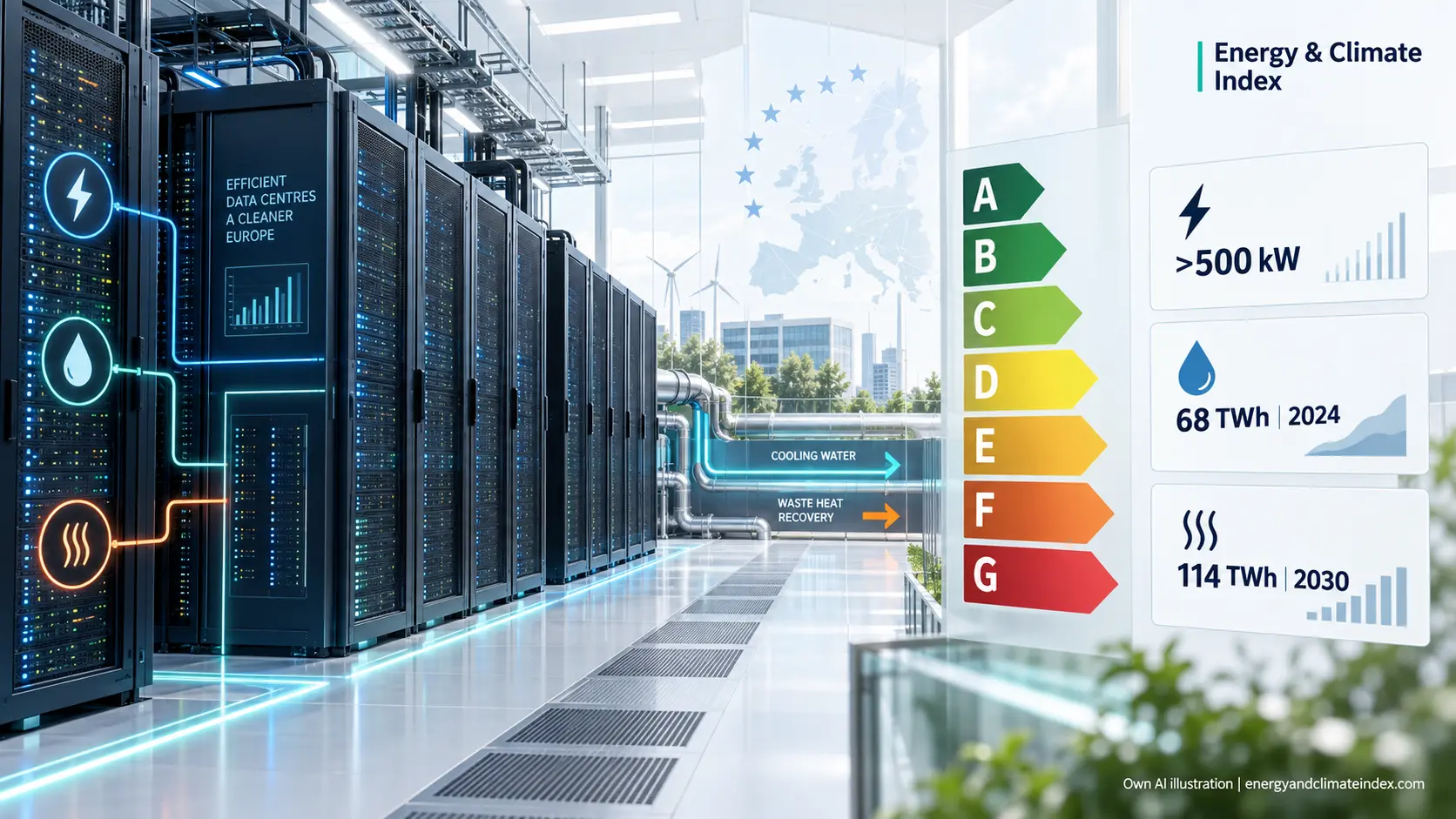
The European Commission has proposed a common rating scheme for the energy and water efficiency of data centres across the European Union. The new framework aims to increase transparency over their resource consumption and support their sustainable integration into Europe’s energy system.
The scheme will cover all data centres with installed IT power capacity above 500 kW. Their performance will be assessed based on electricity and water consumption, enabling comparisons between facilities across the EU.
According to the Commission, well-designed and flexible data centres can adjust their electricity consumption to grid conditions. This could reduce overall system costs, strengthen grid stability and support the wider integration of renewable energy sources.


To ensure that the digital transformation truly works for our society, we must address the growing energy demand of data centres. Understanding their energy and resource consumption is the essential first step towards integrating them sustainably into our energy system. Digital sovereignty must go hand in hand with energy responsibility.
Dan Jørgensen, Commissioner for Energy and Housing
The proposed scheme is established through a delegated regulation. The European Parliament and the Council will have two months to examine the act, while the first sustainability labels for data centres are expected to be issued in 2027.
Electricity consumption could nearly double by 2030
Data centres in the EU consumed approximately 68 TWh of electricity in 2024. Driven by the rapid development of artificial intelligence and growing demand for computing capacity, their electricity consumption is expected to reach 114 TWh by 2030.
According to estimates by the International Energy Agency, this would represent more than 3% of the European Union’s total electricity demand.
The European Commission considers that the expansion of digital infrastructure must be accompanied by higher energy and water efficiency, the use of clean energy, waste-heat recovery and greater flexibility in relation to the electricity grid.
Tripling our data centre capacity cannot mean tripling the pressure on our grids, our water and our energy bills. That starts with transparency, rating large data centres depending on their impact on our energy system. Efficient, flexible, powered by additional clean energy and reusing waste heat, this is how data centres become an asset for EU’s energy transition.
Teresa Ribera, Executive Vice-President for Clean, Just and Competitive Transition
In parallel, the Commission has launched a public consultation on introducing minimum energy-performance standards for data centres. The consultation will remain open until 14 December 2026.
Data centres are becoming a major energy-system challenge
The EU initiative comes as artificial intelligence accelerates the expansion of energy-intensive digital infrastructure. The International Energy Agency expects global electricity consumption by data centres to double by 2030, while projects such as Croatia’s Pantheon AI megaproject demonstrate the scale of the new capacity seeking access to European grids.
At the same time, technology and energy companies are working on solutions that would allow data centres to operate more flexibly. Google, NVIDIA and Emerald AI recently launched an alliance for flexible AI data centres, designed to adjust electricity consumption in response to grid conditions.
Read more: AI will double data-centre electricity consumption by 2030
ECI