

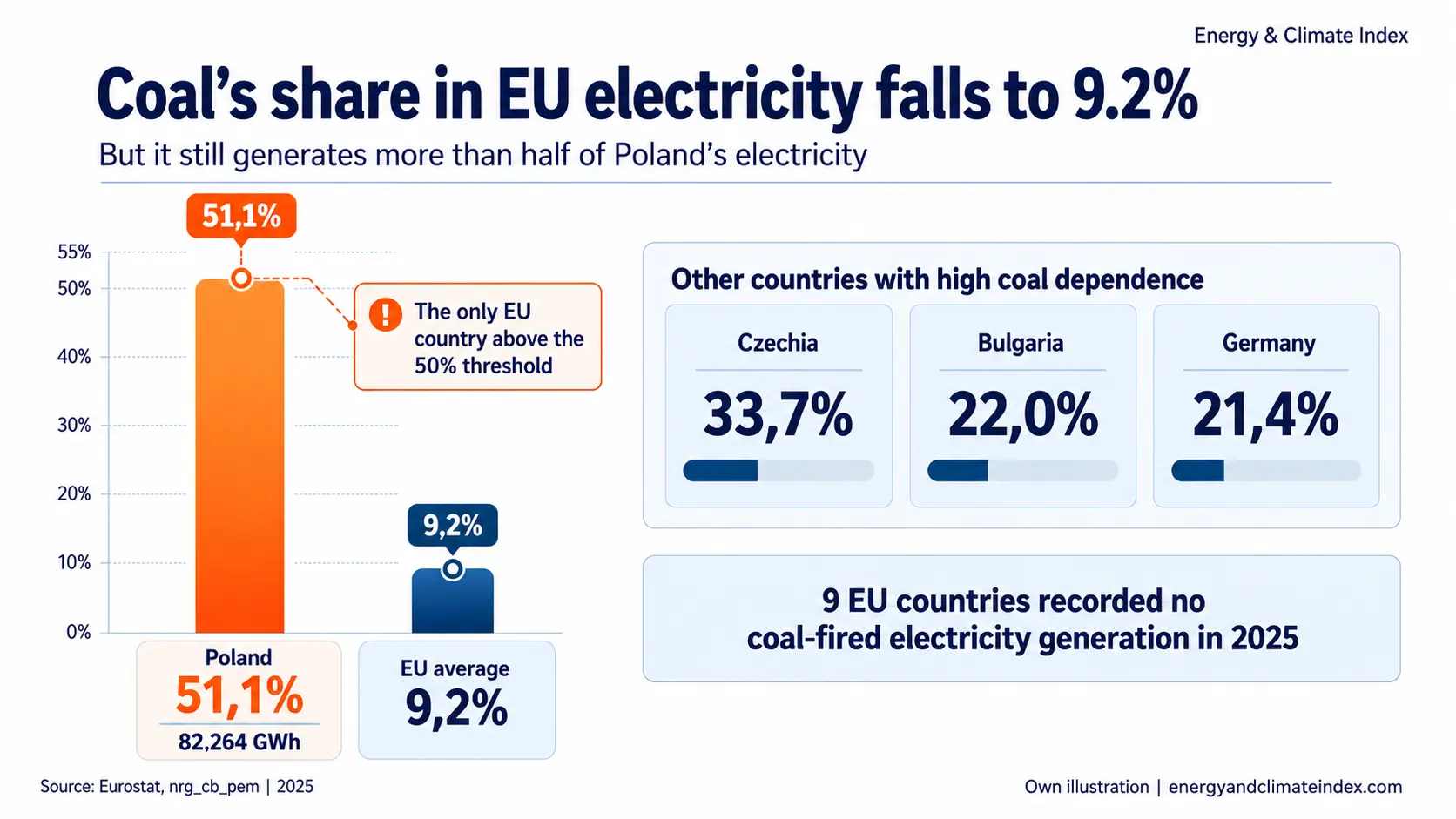
Poland remains the EU’s most coal-dependent country, followed by Czechia, Bulgaria and Germany, while nine member states recorded no coal-fired electricity generation in 2025
Coal’s share in electricity generation in the European Union fell to a historic low of 9.2% in 2025, but the differences between member states remain exceptionally wide.
While coal still generated more than half of Poland’s electricity, nine EU countries recorded no electricity generation from coal in Eurostat’s monthly database during 2025.
Poland had the highest dependence, with coal and manufactured gases accounting for 51.1% of net electricity generation. It was followed by Czechia at 33.7%, Bulgaria at 22.0% and Germany at 21.4%.


Poland remains far above the EU average
Poland generated approximately 82,264 GWh of electricity from coal in 2025, out of total net electricity generation of 161,051 GWh. This means that Poland alone accounted for more than one-third of all coal-fired electricity generation in the EU.
Germany, the largest electricity system among the member states that continue to operate coal-fired power plants, generated approximately 95,541 GWh from coal.
Although Germany’s coal-fired output was higher than Poland’s in absolute terms, its share of the national electricity mix was considerably lower, at 21.4%, compared with 51.1% in Poland.
Czechia generated approximately 24,012 GWh from coal, equivalent to 33.7% of its net electricity generation. In Bulgaria, coal accounted for 22.0%, with approximately 8,083 GWh generated during the year.
Nine countries recorded no coal-fired generation
Eurostat’s monthly database recorded no electricity generation from coal and manufactured gases in France, Portugal, Sweden, Estonia, Cyprus, Latvia, Lithuania, Luxembourg and Malta in 2025.
This does not mean that all these countries have completely stopped using coal in industry or other sectors. The data refer exclusively to electricity generation.
Six countries concentrate the EU’s brown coal consumption
According to Eurostat’s preliminary annual data, Germany accounted for 46% of total brown coal consumption in the EU in 2025.
It was followed by:
- Poland, with 21%;
- Czechia, with 13%;
- Bulgaria, with 10%;
- Romania, with 7%;
- Greece, with 3%.
These six countries effectively accounted for the EU’s entire brown coal consumption. Because of its low energy content and high transportation costs, brown coal is generally used in power plants located close to the mines where it is extracted.
For hard coal, Poland accounted for 45% of total EU consumption and Germany for 23%. They were followed by the Netherlands, France, Belgium and Italy, each with a share ranging from 3% to 7%.
The lowest level in EU history
Hard coal generated 105,601 GWh in the EU in 2025, equivalent to 3.7% of total gross electricity production. Brown coal accounted for 154,186 GWh, or 5.5%.
Their combined share fell below 10% for the first time in 2024 and declined further to a new historic low of 9.2% in 2025.
In 1990, coal generated more than one-third of all electricity produced in the EU. Today, its use is concentrated in a relatively small number of countries, although it continues to represent a significant part of national electricity generation in Poland, Czechia, Bulgaria and Germany.
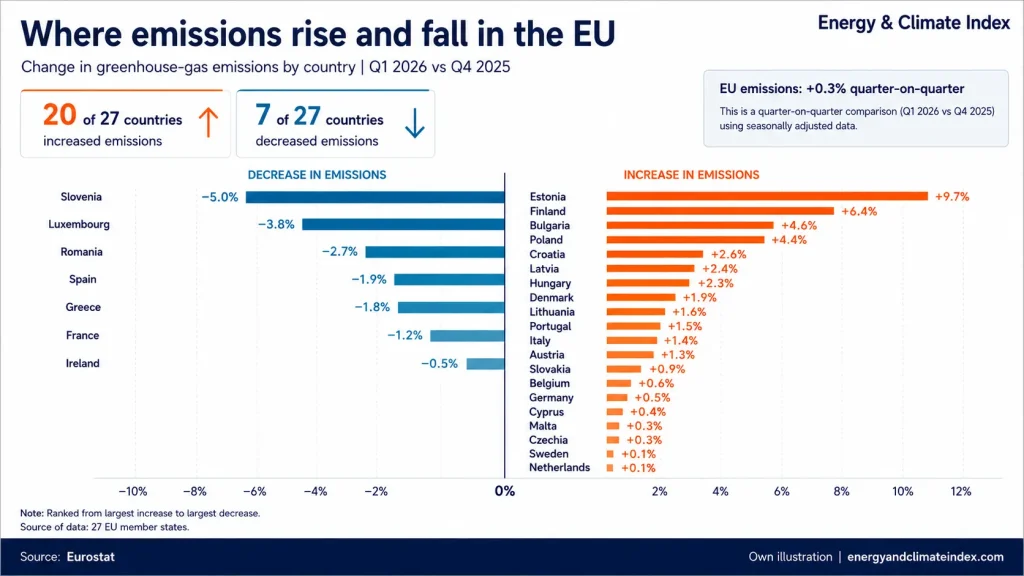
The decline of coal is part of a broader trend in which economic growth and greenhouse-gas emissions are increasingly moving in opposite directions: in the first quarter of 2026, EU greenhouse-gas emissions fell by 1.2%, while GDP increased by 0.8% compared with the same quarter of 2025.
Methodological note: The main EU indicator of 9.2% refers to gross electricity production from hard coal and brown coal. The comparison by country was calculated from Eurostat’s monthly nrg_cb_pem database and refers to net electricity generation in the category “coal and manufactured gases”.
ECI