

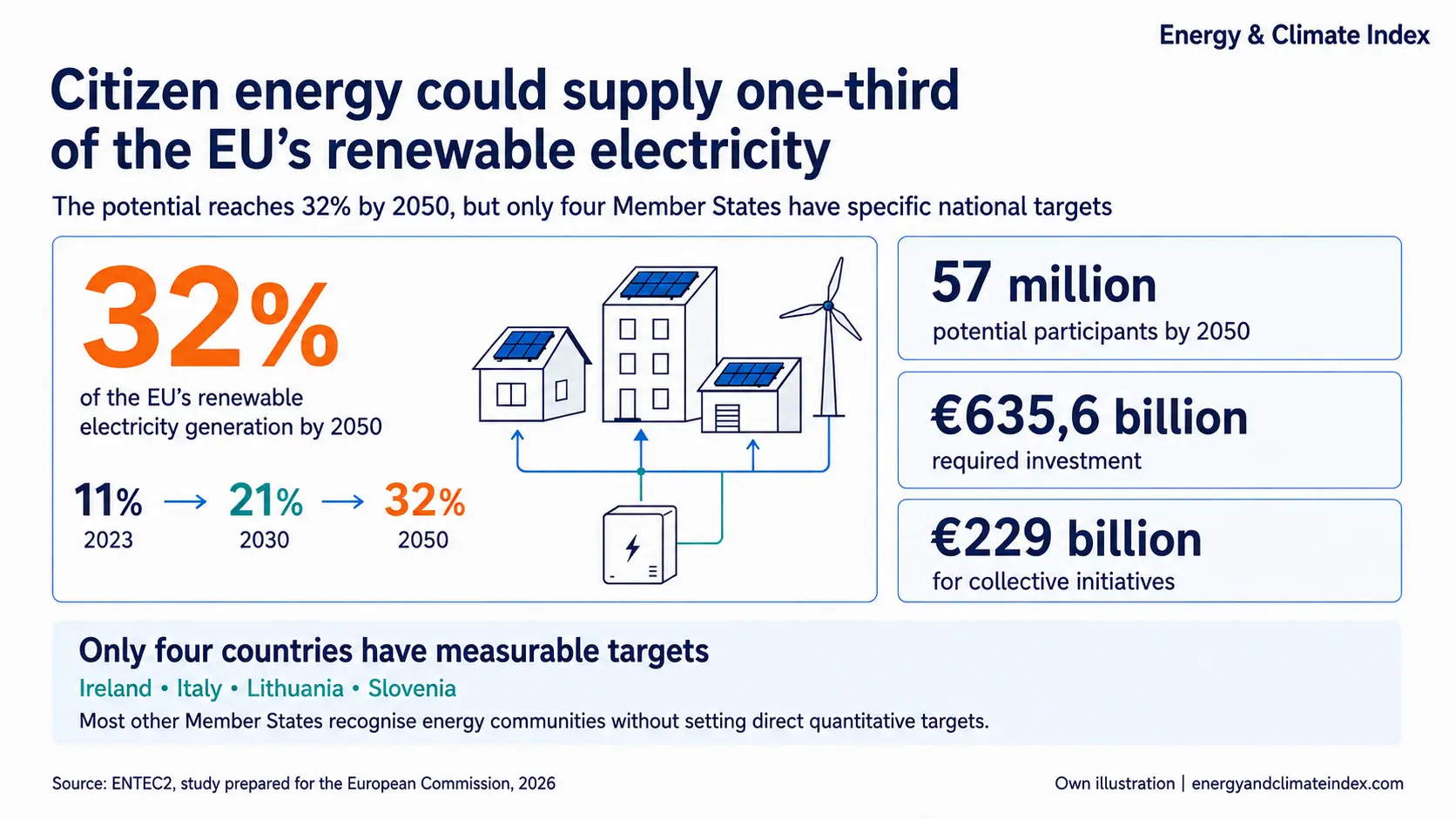
Only Ireland, Italy, Lithuania and Slovenia have set specific national targets, while unlocking Europe’s potential would require approximately €635 billion
Citizens, energy communities, small businesses and public institutions could account for around 32% of the European Union’s total renewable electricity generation by 2050, according to a new study by the Energy Transition Expertise Centre – ENTEC2, prepared for the European Commission’s Directorate-General for Energy.
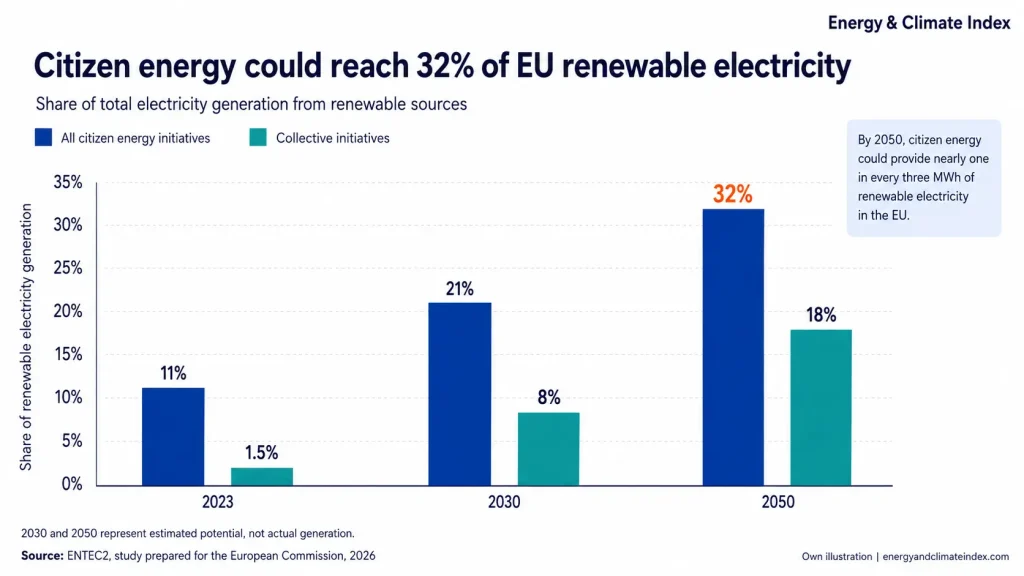
In 2023, citizen energy initiatives generated approximately 150 TWh of electricity. Solar installations accounted for 95.5 TWh, while wind installations produced 54.5 TWh. Together, they supplied around 11% of the EU’s renewable electricity generation.
According to the study’s modelling, this share could increase to 21% in 2030 and 32% in 2050. This means that, with appropriate regulation, infrastructure and financial instruments, citizen energy could supply almost one in every three megawatt-hours of renewable electricity generated in the EU.


Collectives could reach an 18% share
The report draws an important distinction between the broader concept of citizen energy and collectives of households. Citizen energy includes individual households with solar installations, small and medium-sized enterprises, public institutions and household collectives. The last category is used as the closest statistical proxy for energy communities.
In 2023, these collectives generated approximately 18 TWh, equivalent to 1.5% of the EU’s total renewable electricity generation. Their share could increase to 8% in 2030 and 18% in 2050.
This indicates that future growth is expected to come not only from individual rooftop solar systems, but also from joint investments in solar and wind installations, energy storage and demand management.
Up to 57 million participants
The study identified approximately seven million citizen energy initiatives in 2023. Individual households accounted for around 91%, small and medium-sized enterprises for 5.3%, and public entities for 3.2%.
Only around 5,240 household collectives were identified, showing that organised joint electricity generation still represents a small part of Europe’s energy system.
By 2050, around 55 million households – approximately one-third of all EU households – could participate in citizen energy projects. When small businesses and public institutions are included, the total number of potential participants rises to 57 million.
More than 28 million households could participate through collectives, including different forms of energy communities and joint investment initiatives.
Only four countries have set measurable targets
Despite Europe’s substantial potential, explicit national targets remain the exception. According to the report, only Ireland, Italy, Lithuania and Slovenia have established direct and measurable targets related to energy communities.
Ireland aims to reach 1,500 Sustainable Energy Communities by 2030, compared with approximately 900 registered communities in 2024. Its national plan also envisages community-led renewable projects supplying up to 10% of the country’s electricity generation.
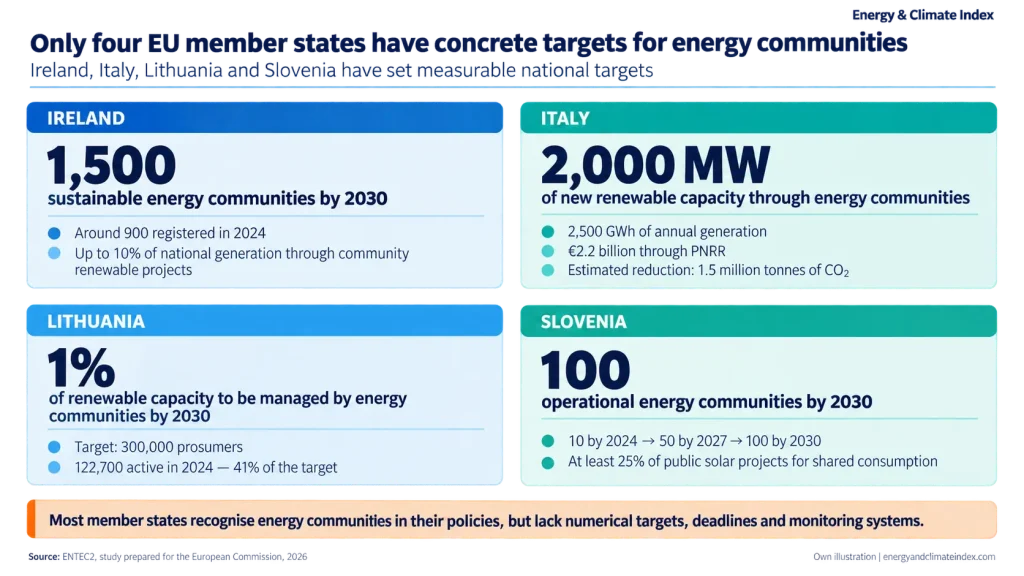
Italy has allocated €2.2 billion from its Recovery and Resilience Plan to support energy communities in municipalities with fewer than 5,000 inhabitants. The objective is to install 2,000 MW of new renewable capacity and generate 2,500 GWh annually, with an estimated reduction of 1.5 million tonnes of CO₂ emissions.
Lithuania plans for energy communities to manage at least 1% of the country’s installed renewable electricity capacity by 2030. It has also set a target of 300,000 prosumers, of whom around 122,700 were already active in 2024.
Slovenia has established a phased target: 10 operational energy communities by 2024, 50 by 2027 and 100 by 2030. Slovenian legislation also requires at least 25% of public solar projects to be allocated to shared consumption, prioritising multi-apartment buildings and vulnerable households.
€635 billion in investment required
Realising the estimated potential by 2050 would require investments of approximately €635.6 billion.
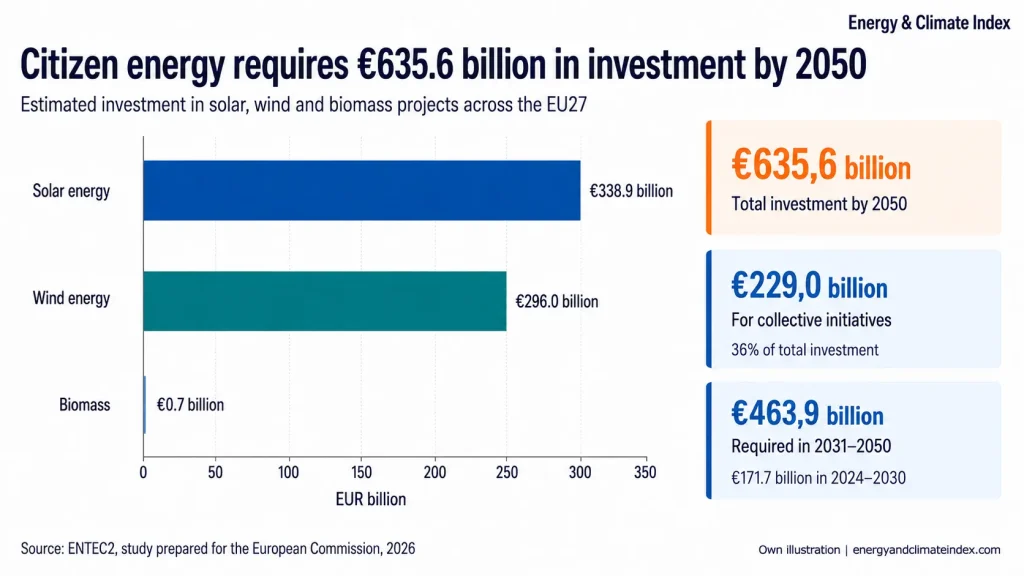
Of this amount:
- €338.9 billion would be invested in solar energy;
- €296 billion would be invested in wind installations;
- approximately €0.7 billion would support electricity generation from biomass.
Around €229 billion, or 36% of total investment, would be directed towards household collectives. Approximately €171.7 billion would be required between 2024 and 2030, followed by an additional €463.9 billion between 2031 and 2050.
From electricity producers to active participants in the energy system
Energy communities should not remain limited to generating and sharing electricity. By combining batteries, smart meters, dynamic tariffs, aggregation and demand management, they could provide flexibility and contribute to balancing the electricity system.
This could reduce peak demand, limit the need for costly grid reinforcement and improve the integration of variable solar and wind generation.
However, many countries still lack practical rules for energy sharing, standardised grid access, aggregation and participation in flexibility markets. The report warns that legal recognition alone is insufficient if energy communities do not have effective access to electricity markets and grid infrastructure.
ECI