

The rapid expansion of solar energy raises a new question for the energy transition: what will happen to millions of photovoltaic panels once they reach the end of their operational life? According to the International Renewable Energy Agency – IRENA, reusing and recycling these panels could create new industries, jobs and considerable economic value.
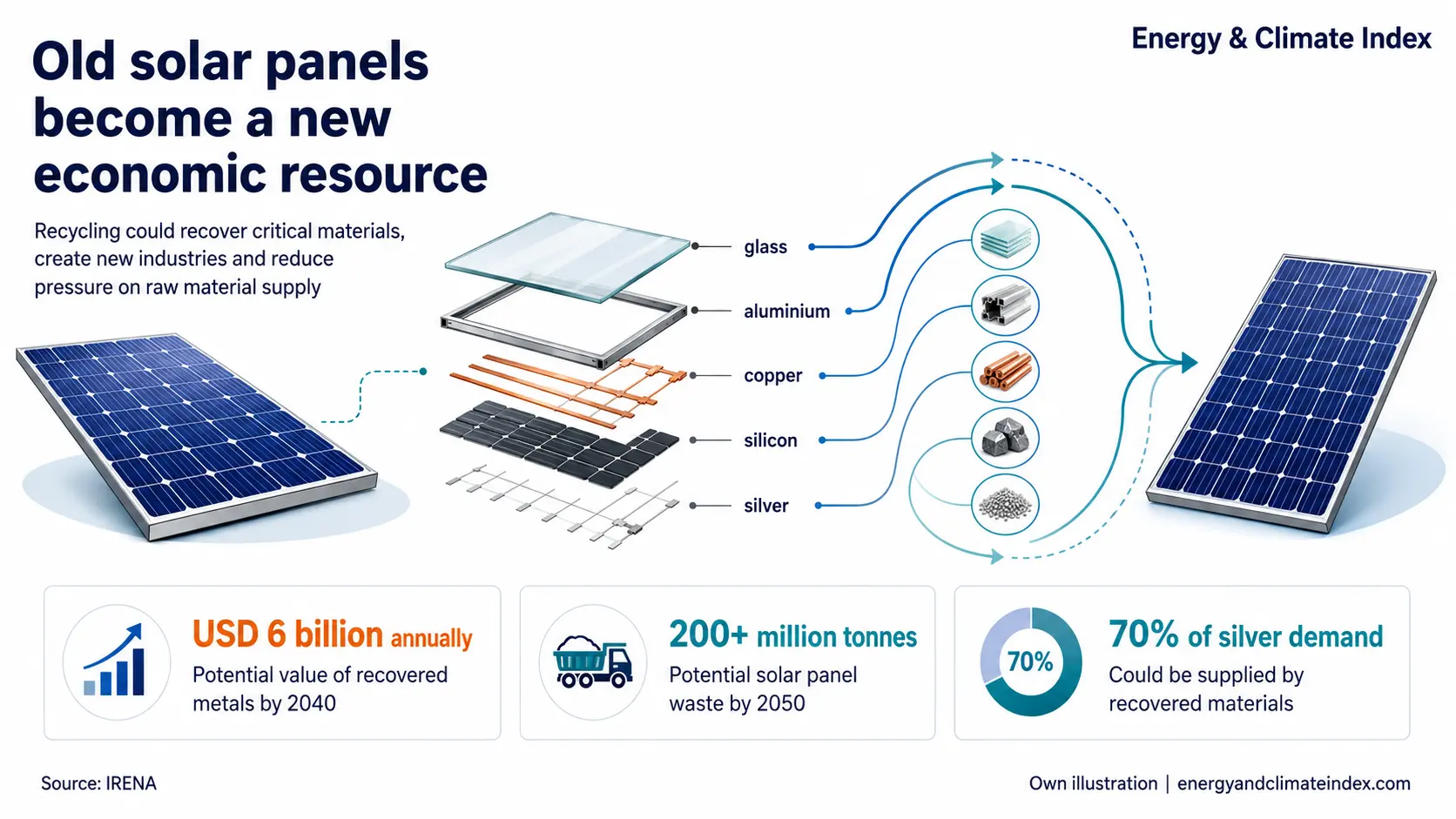
More than 200 million tonnes of waste by 2050
Global solar capacity reached approximately 2.4 TW at the end of 2025. Its continued expansion will gradually generate increasing quantities of end-of-life panels.
IRENA estimates that solar panel waste could rise from around 0.2 million tonnes in 2021 to 4 million tonnes in 2030. It could approach 50 million tonnes by 2040 and exceed 200 million tonnes by the middle of the century.


Materials worth USD 6 billion annually
Solar panels contain glass, aluminium, copper, silicon and silver, which can be returned to production through appropriate recycling technologies. According to IRENA’s estimates, recovered metals could generate approximately USD 6 billion in annual economic value by 2040.
Recycled materials could potentially provide around 70% of the silver and approximately 20% of the aluminium and copper needed for the solar industry’s continued expansion. End-of-life panels could therefore become a secondary source of raw materials rather than simply waste.
Recycling still faces economic barriers
One of the main challenges is that end-of-life panels are distributed across many different locations, while the volumes currently available for processing remain relatively limited. Under these conditions, the value of recovered materials does not always cover the costs of collection, transportation and recycling.
Panel construction presents an additional challenge. Their materials are tightly bonded to withstand several decades of operation, making them difficult to separate and limiting the recovery of high-quality raw materials.
Rules are needed for the entire life cycle
The European Union already regulates end-of-life solar panels through its rules on waste electrical and electronic equipment. Other markets are also introducing extended producer responsibility policies, requiring manufacturers or asset owners to finance panel collection and treatment.
IRENA’s central message is that circular economy principles must become an integral part of solar energy development from designing panels that are easier to repair and recycle to enabling reuse and returning recovered materials to production. In this way, the future wave of end-of-life panels could be transformed from an environmental burden into a new economic opportunity.
ECI