

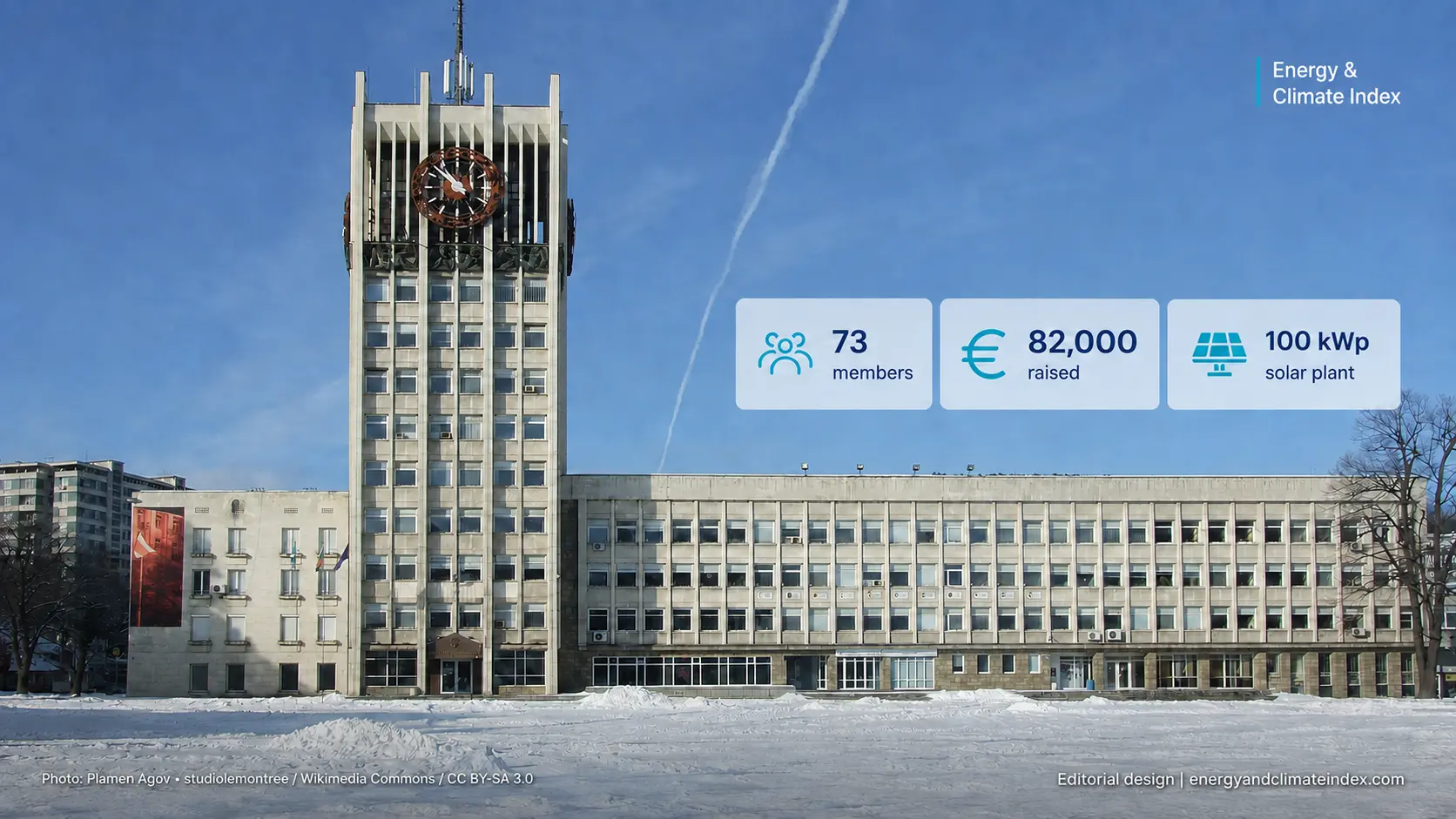
Bulgaria is developing municipally led energy communities as a way to reduce electricity costs, decarbonize public facilities and attract local capital to renewable energy projects, according to the Bulgarian Ministry of Energy.
The first practical example comes from Gabrovo, where 73 citizens, businesses, institutions and organisations raised more than BGN 160,000, equivalent to approximately €82,000, to build a jointly financed solar power plant.
The installation has a capacity of 100 kWp and is located on the roof of a municipal non-hazardous waste disposal facility.


The municipality will take ownership after ten years
The solar installation will remain under the ownership of the energy community during its ten-year operating period. After that, ownership will be fully transferred to the Municipality of Gabrovo.
The electricity generated is sold to municipal utility services at a fixed price under power purchase agreements, while the remaining output is sold on the electricity market.
This structure links the members’ investment to the actual consumption of municipal facilities. At the same time, the municipality gains access to locally generated electricity and will ultimately take ownership of the solar plant.
The Gabrovo initiative has also been selected to receive a €45,000 grant from the European Energy Communities Facility. The funding will support the preparation of a business plan and the further development of the energy community.
A model that can operate before energy sharing is fully introduced
The Ministry describes the municipal model as a practical and relatively low-risk solution that can be implemented while parts of the regulatory framework for electricity sharing are still being developed.
In the initial stage, a municipality establishes an energy community around a public facility with its own electricity consumption, such as a school, sports centre or municipal utility facility.
The solar plant is sized to maximise direct consumption of the electricity generated. Any surplus can be sold on the open market through a licensed electricity trader.
The economic benefits come from lower electricity purchasing costs and revenue from selling the electricity that is not consumed on site.
The next phase could bring energy sharing and battery storage
At a later stage, energy communities could introduce electricity sharing, virtual metering and the allocation of generated electricity among their members.
The model could then be expanded to include multiple generation and consumption sites, battery storage systems, demand response and flexibility services. This would allow more participants to join, including energy-vulnerable households.
Bulgaria formally recognised renewable energy communities and citizen energy communities in its primary legislation in 2023. The secondary legislation was further amended in February 2026.
In addition to Gabrovo, pilot models are also being developed in Burgas and Sofia. Burgas has a 420 kWp solar power plant on the roof of the municipal Slaveykov swimming complex. Sofia is planning a 70 kWp installation on a school, with approximately 40% of its output expected to be consumed directly by the building.
ECI