

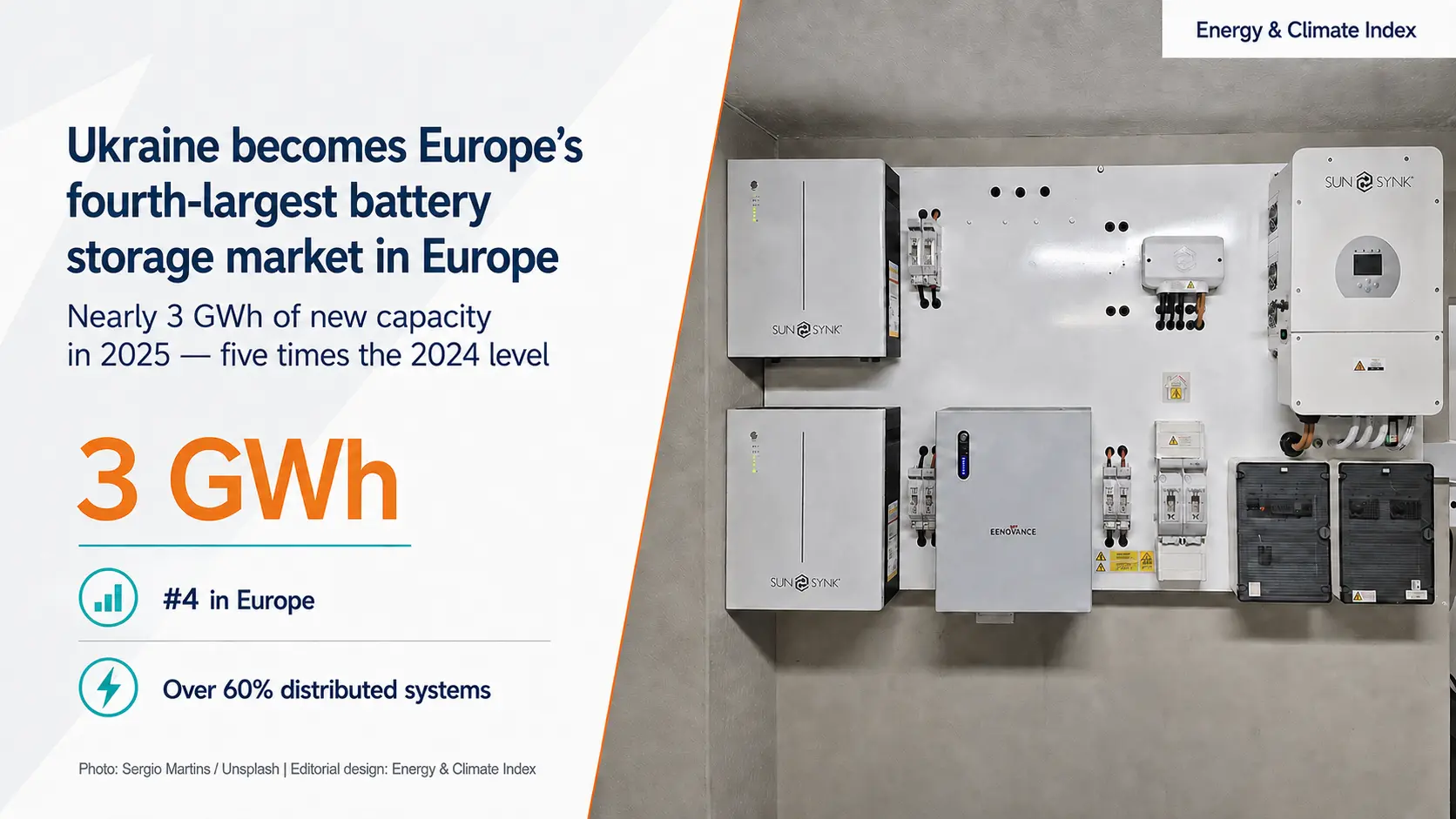
In a country affected by war, batteries are purchased primarily to keep the power on during outages, not to reduce electricity bills
Ukraine installed nearly 3 GWh of new battery energy storage capacity in 2025, becoming Europe’s fourth-largest market. Only Germany, the United Kingdom and Italy installed more battery capacity during the year.
According to the latest data from SolarPower Europe, the Ukrainian market expanded fivefold compared with 2024. Ukraine ranked ahead of Bulgaria, which also added close to 3 GWh and completed Europe’s top five.
However, the structure of Ukraine’s battery storage market differs significantly from that of other European countries.


More than 60% came from distributed storage
More than 60% of newly installed capacity came from distributed systems deployed in homes, businesses, schools, hospitals, water treatment facilities and other critical infrastructure.
Batteries are often combined with solar installations, but many household systems operate without solar generation. Their primary purpose is to provide electricity during outages caused by attacks on the country’s energy infrastructure.
The average residential systems installed in Ukraine have a capacity of only 3–5 kWh, approximately half the European average. Portable power stations with capacities ranging from 0.6 to 2.5 kWh also account for a significant part of the market, providing standalone electricity during blackouts.
Unlike households in much of Europe, which invest in batteries to optimise their electricity bills and store power generated by rooftop solar systems, Ukrainian consumers primarily purchase them to keep the lights and essential equipment running.
Utility-scale batteries enter the market
Utility-scale battery projects accounted for almost one-third of the newly installed capacity. These systems are already being used to provide ancillary services, balance the electricity system and conduct energy arbitrage—charging when electricity is cheaper and discharging when prices are higher.
This segment should help the power system recover more rapidly following the loss of generation capacity and support the integration of decentralised renewable energy production.
Ukraine’s experience demonstrates that batteries are no longer merely an energy-transition technology. In a system where centralised infrastructure has been damaged or destroyed, they have become a critical instrument for energy security and resilience.
Europe surpasses 100 GWh for the first time
Europe installed a record 36 GWh of new battery storage capacity in 2025, representing a 48% year-on-year increase.
It was the twelfth consecutive year of record growth, while Europe’s total operational battery capacity surpassed 100 GWh for the first time. Utility-scale projects connected to the electricity grid are increasingly driving this expansion.
Ukraine and Bulgaria illustrate two different drivers of rapid market growth. In Ukraine, deployment is primarily driven by the war, supply disruptions and the need for energy resilience. Bulgaria’s expansion, meanwhile, has been supported mainly by funding programmes for utility-scale battery projects.
ECI