

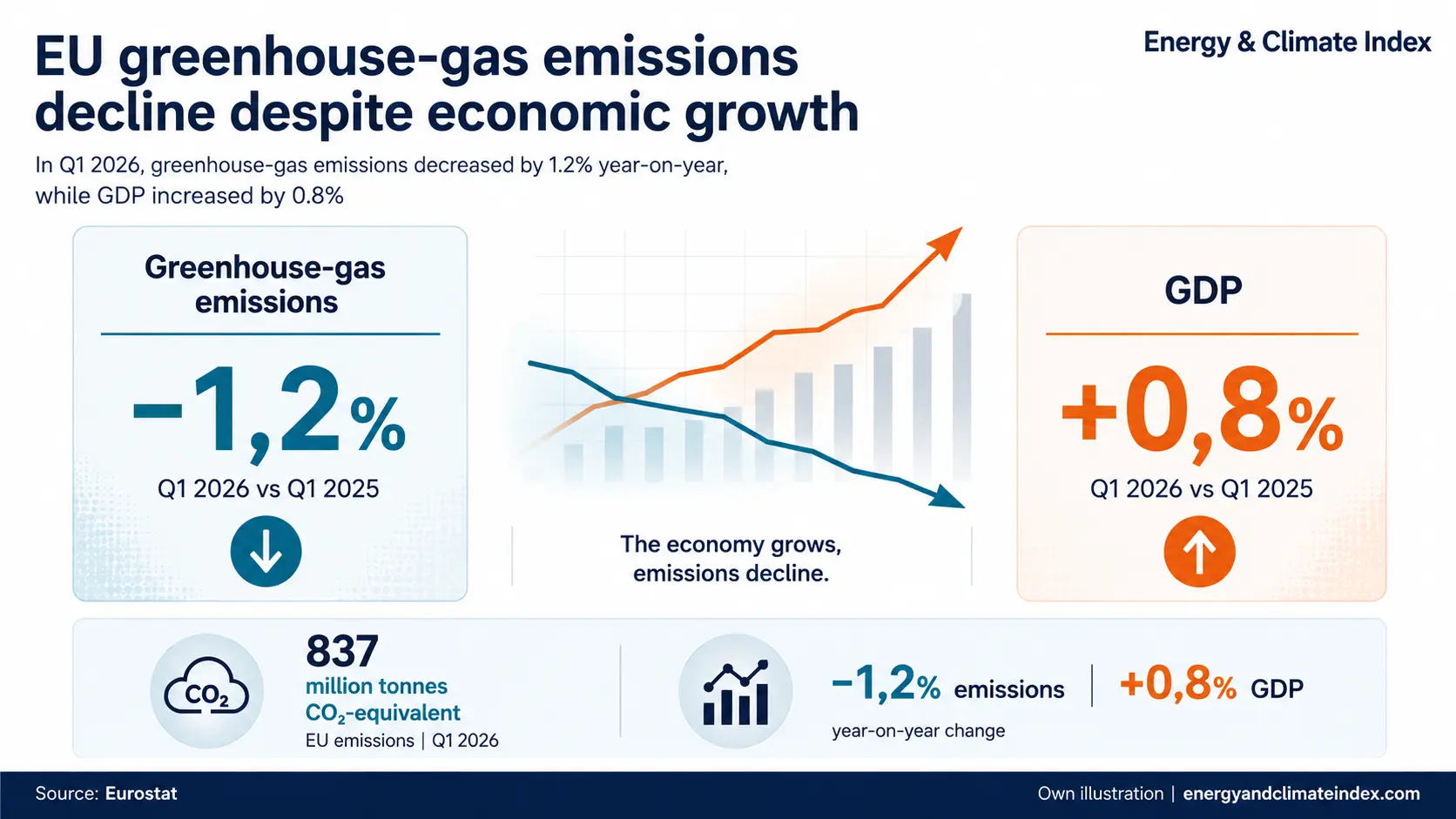
In the first quarter of 2026, greenhouse gas emissions were 1.2% lower than a year earlier, while the European Union’s GDP grew by 0.8%
The European Union recorded a year-on-year decline in greenhouse gas emissions in the first quarter of 2026 while its economy continued to grow. According to the latest Eurostat data, seasonally adjusted emissions were 1.2% lower than in Q1 2025, while EU GDP increased by 0.8%.
Total greenhouse gas emissions from the EU economy were estimated at 837 million tonnes of CO₂ equivalent in Q1 2026.
The short-term quarterly picture, however, was different. Compared with Q4 2025, emissions increased by 0.3%, from 835 million to 837 million tonnes of CO₂ equivalent, while EU GDP remained unchanged.


Energy sector records the largest quarterly increase in emissions
The largest quarter-on-quarter increase was recorded in the electricity, gas, steam and air conditioning supply sector, where emissions rose by 4.8%.
An increase of 0.7% was recorded in water supply, sewerage and waste management.
In the opposite direction, emissions from households decreased by 1.3%, while manufacturing, construction, and transportation and storage each recorded a decline of 0.6%.
In terms of the structure of total emissions in Q1 2026, manufacturing accounted for the largest share at 20.8%, followed by households at 20.2% and electricity, gas, steam and air conditioning supply at 16.5%.
Emissions increased in 20 of the EU’s 27 member states
Behind the relatively modest 0.3% increase at EU level were significant differences among individual member states.
In Q1 2026, compared with the previous quarter, greenhouse gas emissions increased in 20 of the 27 EU member states and decreased in seven.
The largest increases were recorded in Estonia, +9.7%, followed by Finland, +6.4%, and Bulgaria, +4.6%. According to Eurostat, the increases in these countries were largely driven by higher emissions from construction and from electricity, gas, steam and air conditioning supply.
At the other end of the ranking, Slovenia recorded the largest decline, at 5.0%, followed by Luxembourg at 3.8% and Romania at 2.7%.
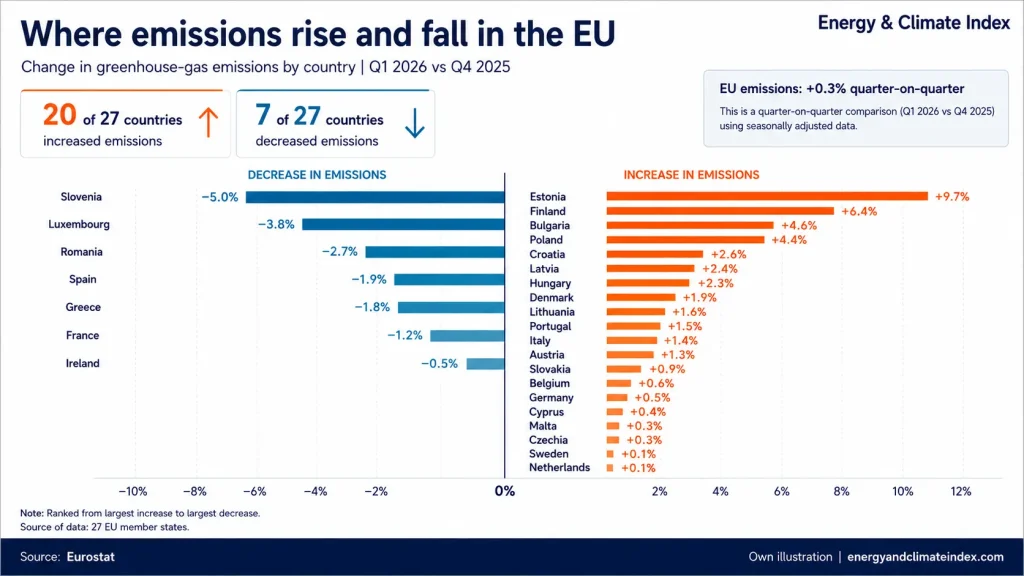
The data also show that emissions and economic activity did not move in the same direction across all member states. Of the 20 countries where emissions increased, 18 also recorded GDP growth.
Among the seven countries that reduced their emissions, four recorded either GDP growth or stable economic activity: Spain, Greece, France and Slovenia.
This divergence is important for interpreting the broader European trend. On a year-on-year basis, the EU simultaneously recorded a 1.2% decline in greenhouse gas emissions and 0.8% GDP growth. The quarter-on-quarter figures, however, show that progress in reducing emissions remains uneven across both economic sectors and member states.
Eurostat’s figures are seasonally adjusted quarterly estimates of greenhouse gas emissions by economic activity. They cover CO₂, methane, nitrous oxide and fluorinated gases, expressed in CO₂ equivalent.
ECI