

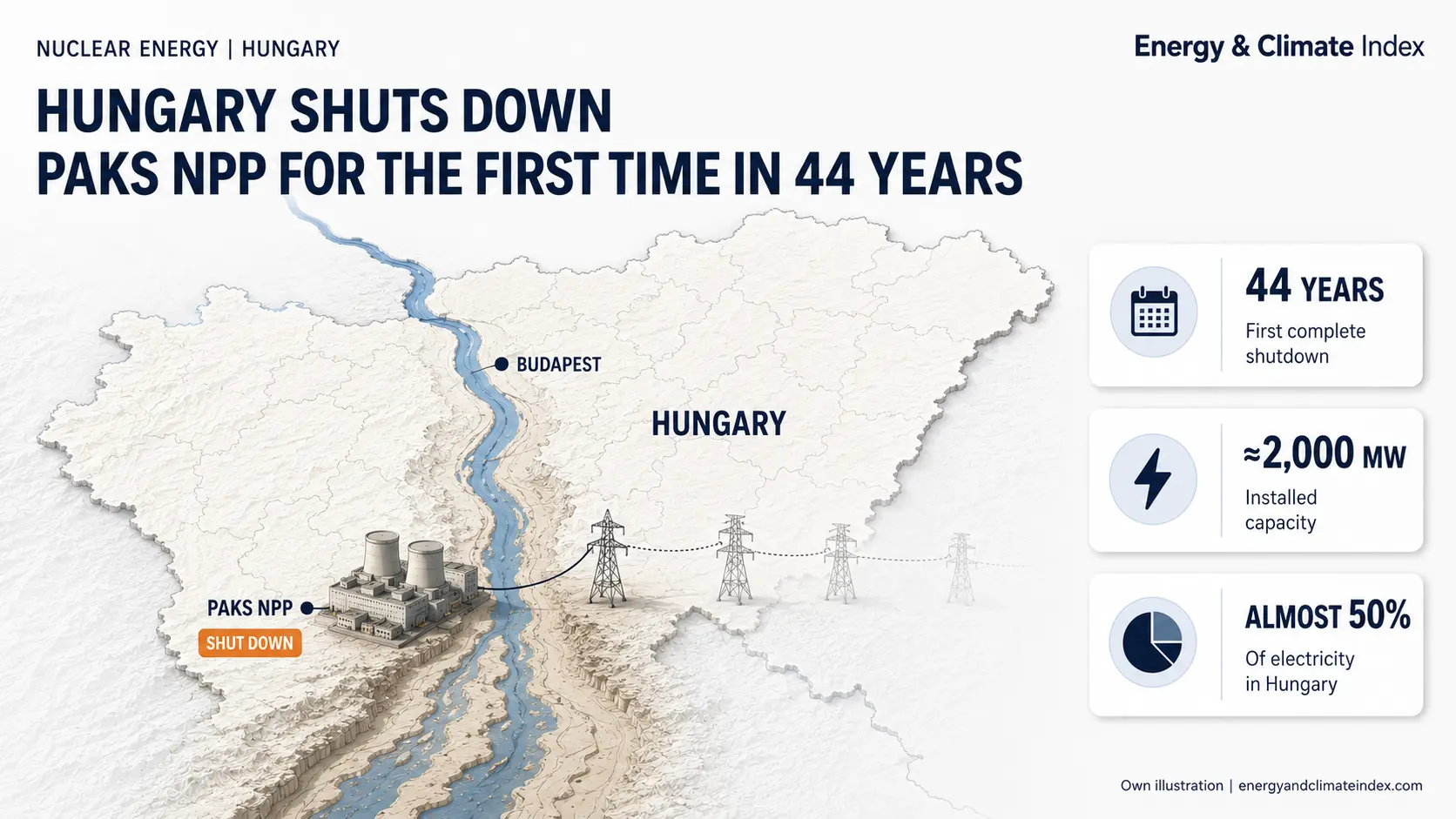
Hungary has begun the complete shutdown of the Paks Nuclear Power Plant for the first time in its 44-year operating history, after record-low water levels in the Danube made it impossible to secure sufficient cooling water for the reactors.
Prime Minister Péter Magyar said that, following the shutdown of another unit, output from the country’s only nuclear power plant would fall to just 240 MW before stopping completely. Paks has an installed capacity of approximately 2,000 MW and normally generates nearly half of Hungary’s electricity.
The complete shutdown could last for several weeks if the Danube continues to recede. Hungary would then have to cover the generation deficit through increased electricity imports, additional output from other domestic power plants and consumption reductions by major industrial users.


According to an estimate by Márk Radnai, vice-president of the Tisza Party, the energy crisis and more expensive electricity imports could cost Hungary between 100 billion and 200 billion forints, equivalent to approximately $315 million–$630 million. This is not an official estimate from the plant operator or the Hungarian Energy Ministry. The final cost will depend on the duration of the shutdown and wholesale electricity prices.
From 2,000 MW to just 240 MW
Paks operates four VVER-440 reactors commissioned between 1982 and 1987. Before the announced full shutdown, generation had already been reduced from approximately 2,000 MW to just 240 MW, or around 12% of the plant’s total capacity.
When operating at full capacity, the plant can theoretically generate approximately 48 GWh of electricity per day. Every full day of lost production therefore creates a substantial deficit that must be covered by other sources.
The plant is located on the Danube, approximately 90 kilometres south of Budapest, and uses river water to cool its reactors. With the river at a historic low, the pumps are finding it increasingly difficult to draw enough water to maintain safe operations.
The Danube at Paks had fallen to approximately 121 centimetres below the reference level and forecasts indicated that it could decline further. Without significant rainfall, the power plant could remain offline for several weeks.
How much could the shutdown cost Hungary?
The largest direct financial burden will come from replacing lost domestic generation with imported electricity, potentially at significantly higher market prices.
The estimated cost of 100 billion–200 billion forints, or $315 million–$630 million, will depend on several factors:
- how long Paks remains offline;
- how much of the lost generation is replaced by imports;
- the price Hungary pays for imported electricity;
- whether other domestic power plants can increase production;
- how much demand reduction industry and households can deliver.
The heatwave is increasing the financial risk by simultaneously raising demand for cooling and reducing output from power plants that depend on river water.
The situation has been further complicated by a malfunction at the gas-fired Dunamenti Power Plant, which temporarily removed another 400 MW from the system. Although work is under way to bring the plant back online, the simultaneous loss of nuclear and gas-fired capacity has significantly reduced Hungary’s operational reserve.
What options does Hungary have?
The first option is a substantial increase in electricity imports. Hungary has approximately 3.6–3.8 GW of cross-border transmission capacity, theoretically enough to replace most of the generation lost through the Paks shutdown.
Physical import capacity, however, is not the same as a guaranteed supply of electricity. Hungary can import power only if neighbouring markets have sufficient generation, available cross-border capacity and the ability to export.
This distinction is particularly important because the low level of the Danube is not affecting Hungary alone. Romania is also experiencing reductions in nuclear generation, while hydropower plants and river transport are under pressure across several countries in the region. If the crisis spreads, several countries could simultaneously seek additional electricity from the same regional market.
The second option is to activate or increase generation at other domestic power plants, including bringing Dunamenti back online. This could, however, increase natural gas consumption and electricity-generation costs.
The third option is demand management. The Hungarian authorities have already asked major industrial consumers to reduce their electricity use. An initial reduction of 240 MW has been agreed, but voluntary measures could become mandatory if the shortage continues.
Additional options include using system reserves, reducing consumption during peak-demand hours and securing regional assistance from neighbouring electricity systems.
Climate resilience is becoming part of energy security
Nuclear power plants, like many thermal power plants, depend on reliable access to cooling water. Prolonged droughts, low water levels and elevated river temperatures can restrict their output or force them to shut down completely.
The crisis also demonstrates the systemic risk created by dependence on a single generating source that supplies nearly half of a country’s electricity.
The complete shutdown of Paks after 44 years shows that the energy transition is not solely about cutting emissions. It must also create an electricity system capable of withstanding droughts, heatwaves, water shortages and the sudden loss of major generating assets.
ECI