

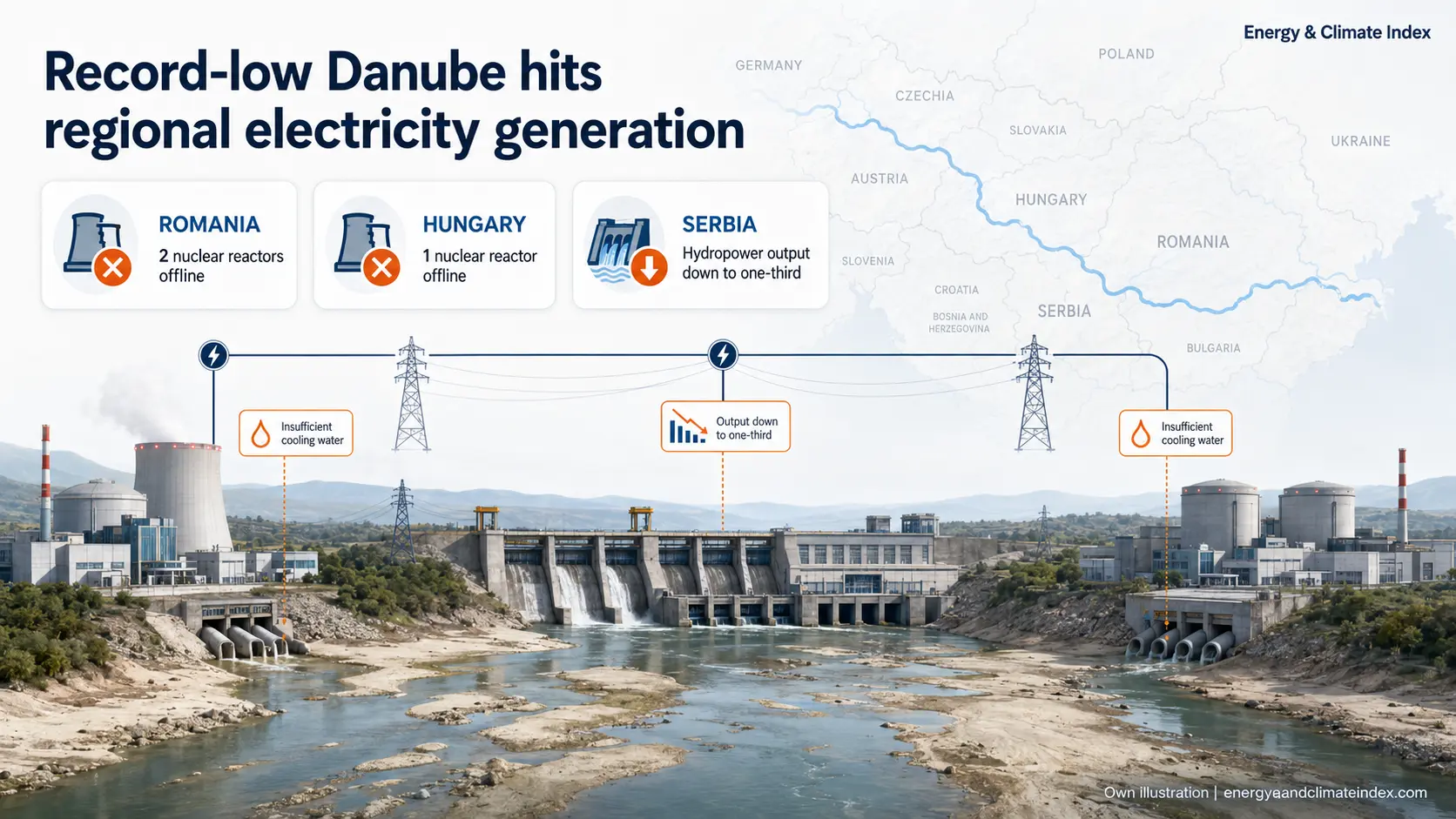
Record-low water levels in the Danube have caused serious disruptions to electricity generation in Romania, Hungary and Serbia. Nuclear reactors have been shut down in Romania and Hungary, while Serbia’s largest hydropower plant has reduced its output to around one-third of its usual level.
Prolonged drought and heatwaves have sharply reduced the river’s flow. The Danube plays a crucial role not only in hydropower generation but also in supplying cooling water to nuclear and thermal power plants along its course.
Romania shuts down both Cernavodă reactors
Romania’s state-owned nuclear power producer Nuclearelectrica has shut down both reactors at the Cernavodă nuclear power plant because of the exceptionally low water level of the Danube.


Unit 1 was disconnected from the national power system on 28 July in line with procedures applicable during periods of severe drought. A subsequent decision was made to shut down Unit 2 as well.
This is the first time that both reactors have been taken offline simultaneously because of insufficient water availability. Each reactor has a capacity of 706 MW, while the plant normally accounts for around one-fifth of Romania’s electricity generation.
On 28 July, the Danube’s flow at its entry point into Romania had fallen to approximately 1,650 cubic metres per second, compared with a July average of around 4,750 cubic metres per second.
The loss of nuclear generation is expected to increase Romania’s reliance on electricity imports at a time when high temperatures are also driving higher demand for cooling.
Hungary shuts down a reactor at Paks
The low water level has also affected Hungary’s Paks nuclear power plant, which uses water from the Danube for cooling.
Operator MVM shut down one of the plant’s four reactors after output had already been reduced at other units. As a result, the plant’s total electricity production fell to approximately 60% of available capacity.
Paks has four reactors with a combined capacity of around 2 GW and normally generates almost half of Hungary’s electricity.
Additional pontoons, pumps and floating cranes have been deployed near the plant to help maintain the cooling-water supply. However, a further decline in the Danube’s water level could require additional output reductions or even a temporary shutdown of the entire plant.
Đerdap 1 output falls to one-third of its average level
In Serbia, no power plant has been completely shut down because of the low water level. However, the extremely weak flow of the Danube has sharply reduced production at the Đerdap 1 hydropower plant.
According to Dušan Živković, CEO of the state-owned power utility Elektroprivreda Srbije – EPS, the plant is currently producing around 5,000 MWh per day, equivalent to only one-third of its average daily output.
In May and June 2026, Đerdap 1 recorded its lowest production for those months since the plant was commissioned in 1970. Jointly operated by Serbia and Romania, the hydropower plant has a total installed capacity of 1,140 MW.
The shortage of water has also affected the Kostolac coal-fired power plants, where reduced water availability has constrained cooling systems and lowered electricity output.
At the same time, the low river level has disrupted the transport of fuels and other energy commodities. Barges and tankers have been forced to operate at only 30% to 40% of their normal cargo capacity.
Drought emerges as a regional energy risk
The situation shows that low river levels are not a challenge only for hydropower generation. Nuclear and thermal power plants also depend on rivers for cooling, while inland waterways are essential for transporting coal, oil and other energy commodities.
Across Romania, Hungary and Serbia, reduced domestic electricity generation is coinciding with higher demand caused by extreme temperatures. The combination could increase cross-border electricity imports and place additional pressure on regional wholesale prices.
Contrary to some media headlines, power plants were not completely shut down in all three countries. Nuclear reactors were taken offline in Romania and Hungary, while Serbia recorded substantial reductions in hydropower and thermal generation rather than a complete shutdown.
ECI