


Every time gas prices rise sharply, parts of European industry come under serious pressure. The gas crisis of 2022 led to factory shutdowns, production relocation and long-term consequences for energy-intensive sectors. New geopolitical tensions have further demonstrated how exposed industry remains to fuels over which it has limited control.
The usual response to such crises is to look for more gas. But according to Jan Rosenow, there is a better answer: faster and more systematic industrial electrification.
In his article, Rosenow refers to the new analysis and report “High Voltage”, which he co-authored with Cassandra Etter-Wenzel. The central question of the report is simple but crucial: how much of industrial energy demand can realistically run on electricity?


The potential is greater than previous expectations
Industry accounts for around 29% of global CO₂ emissions, mainly due to the combustion of fossil fuels for heat. This is why the sector has long been described as “hard-to-abate”. But Rosenow warns that this label too often becomes an excuse for delay.
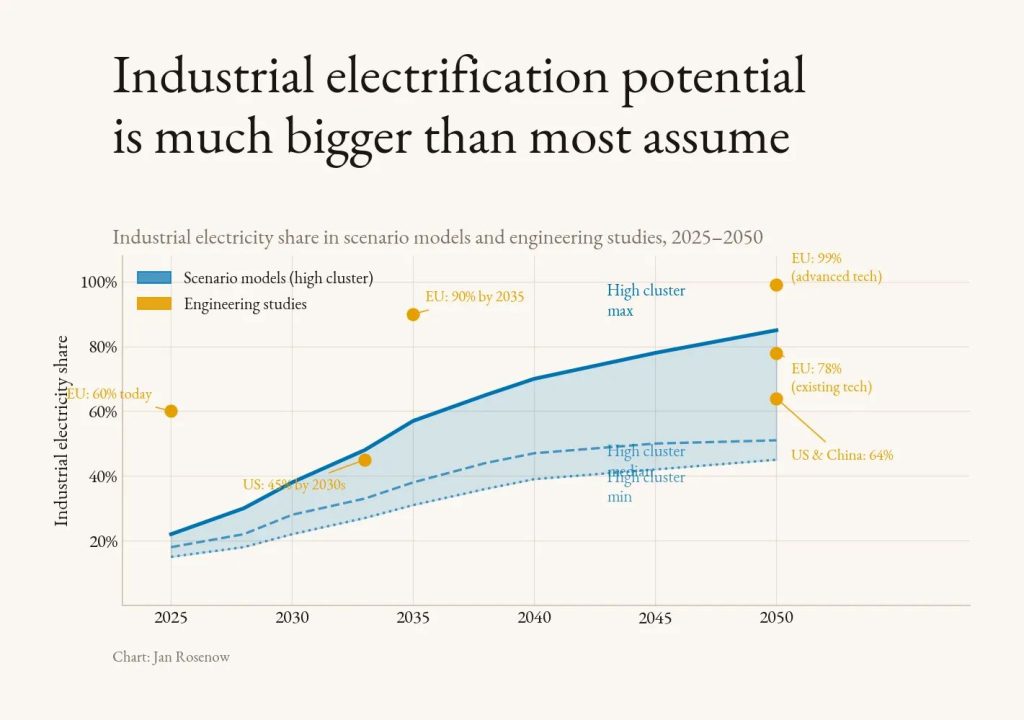
Rather than building yet another model, the “High Voltage” analysis synthesises the best existing knowledge. It combines a meta-review of bottom-up engineering studies with a systematic analysis of 1,600 global emissions reduction scenarios, examining how much industrial energy could come from electricity.
The conclusion is significant: today, electricity covers only around one fifth of final industrial energy consumption. Across all analysed scenarios, this share rises to around 35% by 2050. But in scenarios with strong climate ambition, rapid decarbonisation of the power sector and supportive industrial policy, electrification reaches a median level of 51% by 2050, while the upper range goes as high as 85%.
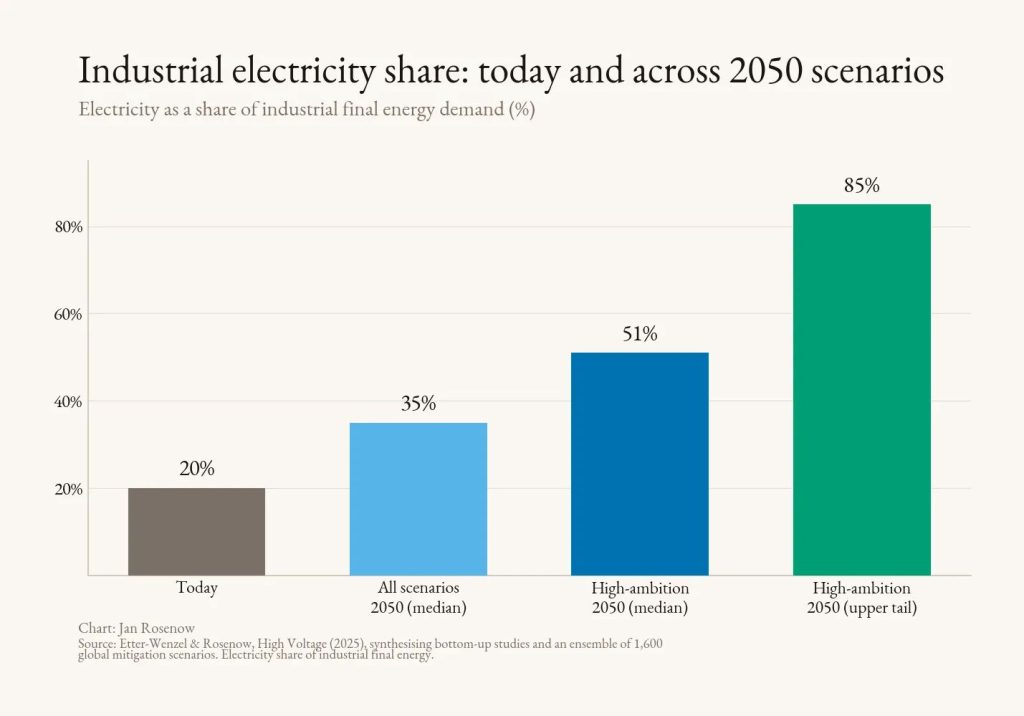
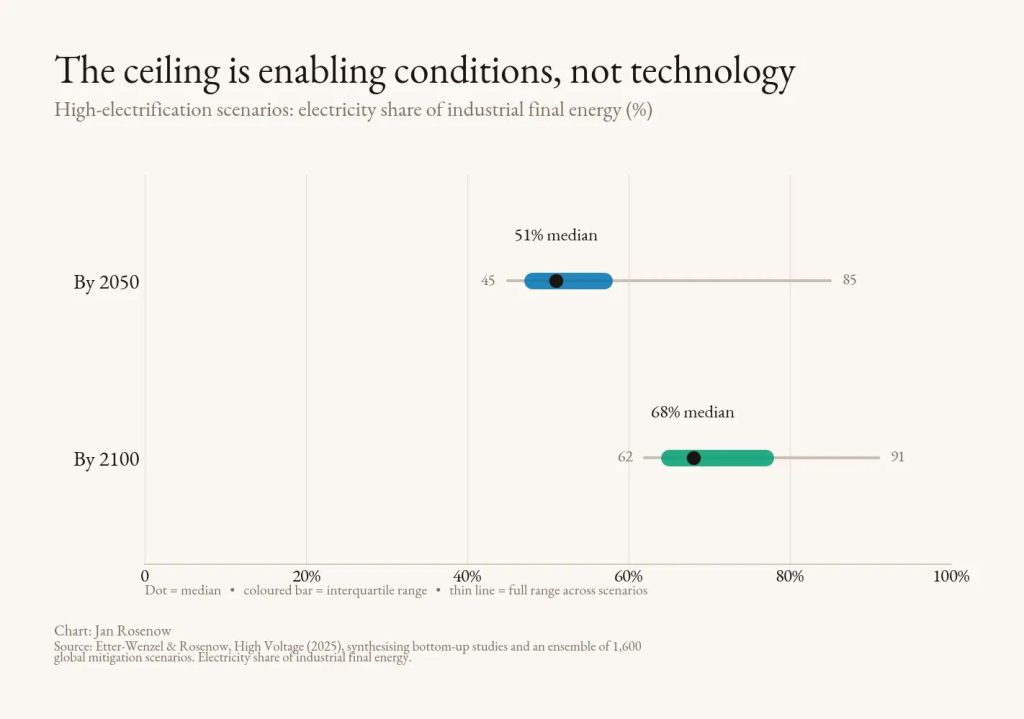
Looking further ahead to 2100, high-electrification pathways cluster around 68–70%, while some scenarios approach almost full electrification of industry.
This is Rosenow’s central message: the limitation is not a technical ceiling. The difference between low and high pathways is not determined by physics, but by the conditions created by policy, infrastructure, prices and investment certainty.
Policies are decisive
The most important number in the analysis is not one specific percentage. More important is why there is such a large gap between low and high electrification scenarios.
High-electrification pathways are consistently linked to several common conditions: early and large-scale infrastructure investment, access to clean electricity and policies that provide a clear long-term signal to industry.
In other words, the difference between an industry that remains only partially electrified and an industry that moves towards high levels of electrification is not technology. It is the decisions made in this decade.
According to Rosenow, electrification is not a marginal climate measure. It is a structural mechanism for reducing dependence on fossil fuels and cutting emissions. When an industrial gas boiler is replaced by a heat pump, emissions fall immediately, and then continue to decline as the electricity system becomes cleaner.
The technologies already exist
One of the most important points in the article is that many of the required technologies are not prototypes. Industrial heat pumps, electric boilers, electro-thermal storage and resistance heating can already replace a large share of low- and medium-temperature industrial heat.
This does not mean that the entire industrial sector can be easily electrified. Steel, cement and chemicals require very high temperatures and changes in the production process itself. But even there, technologies such as plasma, induction heating and other electric solutions for very high temperatures are emerging.
At the same time, Rosenow points out that real constraints remain. Industrial assets are long-lived and capital-intensive, and companies are cautious when investing in new equipment under uncertain future energy prices and uncertain carbon policy.
In addition, in sectors such as pulp and paper or refining, electrification does not only mean replacing a fuel. It may also mean losing on-site energy production that currently helps companies reduce operating costs. These are real barriers, but according to Rosenow they are reasons for carefully designed policy, not reasons to wait.
The main barrier is price, not technology
The most common obstacle is not whether electric technology works. The obstacle is that using electricity is often more expensive than burning gas, because of the way taxes, levies and tariffs are structured.
This creates the wrong economic signal. Industry is encouraged to continue using gas, even though electric technologies can be more efficient, cleaner and less exposed to international price shocks.
That is why the report sets out a short list of immediate priorities. First, electricity should become a more reliable and stable option by removing charges that disproportionately burden power consumption. Second, the deployment of technologies that already work should be scaled up through auctions, contracts for difference, operating grants and clean heat premiums. Third, faster grid connections and faster permitting are needed, because a project that cannot get a grid connection cannot be delivered in practice.
In addition, first movers should be protected through accelerated depreciation, tax credits and concessional finance. Public procurement and industrial clusters can help create stable demand, allowing the first projects to grow into a larger market.
Heat pumps are the most competitive clean option
In the section on economics, Rosenow refers to research comparing the costs of different clean solutions for low- and medium-temperature industrial heat: high-temperature heat pumps, electric boilers, hydrogen boilers and biomass boilers.
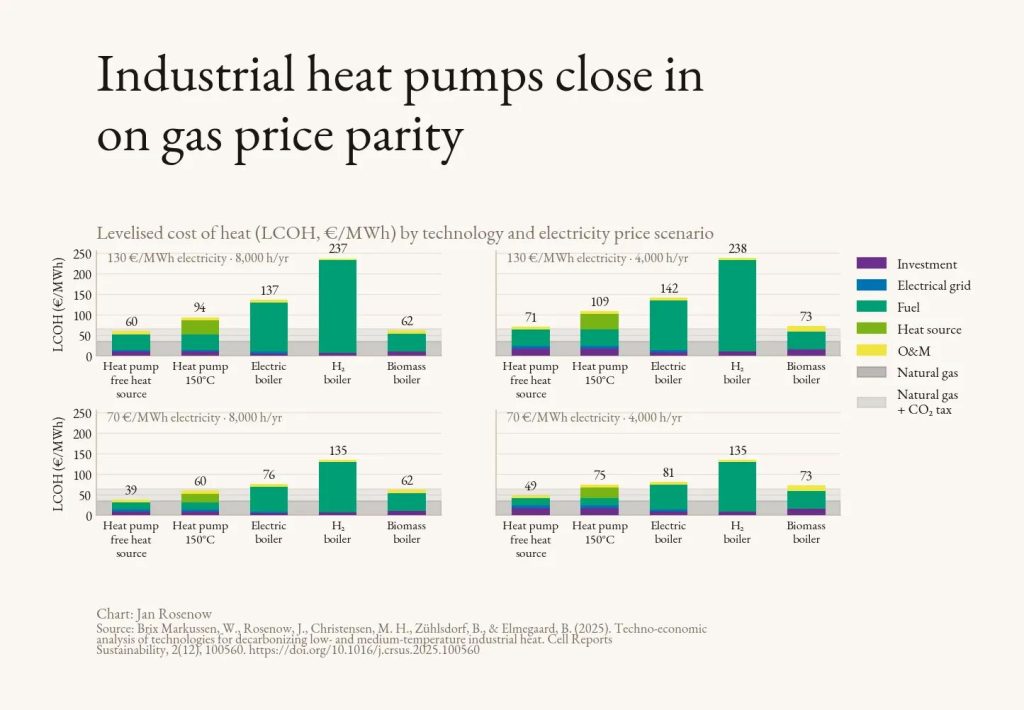
The conclusion is important: high-temperature heat pumps emerge as the cheapest clean option. When combined with thermal storage, the cost of heat can be reduced by up to 15%, because the system can operate during periods when electricity is cheaper.
By contrast, hydrogen boilers remain significantly more expensive, even under optimistic assumptions. This is an important message for industrial policy: where direct electrification is possible, it is usually a more efficient and more economical pathway than using hydrogen.
The European Union is already opening the door
Rosenow notes that the European Union has already taken an important first step through the world’s first auction dedicated to the electrification of industrial heat. This is the industrial heat auction under the EU Innovation Fund.
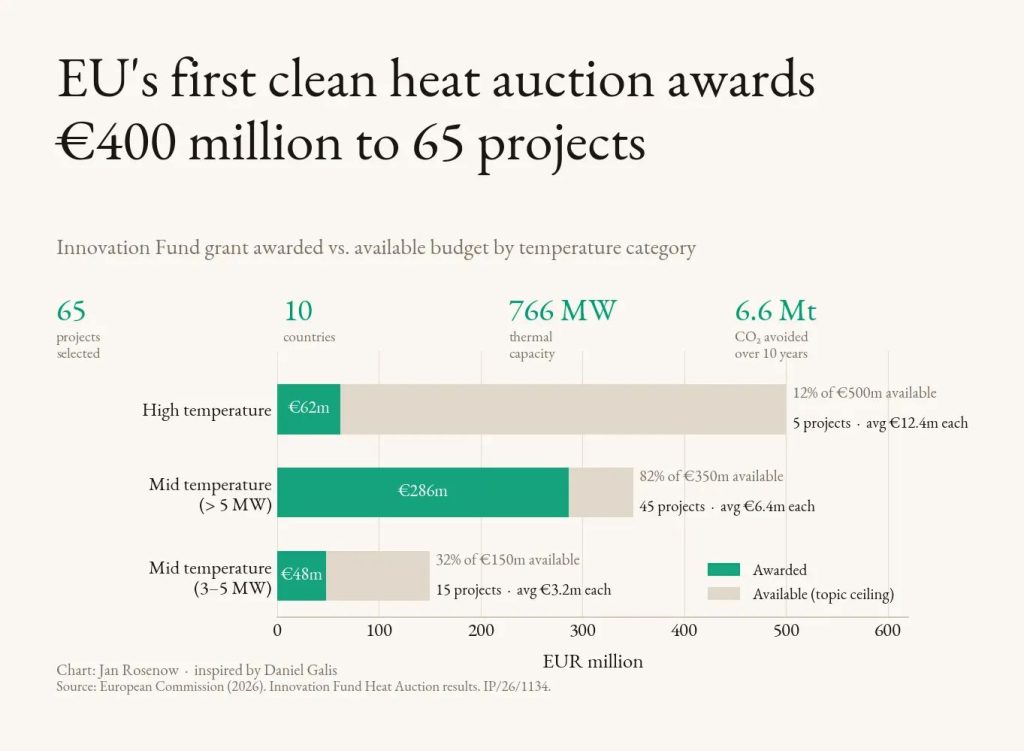
The €1 billion pilot auction, launched in December 2025, attracted 85 applications requesting almost €10 billion in support. In the end, around €400 million was awarded to 65 projects in ten countries. The European Commission has confirmed a second round in 2026, again with a budget of €1 billion.
According to Rosenow, the signal is as important as the money itself. Industrial investments are long-term and capital-intensive. Companies are not looking only for one-off support, but for predictability that such instruments will continue in the future.
An important detail is that the pilot auction covered the full temperature range, with a separate high-temperature category above 400°C. Eligible technologies included heat pumps, induction heating, resistance heating and plasma technologies. This means that, according to Rosenow, electrified process heat is no longer a niche in climate policy, but is becoming part of the core of European industrial policy.
Why this matters for industry
The central message of the article is that the long-term answer to fossil fuel instability is not more gas imports, but lower dependence on internationally traded fuels and greater use of electricity that can be produced domestically from solar and wind.
Every factory that electrifies becomes less exposed to the next price shock. This changes the framing of the debate: industrial electrification should not be seen as “too difficult”, but as a question of why we are waiting so long.
Source
Jan Rosenow, „Industry: from hard-to-abate to ready-to-electrify“, Bright Spots, Substack, 31 мај 2026 година.