

Serbia’s Ministry of Mining and Energy has issued a public call for expressions of interest for the selection of a supplier that will act as a partner in the implementation of the pumped storage hydropower plant Đerdap 3. The project has been identified as strategically important for Serbia’s energy security, the stability of the power system, and the integration of large-capacity renewable energy sources.
Serbia’s Ministry of Mining and Energy has issued a public call for expressions of interest for participation in the procedure for selecting a supplier that will be the partner in the implementation of the project Pumped Storage Hydropower Plant Đerdap 3, also known as the reversible hydropower plant Đerdap 3.
The call was issued on the basis of the Agreement between the Government of Serbia and the Government of the United States of America on strategic cooperation in the field of energy in Serbia, which entered into force on March 28, 2025.


According to the call, it is intended for interested companies from the United States of America, which are invited to express interest in participating in the procedure for selecting a supplier for the implementation of the project.
A Project of Strategic Importance for Serbia
The call states that Serbia has identified the PSHPP Đerdap 3 project as strategically important for the country’s energy security, the stability of the power system, and the integration of large-capacity renewable energy sources.
It is a complex pumped storage hydropower system designed to provide flexibility and stability to the power system by storing electricity during periods of low consumption and returning it to the system during periods of increased consumption.
In other words, Đerdap 3 is not only a new generation facility, but a major infrastructure project for electricity storage and system management. Such capacities are becoming increasingly important in power systems with a growing share of photovoltaic power plants and wind power plants.
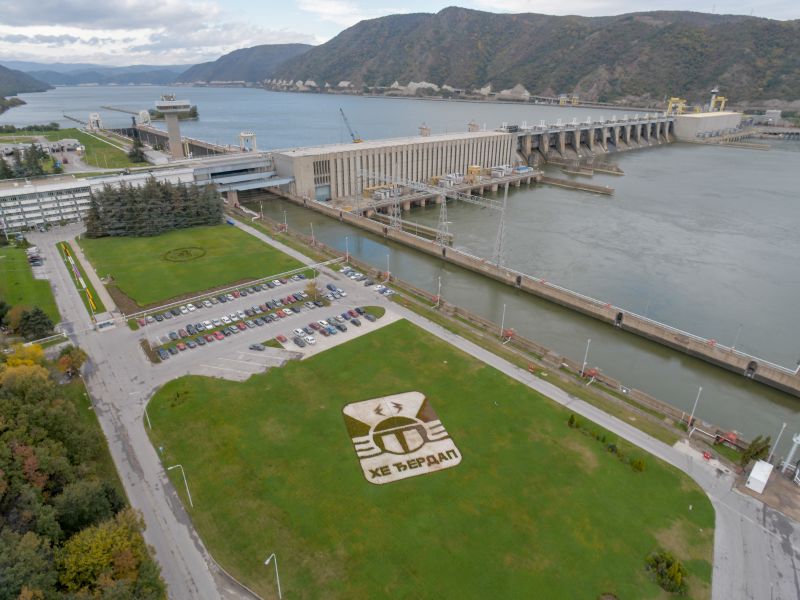
Located on the Danube, Upstream of Đerdap 1
The project is planned in eastern Serbia, upstream of the existing Đerdap 1 hydropower plant, on a section of the Danube River that forms the state border with Romania.
According to the description in the public call, Đerdap 3 is conceived as an open system that will connect the Danube River with one or more upper reservoirs located in the Northern Kučaj mountain massif, on the right bank of the river.
The main elements of the project are expected to include the upper reservoirs Pesača and Brodica, dams and associated hydraulic structures, a system of tunnels for water intake and discharge, an underground or surface powerhouse with pump-turbine units, as well as accompanying electromechanical, hydromechanical and power infrastructure, including connection to the transmission system.
Final Capacity to Be Defined in the Next Phase
The call states that the project was initially considered with several variants of installed capacity and operating regimes, including daily and seasonal energy storage. The final configuration, number of units, installed capacity and size of reservoirs will be defined in the next phase of development, through the preparation of a feasibility study and initial engineering documentation.
This is an important part of the call, as it shows that Serbia is not selecting only a construction contractor at this stage, but a partner that will participate in the engineering design, technical optimization and preparation of the project for implementation.
This is precisely why Đerdap 3 is treated as an energy megaproject. Earlier technical considerations for the project mentioned solutions with a capacity of up to 2,400 MW, which would place Đerdap 3 among the largest pumped storage hydropower projects in the region. In more recent considerations, according to publicly available information, variants of 1,400 MW, 1,800 MW and 2,400 MW have also been mentioned, with the smaller variant having national significance, the medium one regional significance, and the largest one having a wider regional impact on the power system.
First Phase of the Procedure
The call represents the first phase of the procedure. Companies that submit a letter of interest and meet the required conditions will form a pool of economic operators, which will then receive an invitation to participate in the next phase of the procedure.
Interested companies are required to demonstrate relevant experience in the implementation of hydropower or related energy infrastructure projects over the past 15 years, including management of the initial engineering documentation phase and delivery of works under the engineering, procurement and construction model.
The call states that such experience should relate to projects which, in terms of scope and complexity, correspond to the subject of the procedure, with an investment value exceeding one billion euros.
Deadline for Submitting Interest: June 25
Letters of interest should be submitted to Serbia’s Ministry of Mining and Energy no later than June 25, 2026. Questions related to the call may be submitted until June 19, 2026.
After the deadline expires, the Government Working Group is expected to review the submitted letters, form a list of companies that submitted their interest on time and meet the conditions, and then send them an invitation with the Terms of Reference for participation in the next phase.
Đerdap 3 as a Test for the Next Phase of the Energy Transition
PSHPP Đerdap 3 is an example of the next phase in the development of power systems in the region. With the growth of electricity generation from photovoltaic power plants and wind power plants, capacities that can store energy, provide flexibility and support grid stability are becoming increasingly important.
The importance of Đerdap 3 therefore lies not only in the new installed capacity that is yet to be determined, but in its system role. The project should help Serbia achieve greater security of supply, better balancing and more space for the integration of renewable energy sources.
For the Western Balkans, this is a clear signal that the energy transition is no longer only about building new generation capacities. The next step requires major investments in storage, flexibility, transmission infrastructure and better management of the power system.
Editorial Office