

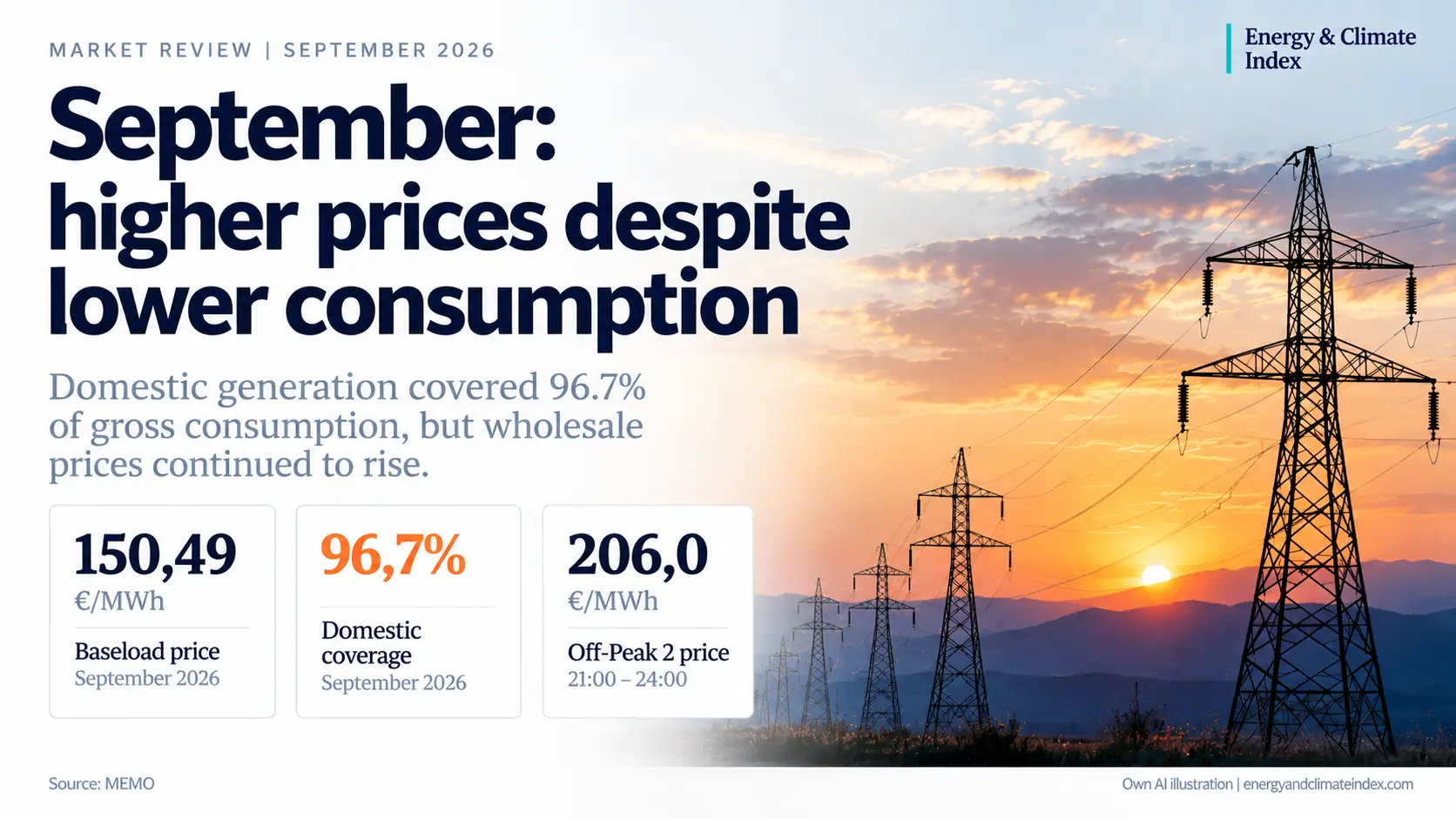
North Macedonia’s electricity market in September showed that a high level of domestic generation coverage does not guarantee lower prices. While generation and consumption declined, wholesale electricity prices continued to rise, with the strongest price pressure concentrated in the evening hours.
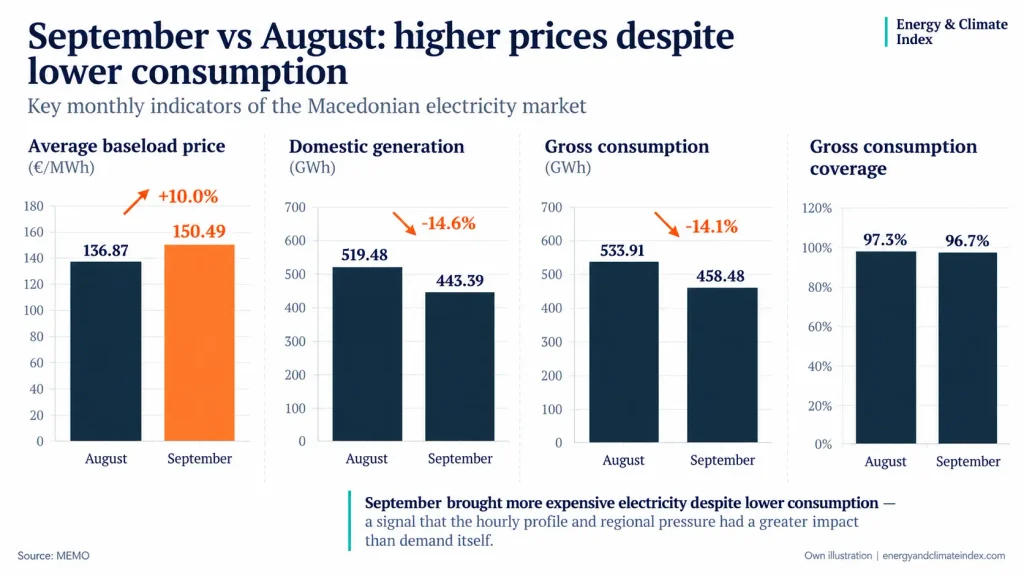
September 2026 brought an interesting shift in North Macedonia’s electricity market. Following an expensive August, lower consumption and the gradual end of the summer season were expected to create conditions for price moderation. However, wholesale electricity prices continued to rise, even as the domestic electricity system generated and consumed significantly less electricity.
According to data from the national electricity market operator MEMO, the average baseload price reached €150.49/MWh in September, while domestic generation covered 96.7% of gross electricity consumption, including transmission and distribution network losses.


This development raises the central question of the monthly analysis: why did electricity prices increase when demand declined and domestic generation covered almost all electricity needs?
Domestic generation covered nearly 97% of gross electricity consumption
The electricity balance remained relatively favourable in September. Domestic generation amounted to approximately 443 GWh, compared with gross electricity consumption of 458 GWh.
This means that domestic generation covered 96.7% of total electricity needs, slightly below August’s coverage of 97.3%.
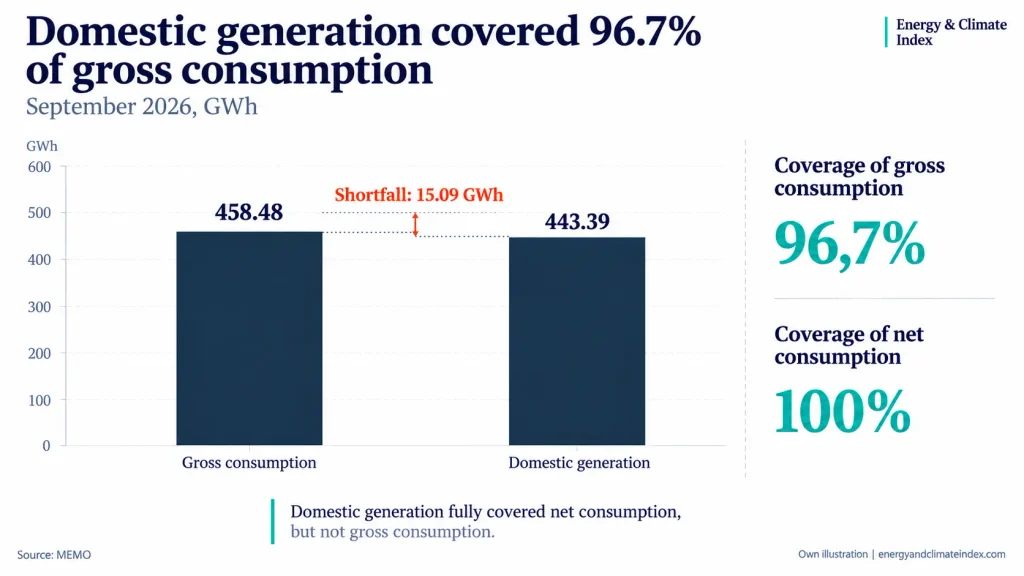
This is an important indicator of domestic generation capacity, but also of the system’s limitations. North Macedonia had sufficient domestic generation to meet almost all monthly electricity requirements, but it did not achieve full coverage once network losses were included.
Furthermore, monthly generation coverage should not be equated with hourly self-sufficiency. During the day, there may be periods of surplus generation, alongside hours when the system requires additional electricity from regional markets.
This distinction between overall generation coverage and hourly availability is becoming increasingly important for understanding electricity prices on the Macedonian exchange.
ESM remains the largest producer, but the market structure is changing
The structure of domestic electricity generation shows that ESM remains the largest individual producer, although it no longer accounts for the majority of electricity generated.
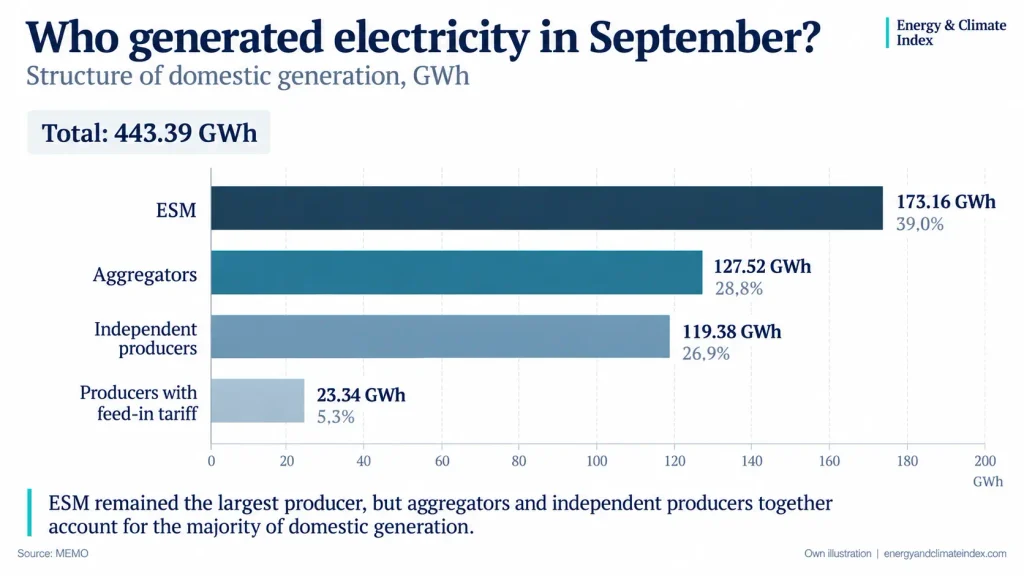
Independent producers and aggregators together now account for more than half of domestic generation. Their role is becoming increasingly significant as renewable energy capacity expands, particularly photovoltaic power plants.
This development indicates that North Macedonia’s electricity system is gradually moving away from a model dominated by state-owned generation towards a more diversified generation structure.
However, a larger number of producers does not automatically guarantee greater flexibility. A significant share of new generation depends on weather conditions and is concentrated in specific hours. As renewable energy expands, electricity storage, demand-side management and the availability of generation facilities capable of responding quickly become increasingly important.
In September, generation from ESM, independent producers and aggregators was lower than in August. This indicates that the decline in domestic electricity generation was not limited to a single category of market participants.
Evening hours remained the most expensive
The most distinctive feature of September’s electricity market was its hourly price structure.
While the average price during the daytime peakload period was approximately €121/MWh, the evening price reached €206/MWh. This substantial difference shows that price pressure was strongest outside the conventional daytime peak period.
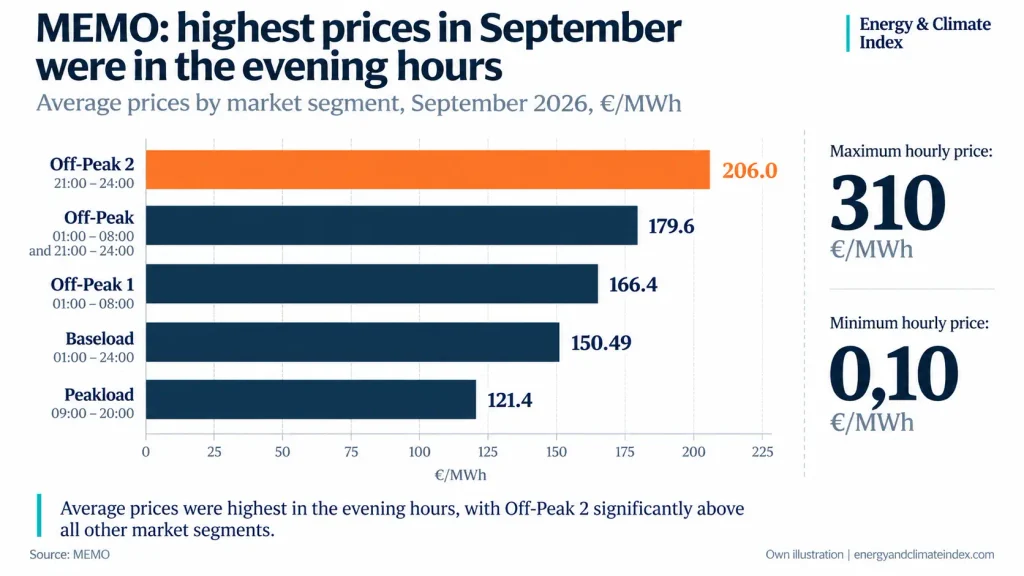
During sunny hours, greater electricity supply can reduce market prices. However, as generation from photovoltaic power plants declines, the system must rely on other generation facilities and regional electricity trading.
This creates conditions for higher evening prices, particularly when hydropower plants and other flexible generation sources have limited availability.
The increase in electricity prices on the Macedonian exchange in September occurred alongside rising prices in neighbouring markets. Greece, Bulgaria and Serbia recorded higher average prices compared with August, with stronger increases in Greece and Bulgaria. This demonstrates that higher prices on MEMO cannot be explained solely by domestic generation and consumption. Regional price pressure, together with declining solar generation and the need for more expensive electricity during evening hours, formed an important part of September’s market dynamics.
What MEMO data clearly demonstrates is that the value of electricity increasingly depends on the hour in which it is available, rather than simply on the total quantity generated.
Renewable energy: Wind dominated among feed-in tariff producers
Among renewable energy producers operating under feed-in tariffs, wind power plants made by far the largest contribution in September.
Wind farms accounted for almost two-thirds of total generation in this category, while the remainder came from small hydropower plants, biogas and biomass facilities, and photovoltaic power plants.
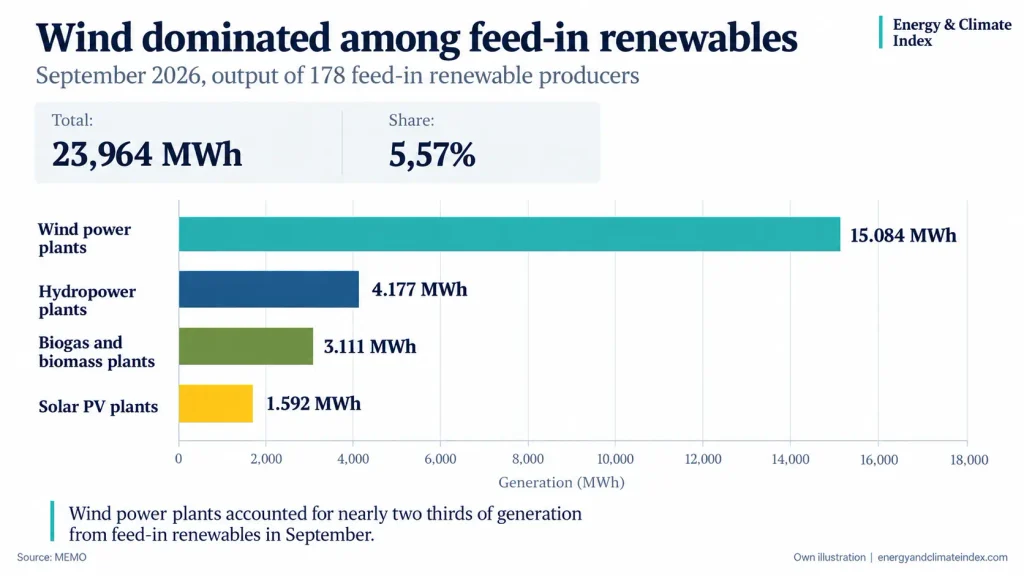
It is important to emphasise that this does not represent total renewable electricity generation in North Macedonia. Data for feed-in tariff producers does not capture all generation from photovoltaic and hydropower plants operating on the electricity market.
Nevertheless, these figures further highlight the importance of analysing the generation mix by technology and availability throughout the day. Renewable electricity contributes to domestic generation coverage, but not every megawatt-hour generated has the same market value at different times of the day.
What does September indicate for the coming period?
September demonstrated that North Macedonia’s electricity market is entering a period in which hourly flexibility is becoming just as important as domestic generation coverage.
It is encouraging that domestic generation provides almost full coverage of gross electricity consumption. At the same time, the growing contribution of independent producers and aggregators indicates a gradual transformation of the market structure.
However, high evening prices also demonstrate the need for better alignment between electricity generation and consumption. This is where battery energy storage systems, pumped-storage hydropower plants and other flexible generation capacities could play a greater economic role.
Nevertheless, investment decisions will depend on whether hourly price spreads remain sufficiently high and predictable to support sustainable revenues.
What can be expected in October, November and December?
With the end of the summer season, North Macedonia’s electricity system is entering a period characterised by changing generation and consumption patterns. Shorter daylight hours and lower generation from photovoltaic power plants, combined with an expected increase in electricity consumption due to falling temperatures, will place additional pressure on domestic generation coverage.
Therefore, a decline in the share of gross electricity consumption covered by domestic generation can reasonably be expected in October, November and particularly December, unless lower photovoltaic generation and higher electricity demand are offset by other domestic generation facilities.
The key question for the final quarter will be whether ESM can increase output from its thermal power plants, what contribution the gas-fired TE-TO power plant will make, and how much electricity hydropower plants can deliver depending on hydrological conditions. If domestic generation cannot meet higher electricity demand, the shortfall will have to be covered through imports.
This is particularly important because September demonstrated that wholesale electricity prices can remain high even when domestic generation covers a substantial share of electricity consumption. In the coming months, alongside the availability of domestic generation facilities, regional electricity prices, natural gas prices and weather conditions will play an important role.
Conclusion
September ended with domestic electricity generation covering 96.7% of gross electricity consumption, but with higher wholesale prices than in August. This demonstrates that a high level of monthly domestic generation coverage is not, by itself, sufficient to ensure lower electricity prices.
The main test for North Macedonia’s electricity system is still ahead. During the final three months of the year, the key issue will be whether reduced photovoltaic generation and rising electricity consumption can be offset by increased domestic thermal power generation, contributions from TE-TO and hydropower plants, or whether greater electricity imports will be required.
This combination will determine the extent to which domestic generation can cover gross electricity consumption through the end of the year.
ECI