

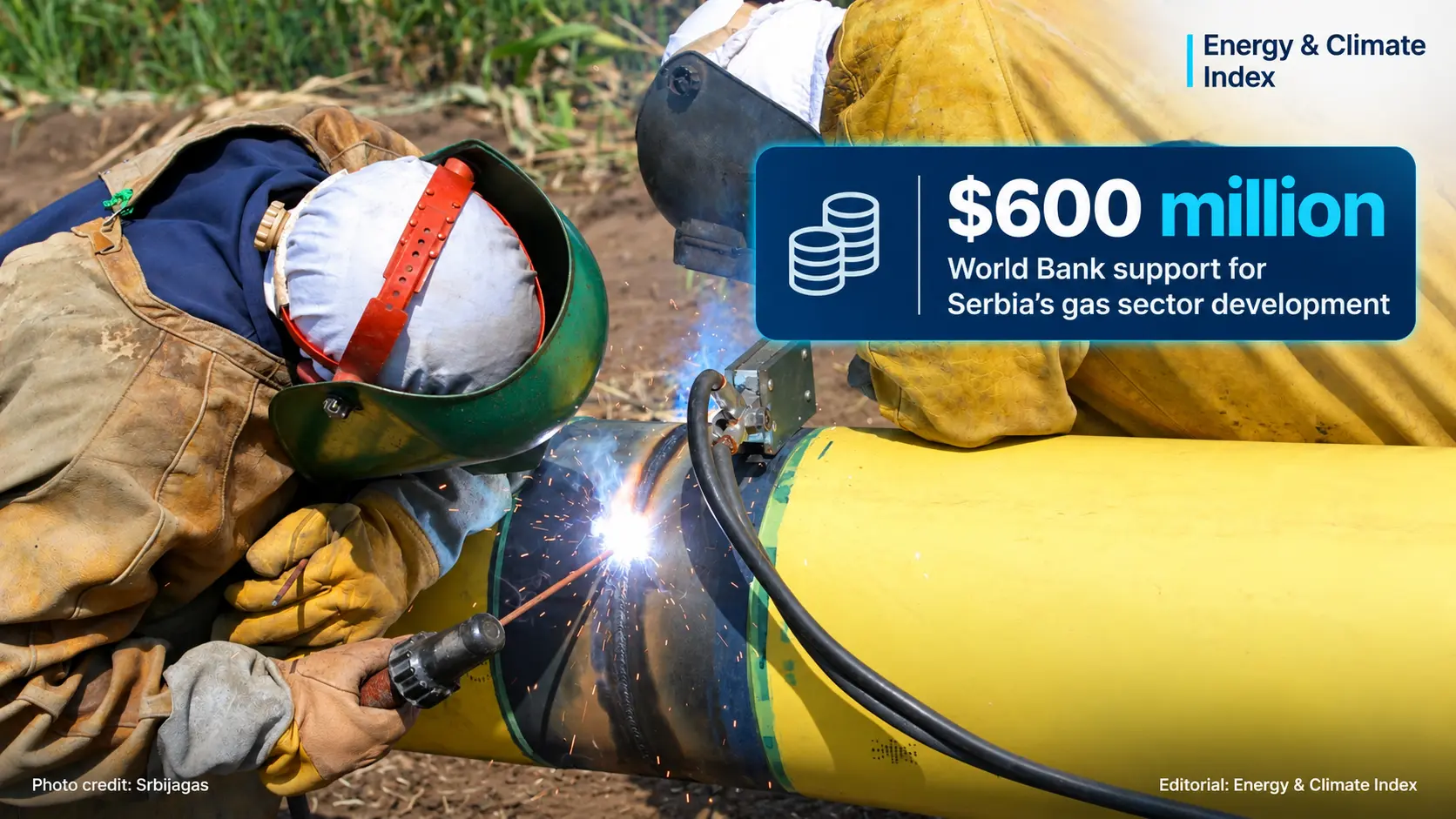
The World Bank has approved $600 million for Serbia’s Gas Sector Development Program, which aims to improve the security and resilience of the country’s energy supply over the next ten years through investments in gas infrastructure, sector reforms and institutional strengthening.
The program has been designed as a long-term framework that is also expected to involve other development partners and the private sector. It will focus on removing constraints in the gas transmission network, improving underground gas storage infrastructure, and strengthening the regulatory and institutional framework.
First phase provides €170 million
The first phase of the program provides €170 million, equivalent to approximately $195.5 million, in financing.


One of the first infrastructure projects will be the Trupale–Pojate gas pipeline, which is expected to improve the security and reliability of gas supply in the country.
Alongside infrastructure investments, funding will also support the organisational, institutional and technical strengthening of the sector.
According to the World Bank, the overall program will be implemented over a 10-year period through a multiphase programmatic approach, with investments aligned with Serbia’s energy development and its European Union accession process.
Gas as part of the transition away from coal
Particularly significant is the way the World Bank positions the role of natural gas in Serbia’s energy system.
The institution states that natural gas has a transitional role as Serbia reduces its dependence on coal and petroleum products and increases the use of alternative energy sources, including renewables.
This makes the investment broader than a conventional gas pipeline project. Serbia must simultaneously manage the gradual reduction of coal’s role, the expansion of wind and solar PV capacity, and the need to maintain sufficient flexibility and security in its energy system.
Improved gas infrastructure is expected to provide greater energy security for households, industry and district heating systems, which the World Bank identifies among the main beneficiaries of the program.
At the same time, the long-term impact of the investment will also depend on how quickly Serbia expands renewable electricity generation and reduces its dependence on fossil fuels.
ECI