

Despite weaker hydrological conditions and a slight decline in renewable electricity generation, renewables remained by far the largest source of electricity in the European Union in 2025.
At the same time, coal use continued to decline, reaching its lowest level since the beginning of the statistical series in 1990, according to preliminary Eurostat data.
Renewables retained their leading position
In 2025, renewable energy sources accounted for 47.2% of total electricity generation in the EU, while fossil-fuel power plants contributed 29.6% and nuclear power plants 23.2%. Electricity generation from renewables reached approximately 1.33 million GWh, representing a slight 0.5% decrease compared with the previous year.


According to Eurostat, the decline was not driven by lower wind or solar generation, but primarily by significantly weaker hydropower output, once again highlighting how weather conditions continue to influence Europe’s electricity system.
More gas used to offset weaker hydropower generation
At the same time, electricity generation from fossil fuels increased by 3.2%, reaching around 830,000 GWh, equivalent to nearly one-third of total EU electricity generation. Nuclear generation also recorded a modest 0.2% increase.
Meanwhile, natural gas supply rose by 2.3%, marking the second consecutive annual increase following the sharp decline recorded in 2023. This suggests that natural gas continues to play an important role as a flexible balancing fuel when renewable generation, particularly hydropower, falls below expected levels.
Coal continues to disappear from Europe’s energy mix
The sharpest decline was recorded in coal. Supply of brown coal (lignite) fell by 7.7%, while hard coal supply declined by 3.2%, with both reaching their lowest levels since 1990. At the same time, the supply of petroleum products decreased by 2.8%.
These figures confirm that Europe’s energy transition continues to advance, while also demonstrating that weather conditions are playing an increasingly important role in shaping the continent’s electricity mix.
When hydrological conditions are less favourable, part of the shortfall is still compensated by natural gas, whereas coal continues its gradual retreat from the European energy system.
North Macedonia follows the same European trend as renewables approach half of electricity generation
North Macedonia also moved close to the European average in terms of the share of renewable electricity generation in 2025.
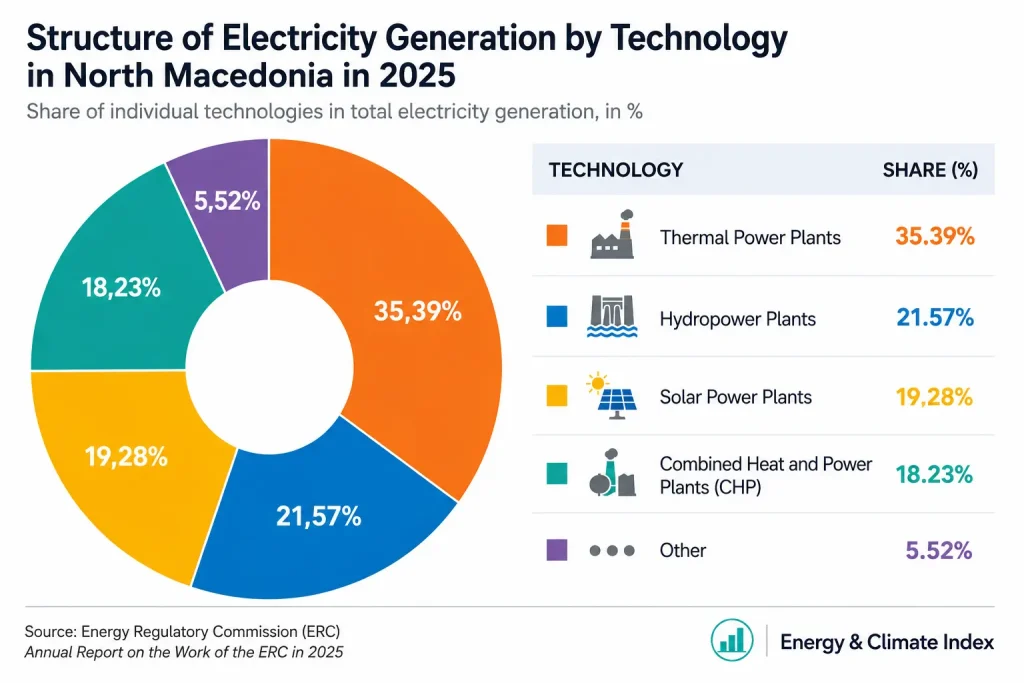
According to the Energy Regulatory Commission (ERC) Annual Report, renewable energy sources accounted for 46.37% of domestic electricity generation, compared with 47.2% across the European Union.
The structure of generation, however, remains different. Thermal power plants continue to provide the largest individual share of electricity generation, while solar photovoltaic plants surpassed combined heat and power (CHP) plants for the first time, highlighting the growing importance of solar energy within North Macedonia’s electricity mix.
ECI