

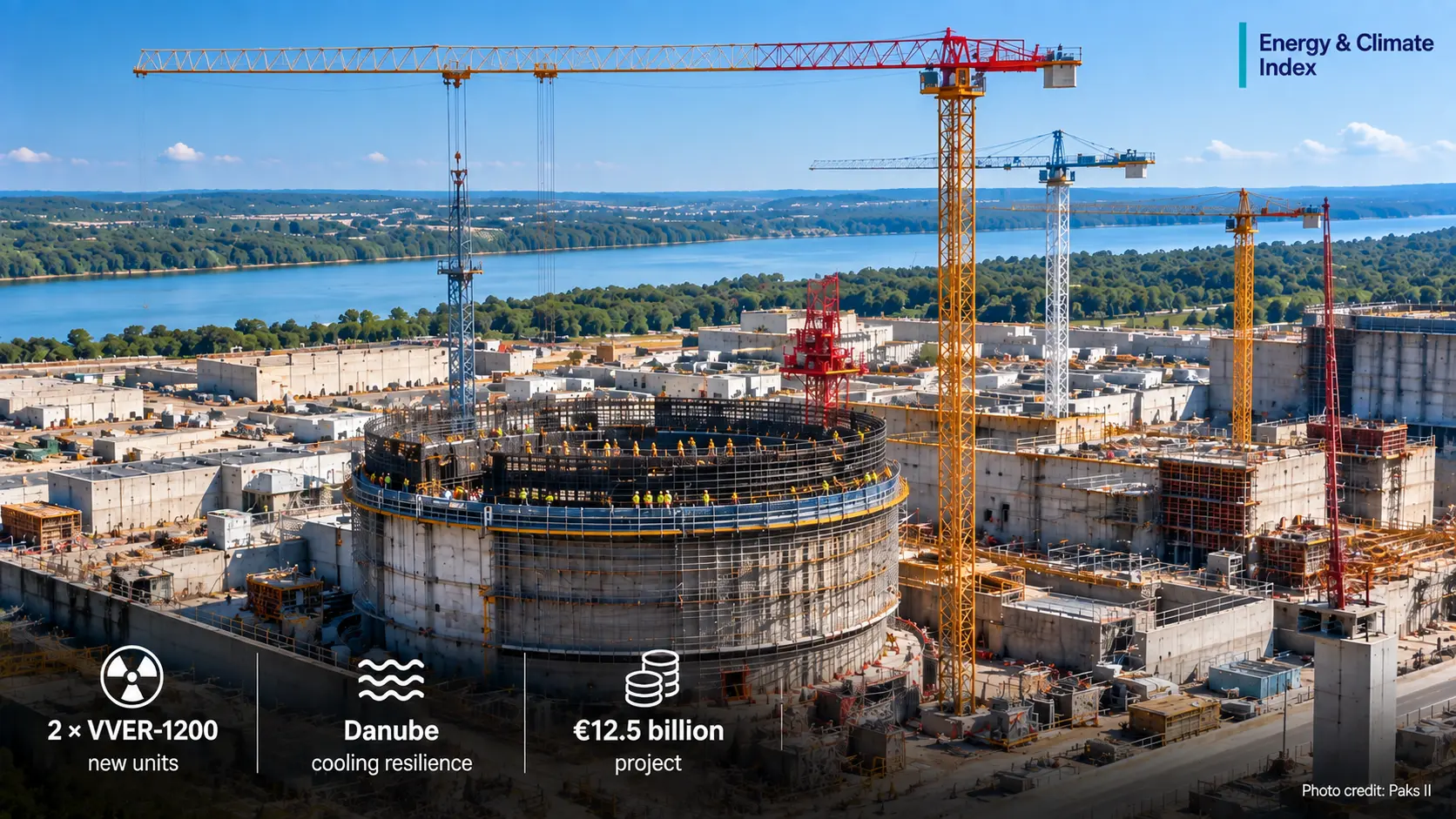
The new Paks II nuclear units in Hungary are expected to be able to operate even during periods of low water levels on the Danube, according to Russia’s Rosatom, as climate risks and the availability of cooling water become increasingly important issues for Europe’s nuclear power sector.
The issue has gained additional significance following exceptionally low Danube levels this summer, which created serious operational constraints for the existing Paks nuclear power plant.
New reactors designed for low-water conditions
Rosatom Director General Alexey Likhachev said that low Danube water-level scenarios have been taken into account in the design of Paks II.


The project involves the construction of two new VVER nuclear reactors and represents one of the largest nuclear projects currently under development in the European Union.
Its estimated value is around €12.5 billion.
Paks II is expected to significantly increase Hungary’s nuclear generation capacity and maintain nuclear energy as one of the pillars of the country’s electricity system.
The Danube becomes part of the energy-security equation
Cooling is no longer simply a technical detail.
The existing Paks nuclear power plant relies on the Danube for cooling, while exceptionally low water levels and high temperatures this summer demonstrated how climate conditions can directly affect the availability of large thermal power plants.
In August, the existing plant was forced to significantly reduce its output amid record-low Danube levels.
Official Paks II documentation also pays particular attention to the river, including hydrological conditions, river morphology and the impact of thermal water discharges.
Climate resilience becomes part of nuclear planning
The experience of summer 2026 shows that climate risk is increasingly becoming an energy-security risk.
Nuclear power plants provide stable electricity generation regardless of wind and solar conditions, but facilities that depend on river water for cooling remain exposed to extreme temperatures, drought and low river levels.
The ability of Paks II to operate across a wider range of hydrological conditions will therefore be important not only for the project itself, but also for the long-term security of Hungary’s electricity system.
ECI