

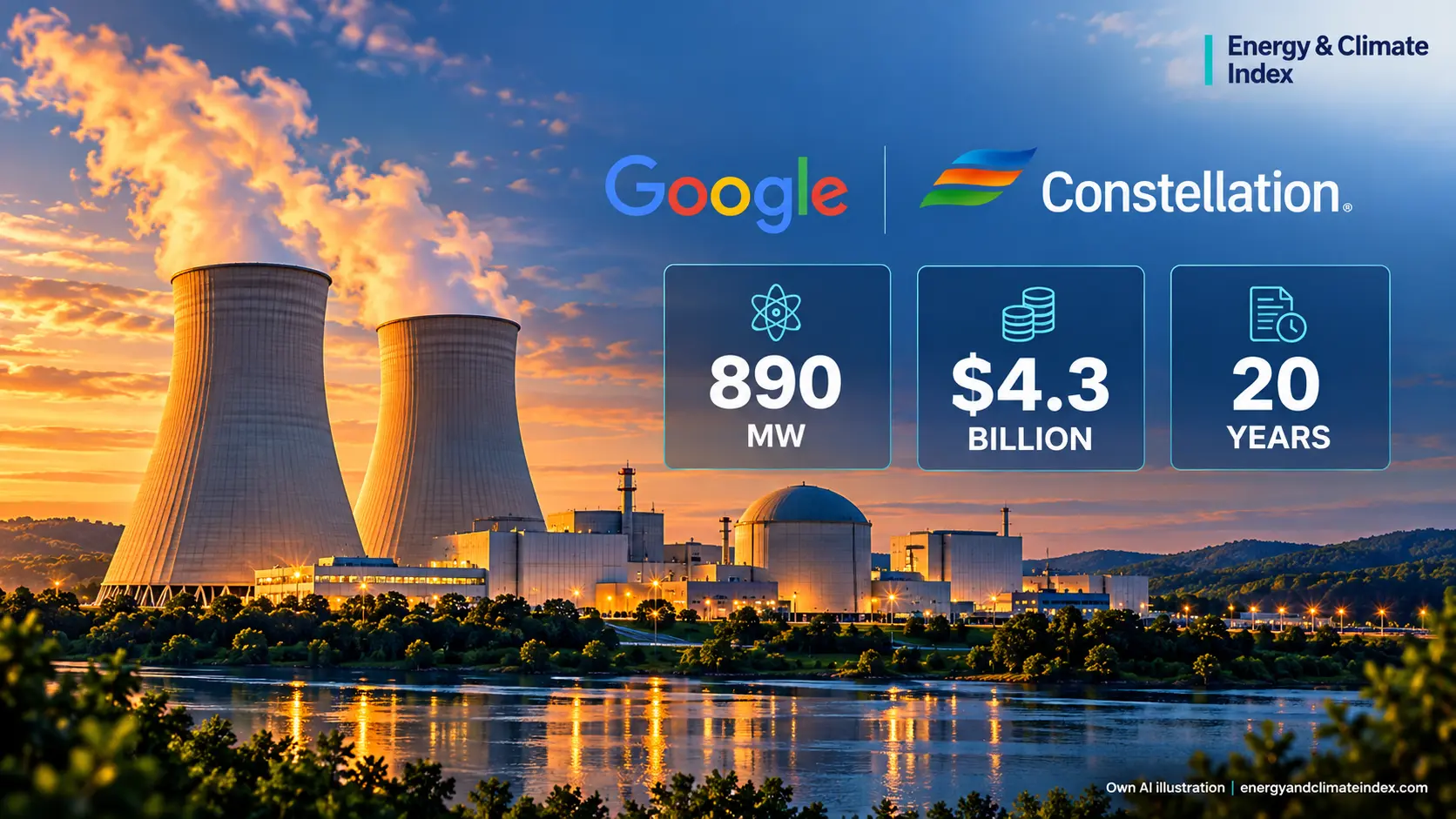
Google and Constellation Energy have signed a long-term agreement that will enable more than $4.3 billion in investment to increase electricity generation from Constellation’s existing nuclear fleet in the United States.
The project is expected to deliver an additional 890 MW of nuclear capacity through upgrades to 11 reactors at six nuclear plants in Illinois, Pennsylvania and New Jersey. The additional capacity will be delivered to the PJM power system, which serves around 67 million people across 13 US states.
Growth of Google’s data centers is driving the investment
A key element of the agreement is why Google is backing the investment. The company explicitly states that the project is being driven by the growth of its US data centers and the resulting increase in electricity demand.


Rather than allowing new digital infrastructure simply to draw additional electricity from the existing power system, Google wants the expansion of its operations to be accompanied by the development of additional generation capacity.
Google will serve as the long-term buyer of the electricity under a 20-year agreement, providing Constellation with the revenue certainty required to invest in upgrading its nuclear reactors. According to Google, the costs associated with these investments will not be passed on to other electricity consumers.
The approach is consistent with the broader US concept of “Bring Your Own Power”, under which large new electricity consumers, particularly data centers, contribute to bringing additional generation capacity onto the system rather than simply increasing demand on an already constrained grid.
890 MW of additional capacity without building a new nuclear plant
The project does not involve the construction of new reactors. Constellation will upgrade turbines, steam generators and digital control systems at its existing nuclear units.
These improvements are expected to increase thermal and electrical efficiency and provide an additional 890 MW of generation capacity. The first capacity increase is expected in 2028, while the entire programme is scheduled to be completed before the end of 2032.
According to Google, the additional capacity is roughly equivalent to one new large nuclear reactor, but can be delivered significantly faster than constructing an entirely new nuclear power plant.
With this agreement, Google says it has now enabled more than 1.5 GW of new nuclear capacity in the United States through uprates at existing reactors and the restart of previously closed nuclear capacity.
Another 2,700 MW from existing nuclear capacity
In addition to the investment supporting the new 890 MW, the companies have signed a separate 15-year agreement covering another 2,700 MW from Constellation’s existing generation portfolio in the PJM market.
The agreement also includes demand flexibility. Part of Google’s non-critical electricity consumption could be reduced during periods when the power system is under significant stress.
At the same time, Constellation will use Google Cloud and Gemini Enterprise for upgrade planning, generation optimisation, outage management and protection of critical infrastructure.
The combination of data centers, nuclear power and flexible electricity demand illustrates how the rapid expansion of AI infrastructure is beginning to directly influence investment in the US electricity system.
ECI