

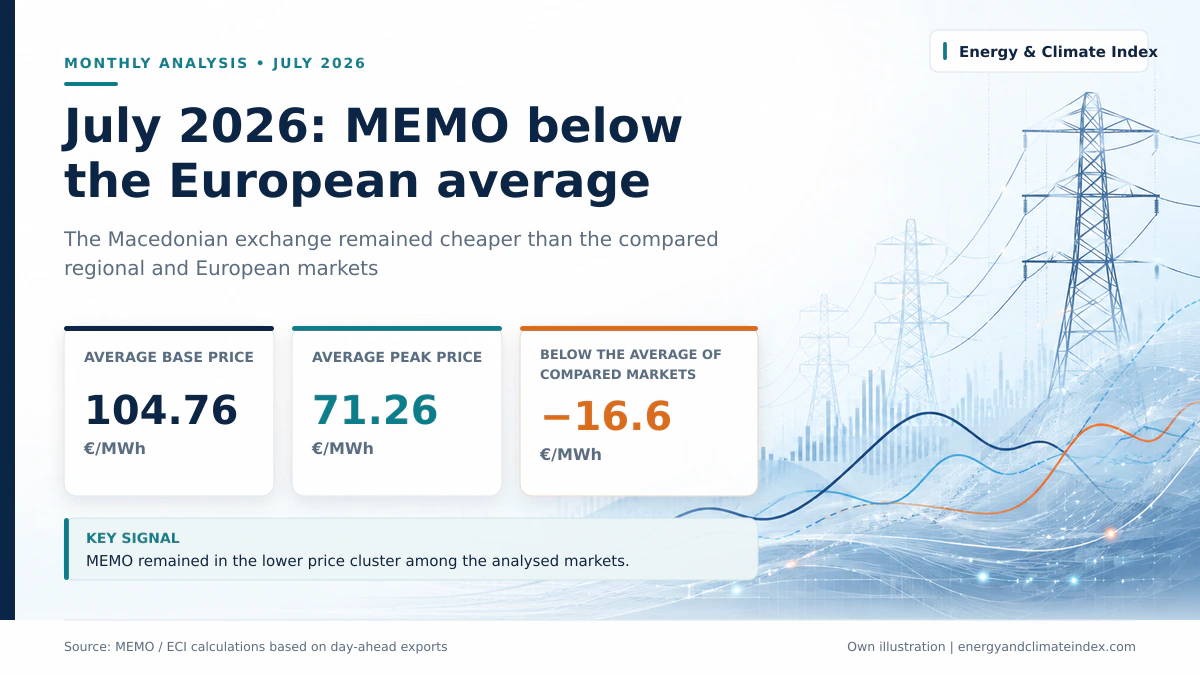
July 2026 brought higher electricity prices across Europe, but also an important distinction for the Macedonian market. MEMO entered a more expensive summer phase compared with June, with an average baseload price of 104.76 €/MWh, but still remained below the average of the analysed European markets.
According to ECI calculations based on day-ahead exports, the average of the compared European markets was 121.39 €/MWh. This means that MEMO was around 16.6 €/MWh below the European average in July. The closest markets to the Macedonian price were Germany/Luxembourg, Greece, Serbia and Bulgaria, while Italy remained the most expensive market in the comparison at 161.37 €/MWh.
Europe: a summer market with winter-like price pressure
The main reason for higher European prices in July was the combination of a heatwave, higher cooling demand, weak wind output, constrained nuclear and gas-fired generation, and higher gas and CO₂ costs. Reuters reported that summer power prices in Europe rose to levels usually associated with winter peaks, as heat simultaneously increased demand and reduced output from French nuclear plants, German and British gas power plants, and European wind turbines.


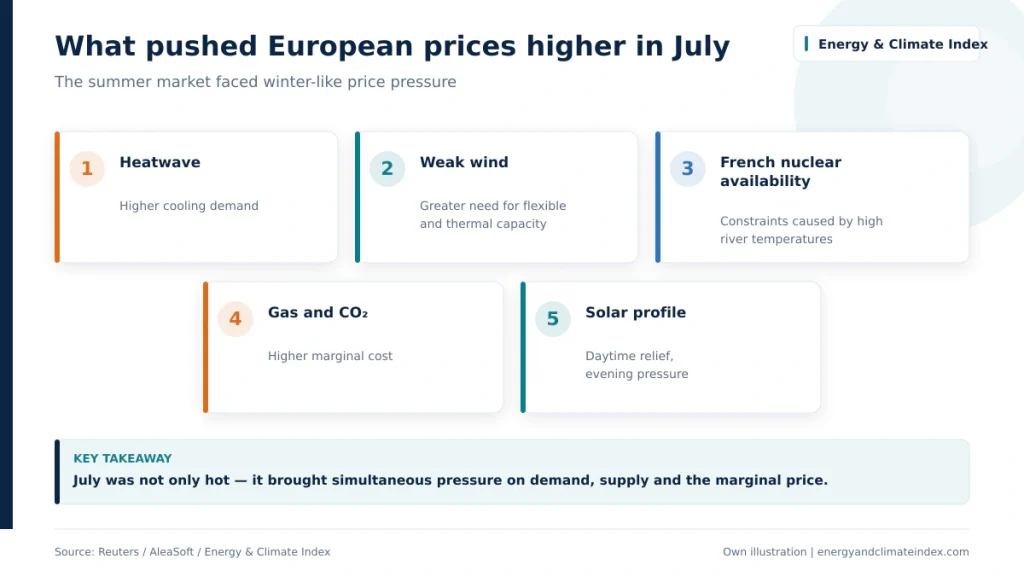
France was again an important factor for the European market. Successive heatwaves, temperatures above 40°C and drought conditions curtailed output at some nuclear plants, while lower water levels also affected hydroelectric generation. This matters for the wider European market because French nuclear power often plays a stabilizing role through exports to neighboring markets.
Additional pressure came from gas and carbon costs. AleaSoft reported that rising gas and CO₂ prices pushed European electricity market prices higher in the third week of July. This shows that even in summer, when solar generation can reduce prices during parts of the day, evening and system-wide price pressure remains linked to flexible capacity, gas and carbon costs.
Why were prices lower in North Macedonia?
The lower MEMO price does not mean that the Macedonian market was isolated from Europe. On the contrary, the domestic price increased compared with June. But the increase was smaller than in some markets that were more directly exposed to heat, fuel prices, CO₂, constrained nuclear availability or more expensive marginal generation.
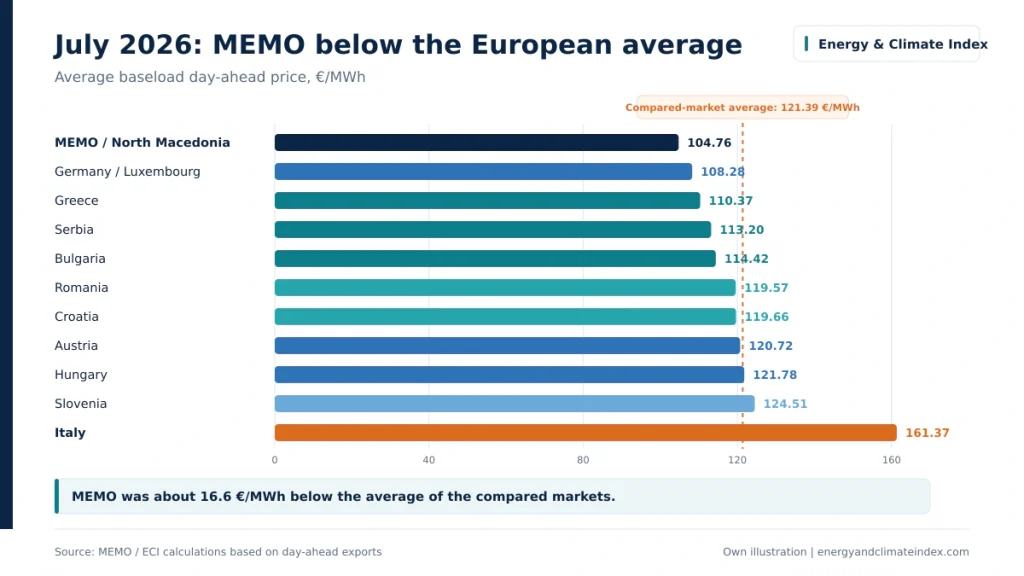
July shows that MEMO was closer to the lower regional price cluster than to the most expensive European markets. The gap with Serbia was around 8.4 €/MWh, with Bulgaria around 9.7 €/MWh, and with Greece around 5.6 €/MWh. By contrast, the gap with Italy reached 56.6 €/MWh.
This difference can also be read in a broader regional context. The Energy Community’s Q1 2026 CBAM quarterly report stated that scheduled commercial electricity exchanges between the Western Balkans and the EU fell by roughly 25% compared with the same period of the previous year, while day-ahead prices in the Contracting Parties were on average around 30 €/MWh lower than in neighboring EU markets. This does not mean that CBAM alone explains July prices, but it is an important part of the new regional market framework.
Domestic specificity: baseload remained above peakload
On MEMO, July had another important feature: the baseload price remained significantly above the peakload price. The average baseload price was 104.76 €/MWh, while the average peakload price was around 71.26 €/MWh. The gap of around 33.5 €/MWh shows that the domestic daily price profile did not follow the classic summer logic in which peak hours automatically carry the strongest average price pressure.
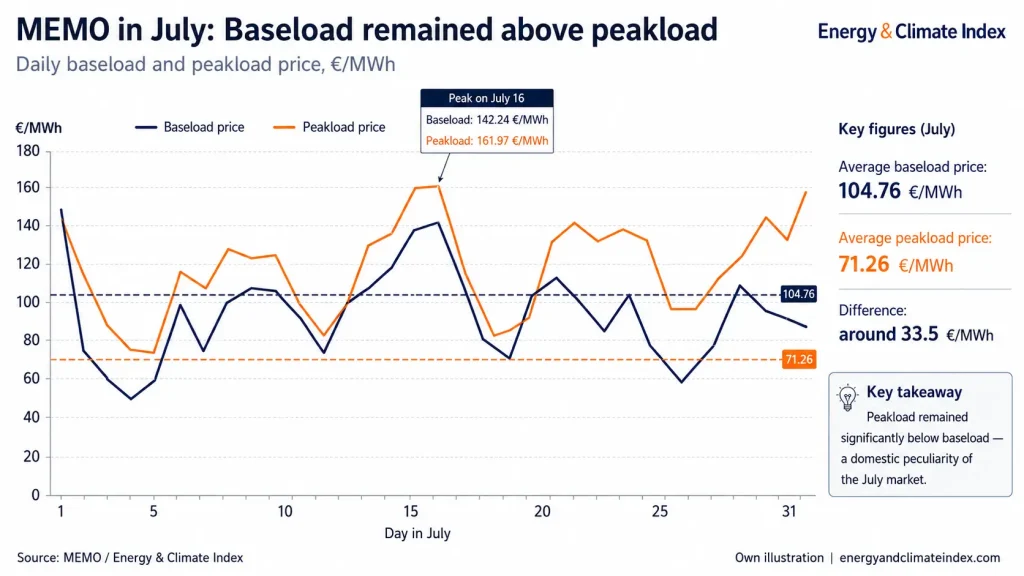
This may reflect several factors: the structure of supply, the hourly trading profile, the daytime solar effect, market liquidity and regional flows. For MEMO, therefore, it is not enough to look only at the monthly average. The relationship between baseload, peakload and hourly prices is equally important.
July was more expensive on average, but less extreme than June
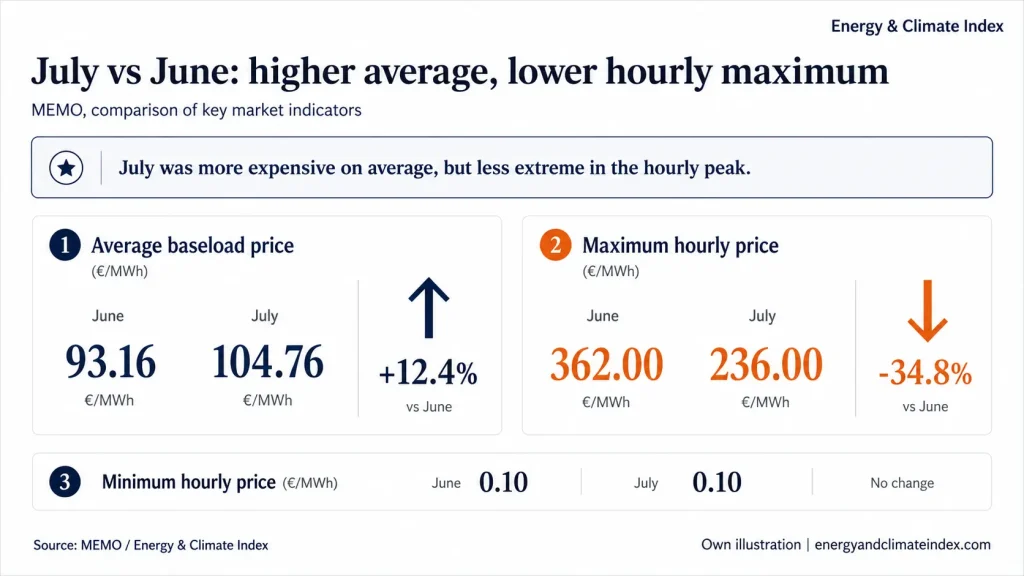
Compared with June, July was clearly a more expensive month for MEMO. The average baseload price increased from 93.16 €/MWh to 104.76 €/MWh, or by around 12.4%. But the hourly maximum was lower: in June it reached 362 €/MWh, while in July the maximum hourly price was 236 €/MWh.
[INSERT CHART 5 HERE: “July vs June: higher average, lower hourly maximum”]
This is an important distinction. July did not bring a more extreme hourly spike than June, but it did bring a higher average price. In other words, the market was more expensive on average, but less dramatic at the highest hourly levels.
Main conclusion
July confirmed the new regional reality of the Macedonian electricity market. MEMO was not isolated from Europe’s summer price pressure, its price increased compared with June. However, compared with the analyzed European and regional markets, the Macedonian exchange remained in a lower price zone.
The main message is not that July was cheap. It was not. July was more expensive than June. The main message is that MEMO remained below the European average, closer to Greece, Serbia, Bulgaria and Germany/Luxembourg, and significantly below the most expensive markets such as Italy.
In the next summer months, the key question will be whether this lower regional positioning continues, or whether higher cooling demand, weak hydrology, gas, CO₂ and regional constraints bring MEMO closer to the higher European price signal.
ECI