

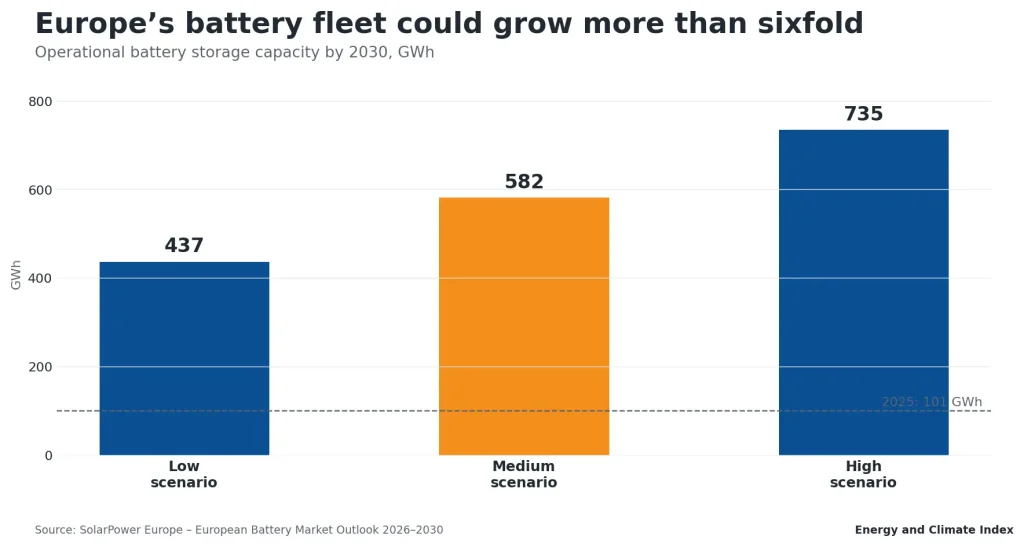
Europe’s battery energy storage market entered a new phase in 2025. According to SolarPower Europe’s latest European Battery Market Outlook 2026–2030, the continent installed 36 GWh of new battery storage capacity during the year, representing 48% growth compared with 2024. As a result, Europe’s total operational battery storage fleet exceeded 100 GWh for the first time.
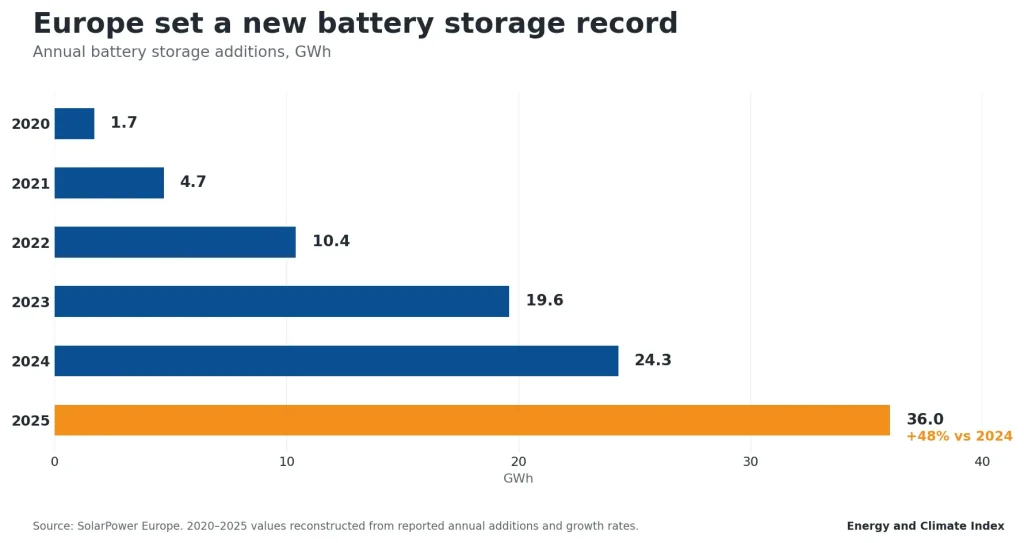
This marks the twelfth consecutive record year for Europe’s battery market. More importantly, however, the market is no longer defined only by higher installation volumes. In 2025, its structure changed significantly, with large grid-connected battery systems becoming the dominant investment segment.
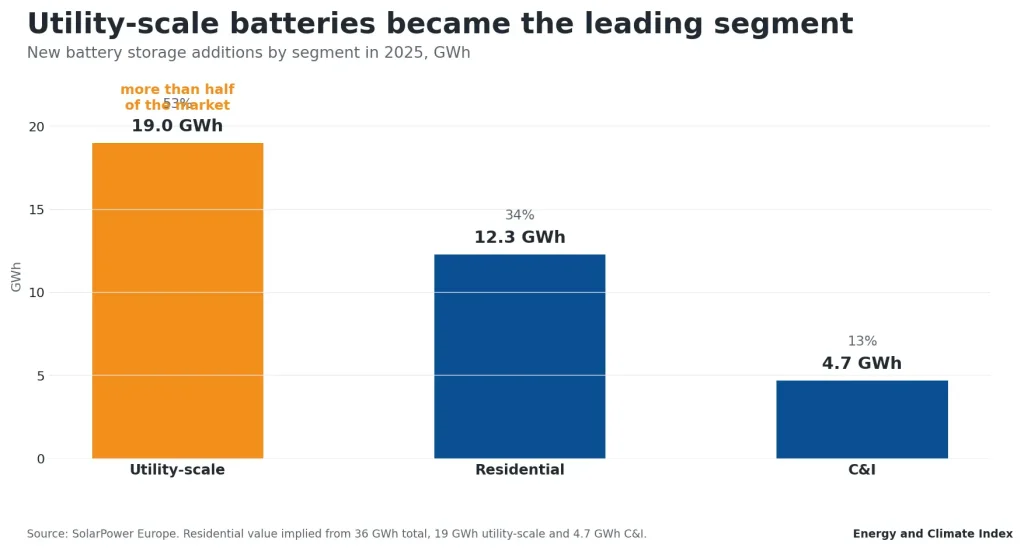
Utility-scale projects accounted for 19 GWh of new installations, representing more than half of all battery capacity deployed across Europe. Meanwhile, the commercial and industrial (C&I) segment expanded by 77%, reaching 4.7 GWh, while the residential market within the EU-27 declined. This indicates that batteries are increasingly being deployed as critical electricity infrastructure rather than simply as an addition to residential rooftop solar systems.


Total investment in Europe’s battery storage sector reached approximately €17 billion in 2025. The EU-27 alone accounted for 27 GWh of newly installed capacity, representing roughly three-quarters of all battery installations across the wider European market.
Bulgaria and Ukraine entered Europe’s top five battery markets
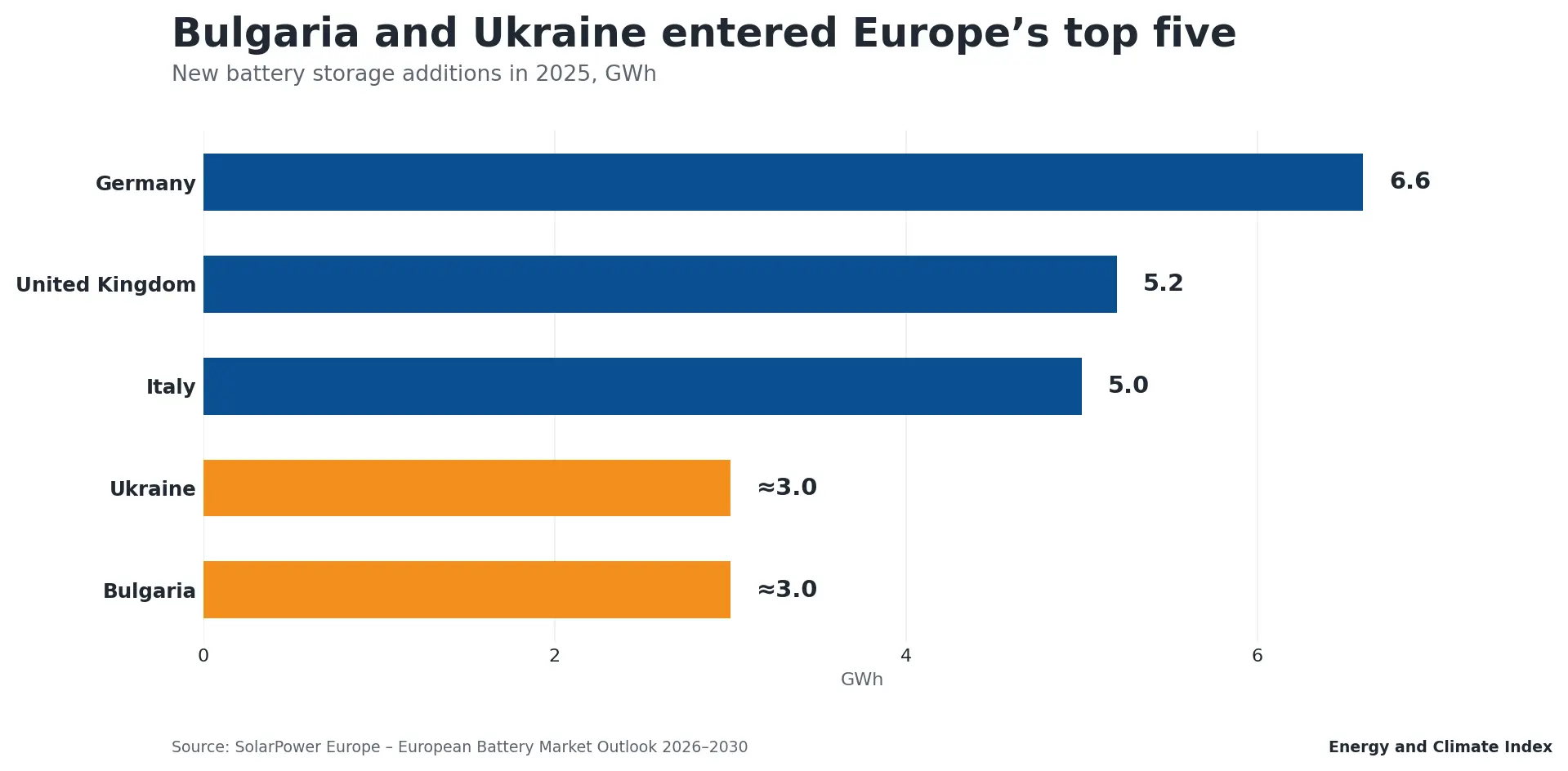
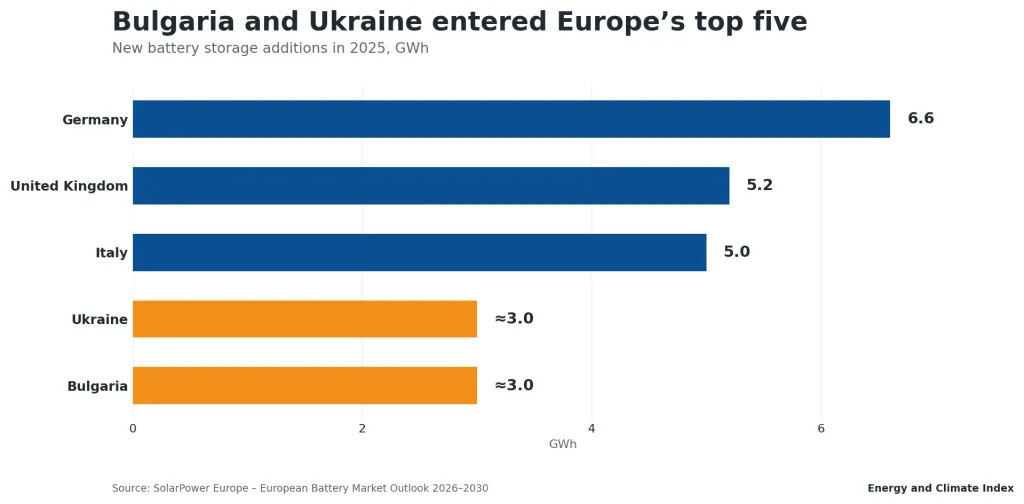
Germany remained Europe’s largest battery storage market, adding 6.6 GWh of new capacity in 2025. The United Kingdom ranked second with 5.2 GWh, followed by Italy with 5.0 GWh, despite an 18% decline compared with the previous year.
Perhaps the most notable development, particularly for Southeast Europe, was the emergence of Bulgaria and Ukraine among Europe’s five largest battery markets. Both countries installed approximately 3 GWh of new battery capacity during 2025.
According to SolarPower Europe, Bulgaria’s rapid expansion was driven primarily by successful public funding schemes supporting large-scale battery projects, while Ukraine continued deploying battery storage as part of its strategy to strengthen electricity system resilience following repeated attacks on critical energy infrastructure.
The report also highlights a broader structural shift. In 2023, only three European countries installed more than 1 GWh of battery storage in a single year. By 2025, that number had increased to ten, demonstrating that battery investment is no longer concentrated exclusively in Europe’s largest economies.
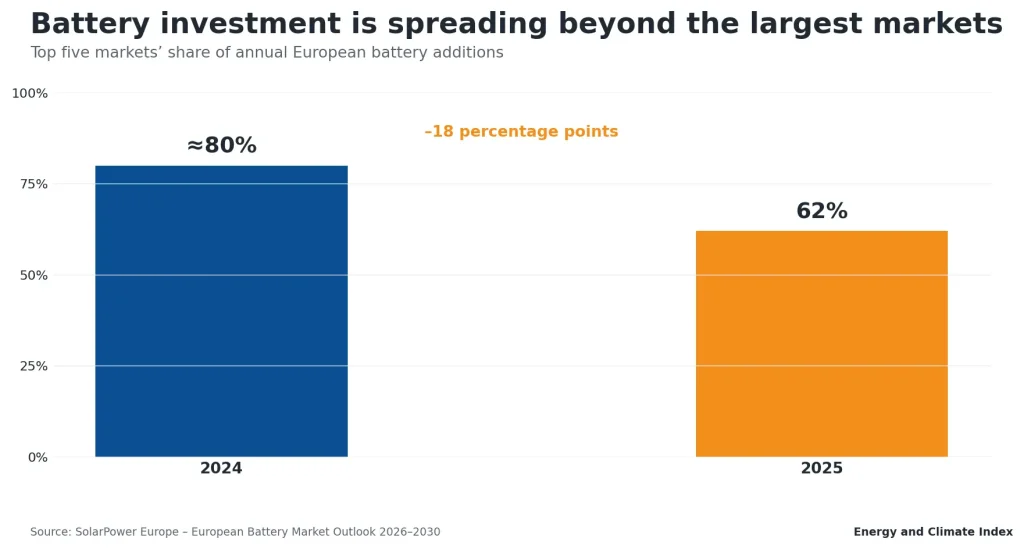
The same trend is reflected in market concentration. In 2024, the five largest markets accounted for nearly 80% of all new European battery installations. By 2025, their combined share had fallen to 62%. Rather than indicating slower growth in leading markets, this suggests that battery deployment is expanding much more rapidly across the rest of Europe.
Strong growth, but still below what Europe needs
Despite another record-breaking year, the report concludes that the current pace of deployment remains insufficient to support Europe’s long-term energy transition objectives.
Under the report’s medium scenario, annual battery installations will need to increase from 36 GWh in 2025 to approximately 138 GWh by 2030. Total operational battery storage capacity would reach around 582 GWh, while the high-growth scenario projects 735 GWh by the end of the decade.
At the same time, the European Commission’s AccelerateEU initiative has introduced a political target of 200 GW of battery storage power capacity by 2030. It is important to note that this target measures power capacity (GW), whereas the market scenarios presented in the report refer to energy storage capacity (GWh). These indicators measure different characteristics of battery systems and therefore should not be directly compared. Together, however, they clearly illustrate the scale of investment required over the remainder of the decade.
Regulation is becoming the decisive investment factor
SolarPower Europe identifies three major barriers that continue to slow battery deployment: network tariffs, market access, and regulatory certainty.
In several European countries, battery projects are still subject to double charging of network fees, paying grid tariffs both when charging and when discharging electricity. According to the report, removing this distortion is essential for improving project economics and encouraging further investment.
A second challenge is access to multiple revenue streams. Battery projects depend on combining revenues from day-ahead and intraday energy markets, balancing services, ancillary services, local flexibility markets and capacity mechanisms. Without clear and non-discriminatory market access, investment returns become less predictable.
Finally, regulatory stability remains critical. Utility-scale battery projects require substantial upfront capital, making investors highly sensitive to unexpected changes in connection rules, tariff structures or market design. Stable regulation is therefore essential for reducing investment risk and accelerating deployment.
For this reason, SolarPower Europe calls for a dedicated EU Battery Storage Action Plan, including harmonised network tariffs, fair market access and greater regulatory certainty across Member States.
The numbers tell the real story
Europe’s battery market can no longer be viewed simply as a technology supporting renewable energy. The latest figures point to the emergence of a standalone strategic industry: 36 GWh of new installations in a single year, more than 100 GWh of operational capacity, €17 billion in annual investment, 19 GWh of utility-scale deployments, and Bulgaria joining Europe’s five largest battery markets.
The next challenge is no longer whether battery storage will continue expanding, but whether European regulation and market design can evolve quickly enough to support the scale of investment required for a secure, flexible and decarbonized electricity system.
ECI