

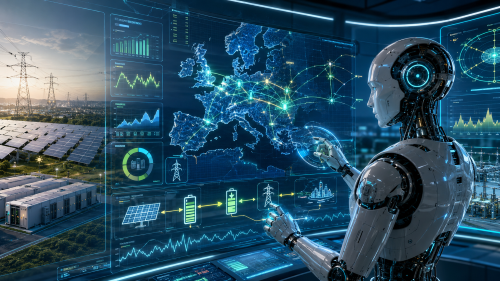
The European Commission has presented a new roadmap for digitalisation and artificial intelligence in the energy sector, with a focus on lower bills, smart grids, better demand management and the secure integration of data centres.
The roadmap includes new measures for the digitalisation of Europe’s energy system, with the aim of making the energy sector more efficient, safer and better prepared for a higher share of renewable energy sources. The new Strategic Roadmap for Digitalisation and Artificial Intelligence in the energy sector is part of the broader package for European technological sovereignty.
The key message is that digital solutions are no longer merely a technical upgrade of the energy system. They are becoming an essential instrument for reducing costs, managing demand, integrating photovoltaic power plants and wind power plants, and increasing grid resilience.


Consumers Will Be Able to Shift Consumption to Cheaper Hours
According to the European Commission, digital solutions can help consumers shift their electricity consumption to hours when electricity is cheaper. This is the essence of demand-side flexibility: households, companies and industry should no longer be only passive consumers, but active participants in the energy system.
The Commission estimates that demand-side flexibility could directly reduce electricity costs for consumers in the EU by more than €71 billion per year, which, according to the Commission’s announcement, corresponds to a 64% reduction in electricity consumption costs.
Artificial Intelligence Is Entering Grid Management
Artificial intelligence is expected to play an increasingly important role in the management of electricity grids. This includes better forecasting of renewable energy generation, optimisation of maintenance, management of grid congestion and faster response to changes in production and consumption.
For industry, the European Commission states that digitalisation can increase efficiency and enable a better response to price signals. Optimising operation and maintenance with the help of artificial intelligence could bring savings of up to €94 billion per year by 2035.
Three Main Pillars of the New European Approach
The European Commission’s roadmap is based on three directions.
The first is the sustainable integration of data centres into the energy system. This is important because the digital economy and artificial intelligence are increasing electricity demand, meaning that data centres must be better connected with energy planning.
The second is the acceleration of digital solutions and artificial intelligence, including technologies for better use of the existing grid and faster deployment of smart meters.
The third is the creation of a framework for cross-border data exchange within the EU, with the aim of enabling safer and more efficient regional cooperation.
Why This Matters for the Western Balkans
For the Western Balkan countries, this European direction is particularly important. The region is already experiencing rapid growth in photovoltaic power plants, but grids, smart metering, electricity storage and demand management are still lagging behind the needs of the new energy system.
Without digitalisation, the growing share of renewable energy sources could create greater pressure on the grid. With digitalisation, the same energy can be used more efficiently through dynamic tariffs, battery systems, flexible industrial consumption and better regional planning.
For North Macedonia, where photovoltaic power plants have already recorded strong growth, the next step is not only the construction of new capacities, but the smart management of production and consumption. This means smart meters, daily price signals, batteries, digital grid management and clear rules for flexibility.
Editorial Office