

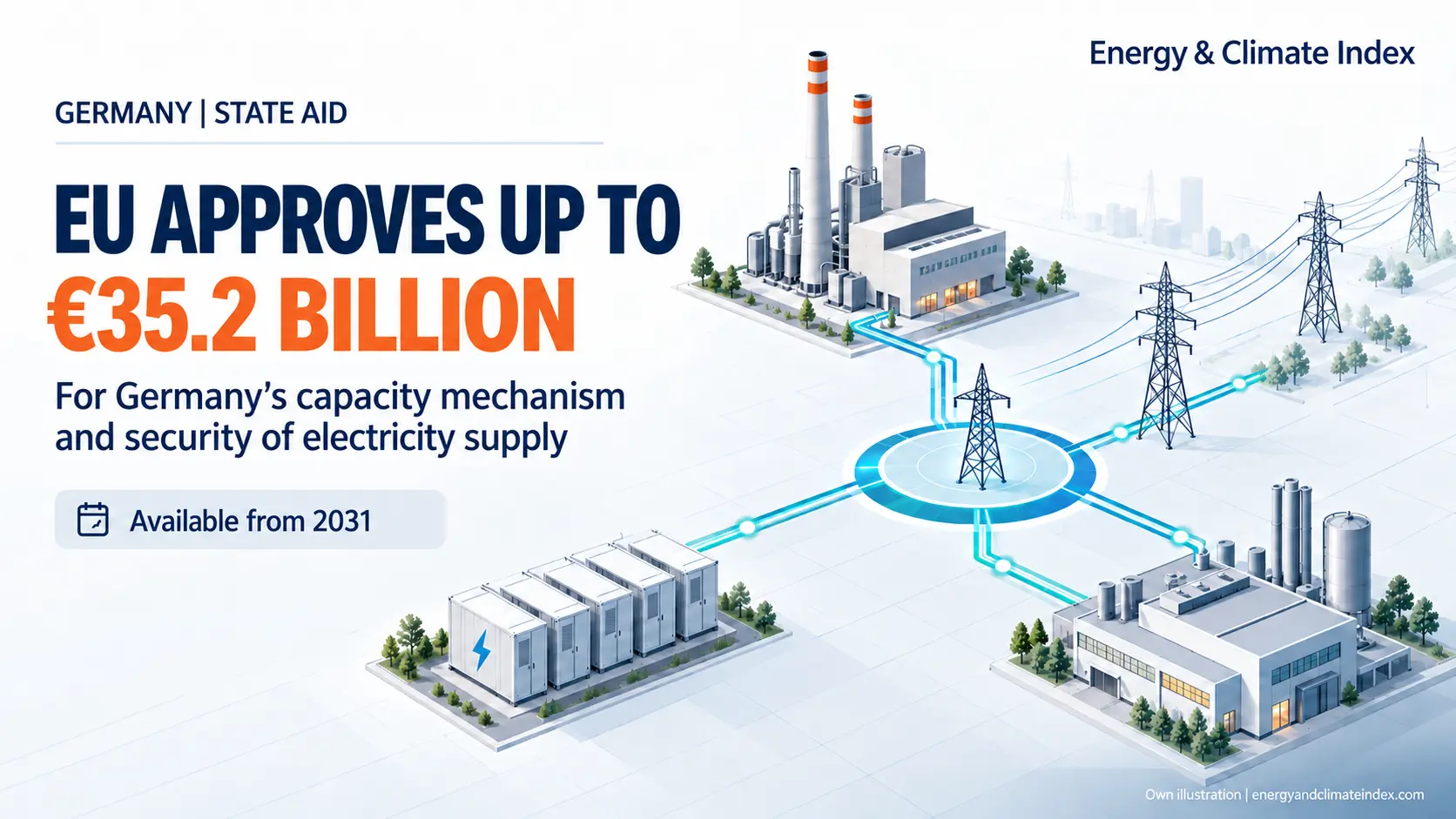
The capacity mechanism will be open to power generation, energy storage and demand-side flexibility, while new gas-fired power plants awarded long-term contracts will have to be hydrogen-ready
The European Commission has approved, under European Union State aid rules, a German capacity mechanism with an estimated total cost of between €15.6 billion and €35.2 billion.
The mechanism will become available from 2031 and is intended to ensure sufficient capacity to generate and store electricity, as well as to provide demand-side flexibility. This should enable Germany’s electricity system to consistently meet expected demand.
According to the European Commission, capacity mechanisms can play an important role in ensuring security of supply during the transition towards a decarbonised electricity system. The German scheme also includes conditions supporting the achievement of climate neutrality by 2045 at the latest.


Support for available capacity
Germany notified the European Commission of the measure designed to ensure security of electricity supply in 2031.
Under the market-wide mechanism, the transmission system operator will remunerate the capacity required to meet Germany’s reliability standard. This standard was established on the basis of the European Resource Adequacy Assessment 2025, or ERAA 2025.
The mechanism will be open to all technologies, including:
- electricity generation capacity;
- energy storage systems;
- demand response and demand-side flexibility;
- existing and new capacity;
- eligible cross-border capacity.
Capacity will be selected through competitive auctions, with delivery beginning in 2031. Contracts may run for up to 15 years.
All supported capacity benefiting from 15-year contracts will be required to operate in a climate-neutral manner by 2045 at the latest.
New gas-fired power plants bidding for a 15-year capacity contract will have to be hydrogen-ready, enabling them to switch from natural gas to hydrogen in the future.
First auctions to begin in 2026
The first auctions will be organised in 2026, with an additional auction to be held in 2027 if the initial rounds are undersubscribed.
These initial auctions will be reserved for additional long-term capacity located in Germany.
Subsequent auctions, scheduled for 2027 and 2029, will be open to all technologies and to both existing and additional capacity.
Apart from the initial tenders reserved for additional capacity in Germany, the mechanism will also be open to capacity located in other EU Member States that have a direct electricity interconnection with Germany.
Annual costs of up to €2.3 billion
According to the European Commission’s estimates, the mechanism will cost between €1 billion and €3 billion in 2031, depending on the results of the auctions.
From 2032 to 2045, annual costs are estimated to range between €900 million and €2.3 billion.
This results in an estimated total State aid budget of between €15.6 billion and €35.2 billion.
Separate auctions for the transition from gas to hydrogen
Germany also plans to organise separate decarbonisation auctions to support the conversion of part of its gas-fired generation capacity to hydrogen.
By the end of 2027, auctions are expected to be held for the conversion of 2 GW of gas-fired capacity to hydrogen by 2040. A further 2 GW is expected to switch to hydrogen by 2043, through auctions to be organised between 2032 and 2035.
This decarbonisation support is not covered by the Commission’s current decision. It will be notified and assessed separately under EU State aid rules.
Germany also plans to introduce a broader structural capacity mechanism in 2027 to address security-of-supply concerns more extensively from 2032 onwards. This mechanism will have a separate budget and is not part of the current decision.
ECI