

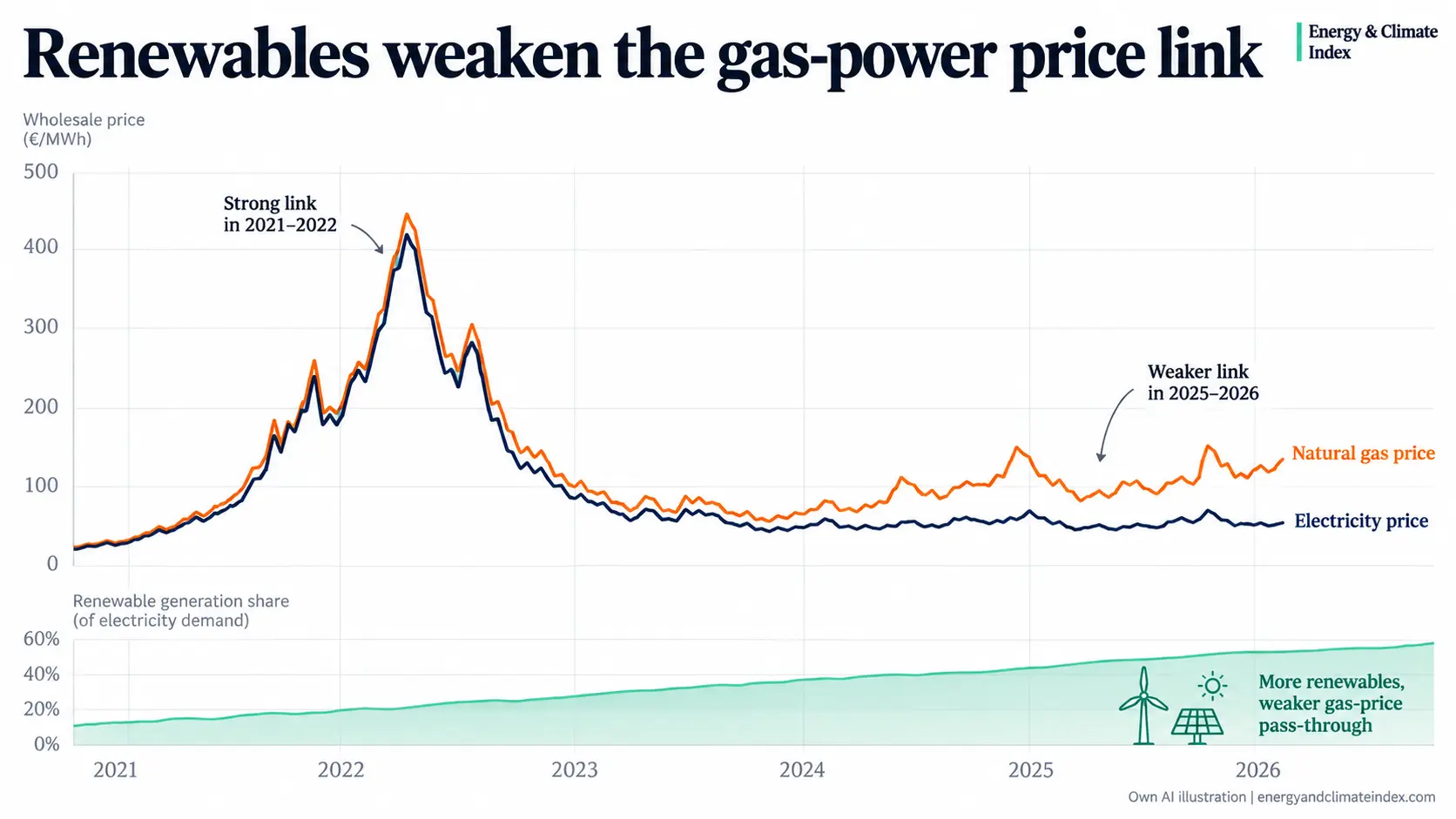
Natural gas remains an important factor in determining wholesale electricity prices in Europe, but its influence is gradually declining as electricity generation from renewable sources increases.
An analysis by the European Central Bank (ECB), published in Economic Bulletin 6/2026, shows that the relationship between natural gas and electricity prices is weakening, although significant differences remain across European markets.
European electricity markets faced renewed pressure from rising natural gas prices in 2026. However, the increase in wholesale electricity prices was considerably more limited than during the energy crisis of 2021–2022.


According to the ECB’s research, this difference is not solely attributable to the smaller increase in gas prices, but also reflects changes in the structure of European electricity generation. The growing share of renewable energy reduces the need to dispatch gas-fired power plants and, consequently, the number of hours during which natural gas determines the market price.
Why does natural gas determine electricity prices?
In European electricity markets, prices are largely determined through the principle of marginal pricing. Generation facilities are dispatched according to their offered prices, with the last power plant required to meet demand setting the market price for the relevant period.
When a gas-fired power plant is the marginal producer, the price of natural gas becomes one of the main factors determining the electricity price. In addition to fuel costs, generation costs are influenced by the price of CO₂ emissions under the European Union Emissions Trading System (EU ETS).
This mechanism was particularly evident during the energy crisis of 2021–2022. Reduced natural gas supplies coincided with droughts that constrained hydropower generation and reduced availability of France’s nuclear power plants.
As a result, gas-fired power plants were needed for a greater number of hours, allowing high natural gas prices to be transmitted strongly to wholesale electricity prices.
The situation in 2026 is different. Although natural gas prices have risen again, increased renewable electricity generation in several European countries has limited the impact of this increase on electricity markets.
Spain reduces its dependence, while Italy remains sensitive to gas prices
One of the most significant findings of the ECB’s research is that the influence of natural gas on electricity prices varies considerably across European countries.
Spain, with its high share of renewable energy in electricity generation, has recorded a substantial reduction in the number of hours during which natural gas sets the market price. A similar trend can be observed in France, where nuclear power plants play a particularly important role in electricity generation and price formation.
By contrast, electricity prices in Italy continue to be frequently determined by gas-fired power plants. Consequently, the Italian market remains more sensitive to changes in natural gas prices.
These differences help explain why wholesale electricity prices across Europe are increasingly diverging between countries, despite interconnected markets and their exposure to common energy risks.
The ECB finds that an increasing share of renewable energy has a negative, or downward, effect on wholesale electricity prices, although this relationship is not linear. The impact depends on the generation mix, electricity demand and the technology setting the market price during a particular period.
The analysis draws on electricity generation and market price data from ENTSO-E and LSEG, alongside ECB calculations. To estimate the number of hours during which gas determines electricity prices, researchers compare hourly electricity prices with the estimated short-run marginal costs of gas-fired power plants, including natural gas and CO₂ emission costs.
Renewable energy weakens the link between gas and electricity prices
The analysis demonstrates that the energy transition is already having a measurable impact on the functioning of European electricity markets.
Increased generation from wind and photovoltaic power plants reduces the need to dispatch gas-fired generation during periods when renewable sources can meet a larger share of electricity demand.
However, this does not mean that natural gas is losing its role in the electricity system. During periods of low renewable generation or high demand, gas-fired power plants may still be required to meet consumption and can continue to determine the market price.
Therefore, the influence of natural gas on wholesale electricity prices is not disappearing, but is becoming weaker and more unevenly distributed across different markets and periods.
The ECB also finds that the pass-through of wholesale electricity prices to final consumer bills depends on national regulatory frameworks, supply contracts, taxes and network charges. Consequently, changes in wholesale market prices do not necessarily translate immediately or proportionately into the prices paid by consumers.
The central conclusion of the research is that natural gas remains a significant factor in electricity price formation, but growing renewable electricity generation is gradually reducing its dominant role in European wholesale electricity markets.
ECI