

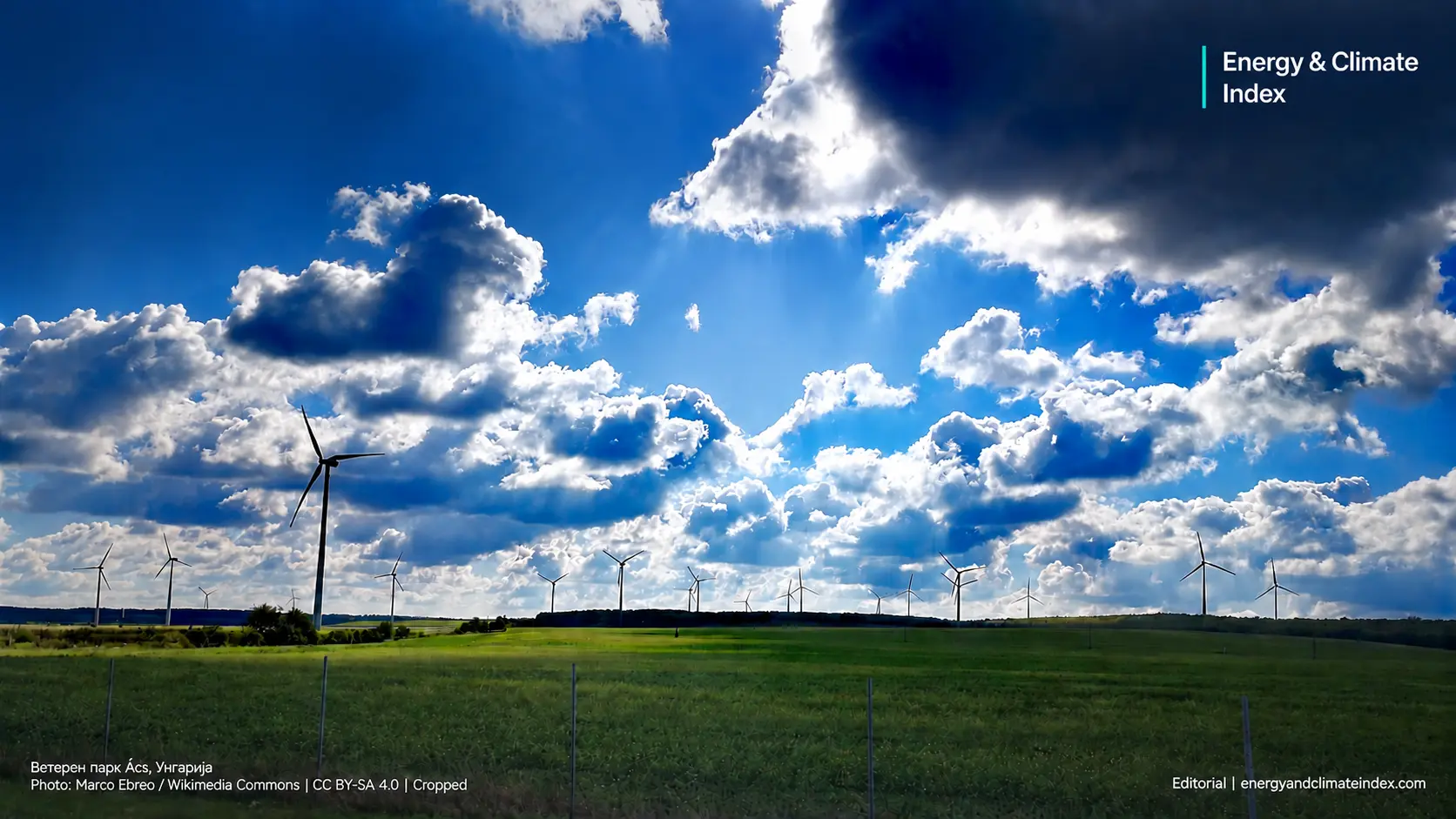
A total of 702 MVA is available across nine grid nodes, while proposed projects may also include battery energy storage systems
Hungary has launched its first tender to allocate available grid capacity for the construction and expansion of wind power plants. Investors will compete for a total of 702 MVA of feed-in capacity on the country’s medium- and high-voltage grids.
The tender was announced by the Hungarian Energy and Public Utility Regulatory Authority – MEKH, following a nationwide market survey, a detailed grid assessment and consultations with energy companies and potential investors.
According to the regulator, the procedure was prepared in accordance with the applicable legislation and a formal request from the minister responsible for energy policy.


Capacity available at nine grid nodes
The available 702 MVA is distributed across nine grid nodes located in six Hungarian districts.
The largest individual allocation is offered at Ócsa, with 255 MVA, while a further 200 MVA is available at the Szombathely OVIT grid node. Together, these two locations account for almost two-thirds of the total capacity offered through the tender.
The capacity is distributed as follows:
| Grid node | Available capacity |
|---|---|
| Ócsa | 255 MVA |
| Szombathely OVIT | 200 MVA |
| Ács Katódgyár | 50 MVA |
| Dunaújváros Dél | 50 MVA |
| Iváncsa | 50 MVA |
| Székesfehérvár Nyugat | 40 MVA |
| Komárom Ipari Park | 21 MVA |
| Szombathely Észak | 20 MVA |
| Kisbér | 16 MVA |
| Total | 702 MVA |
Each applicant must request at least 14 MVA of grid feed-in capacity and propose a wind power plant with a minimum installed capacity of 14 MW.
Wind power projects may be combined with battery storage
Wind power must be the primary technology included in each project. However, investors may also propose a battery energy storage system as a secondary technology.
The installed capacity of the battery system may not exceed the installed capacity of the wind power plant included in the application.
Battery storage will also play a role in the ranking of projects. MEKH will assess applications according to several criteria, including:
- the share of battery storage capacity;
- construction of a wind power plant with a higher installed capacity than the requested grid feed-in capacity;
- development on former industrial or brownfield sites;
- financial contributions to affected municipalities;
- willingness to share the grid connection point and related infrastructure;
- the share of equipment manufactured in the European Union.
The tender therefore goes beyond the administrative allocation of available grid capacity. Its conditions encourage combined wind and battery projects, the use of previously developed sites and greater involvement of local communities.
Grid connections scheduled between 2030 and 2032
Applications opened on 4 September, and the submission deadline is 30 October 2026. MEKH is expected to publish the results by 13 December 2026 at the latest.
Successful projects will not receive immediate access to the electricity grid. The earliest possible connection date is 30 September 2030, while connection plans and agreements may not specify a date later than 30 September 2032.
This means the tender will not immediately increase Hungary’s electricity generation. Instead, it establishes a medium-term investment pipeline for the return of wind energy to the development of the country’s power system.
ECI