

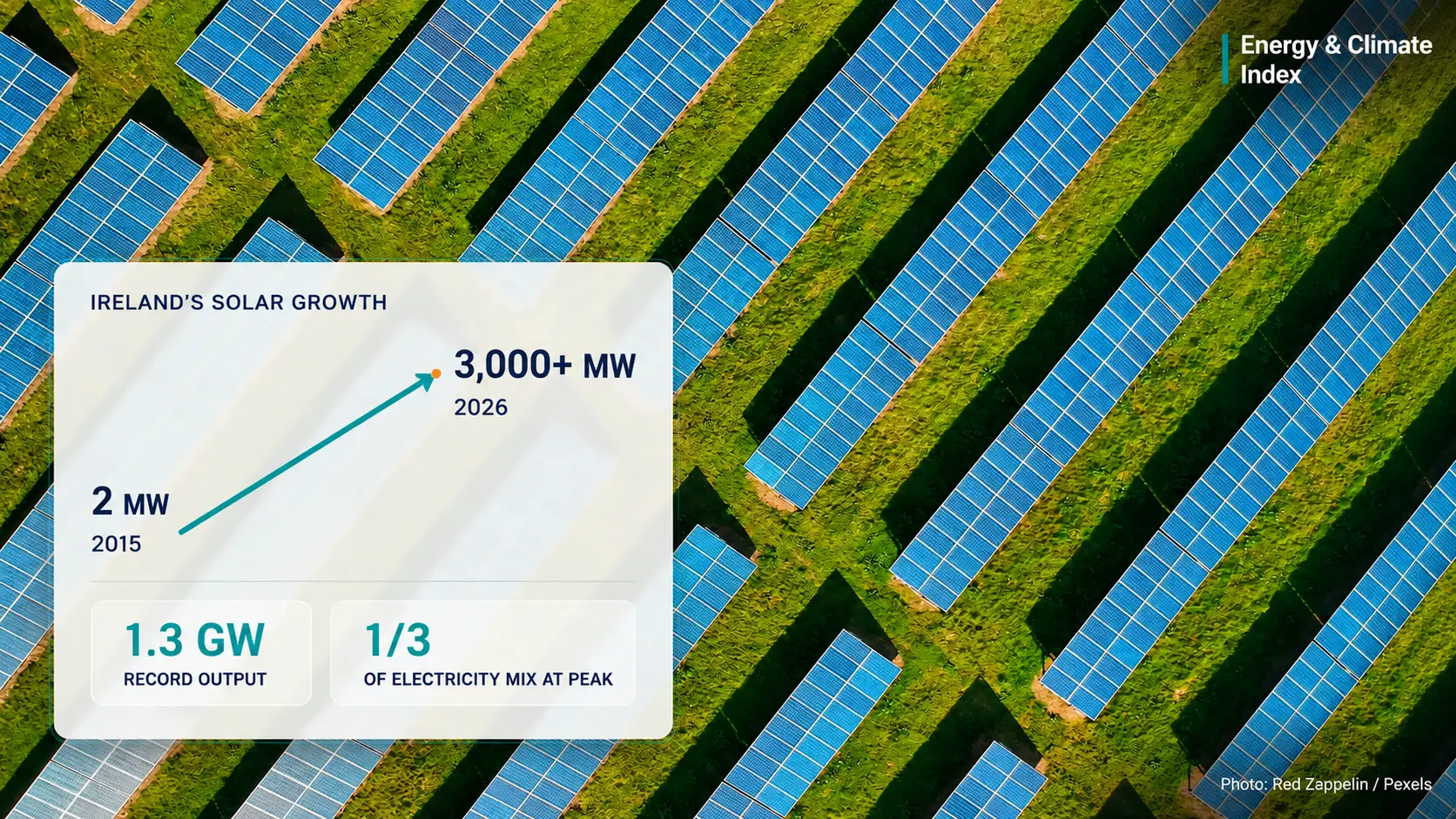
Ireland has surpassed 3 GW of installed solar capacity for the first time, the Department of Climate, Energy and the Environment announced. The milestone covers every segment of the sector, from rooftop installations on homes and commercial buildings to utility-scale solar power plants connected to the grid.
The pace of growth is particularly striking: just over a decade ago, Ireland had only 2 MW of solar capacity. Today, it has more than 3,000 MW.
The new milestone was reached during a week in which the Irish electricity system also recorded an all-time high in generation from utility-scale solar power plants.


Record solar output of 1.3 GW
On 24 August, output from Ireland’s utility-scale solar power plants exceeded 1.3 GW for the first time. According to the official announcement by the Irish Government, they provided around one third of the country’s total electricity generation at that point.
The previous major record was set in April 2026, when output from utility-scale solar power plants exceeded 1 GW for the first time.
EirGrid Chief Executive Cathal Marley said the rapid increase in generation was a clear sign of the progress being made in transforming Ireland’s electricity system. According to EirGrid’s estimate, 1 GW of generation is enough to power approximately 500,000 customers.
First utility-scale solar plant connected in 2022
The development of utility-scale solar power in Ireland began relatively recently. The country’s first grid-scale solar plant was connected in April 2022. Just four years later, solar capacity has become a significant part of the national electricity system.
Alongside utility-scale projects, rooftop generation on homes, commercial buildings, farms and public facilities is also expanding rapidly.
More than 200,000 Irish homes now have rooftop solar panels, while over 120,000 households have received government grants through the Solar PV scheme.
Interest continues to grow. More than 31,000 grant applications were submitted between the beginning of 2026 and the end of July, representing an increase of 76% compared with the same period in 2025.
Free solar panels have also been installed at 2,000 schools across Ireland. Households that generate more electricity than they consume can export the surplus to the grid and receive payment for it.
Government support to continue until 2030
The development of solar capacity is supported through several mechanisms, including the Renewable Electricity Support Scheme – RESS, the Small-Scale Renewable Electricity Support Scheme – SRESS and the Microgeneration Support Scheme – MSS.
Minister for Climate, Energy and the Environment Darragh O’Brien confirmed that the Government would continue funding the rooftop solar grant scheme until 2030.
“With continued investment in solar across homes, farms, businesses and large grid-scale projects, Ireland is building a growing source of homegrown, clean electricity and strengthening its energy security,” O’Brien said.
Ireland now has more than 8 GW of renewable generation capacity connected to the network. Around 5 GW has been added over the past decade, during which the country doubled its wind capacity and developed a significant solar sector from an almost negligible starting point.
The next challenge will be to expand the electricity grid and energy storage systems so that the growing volumes of electricity generated during sunny hours can be used more efficiently when demand is higher.
ECI