

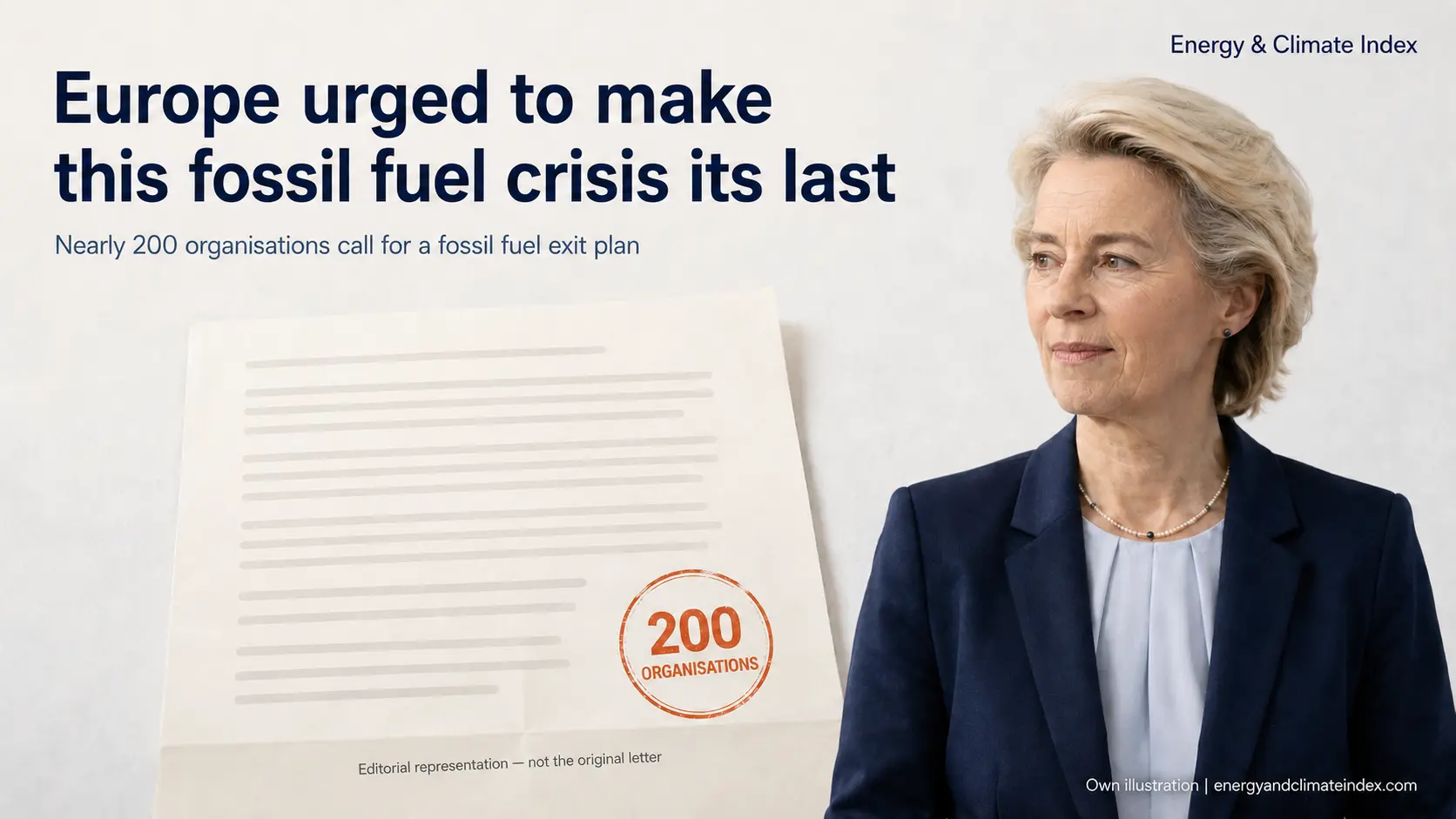
Nearly 200 European and international organizations and industry associations have called on European Commission President Ursula von der Leyen to initiate a comprehensive European plan for phasing out fossil fuels.
The appeal comes ahead of her State of the European Union address in September. The signatories include Climate Action Network Europe, Eurelectric, SolarPower Europe and other organisations representing the energy sector, industry and civil society.
In their joint letter, they urge the European Commission to commission an independent, science-based report showing how Europe can build an affordable, secure and homegrown energy system while permanently reducing its exposure to crises caused by fossil fuel dependence.


The latest crisis added more than €50 billion to Europe’s energy bill
The signatories argue that Europeans are paying twice for their dependence on fossil fuels this summer.
The latest oil and gas crisis, the second in just four years has added more than €50 billion to Europe’s energy bill for households and businesses. At the same time, heatwaves, wildfires and droughts are causing growing human and economic losses.
According to the letter, dependence on imported fossil fuels leaves European citizens and industry exposed to price shocks and geopolitical decisions made outside Europe.
The same vulnerability was examined in the Energy & Climate Index column “The Strait of Hormuz and the energy transition”: geopolitical crises repeatedly demonstrate that energy dependence is not only a question of price, but also of economic and strategic security.
Five priorities for the European plan
The organisations propose that the future European plan should be built around five priorities:
- Quantifying the full economic and financial burden of fossil fuel dependence;
- Identifying the fastest and most competitive pathway for phasing out fossil fuels;
- Aligning European and national financing with this objective;
- Ensuring a just transition for households, workers, companies and regions;
- Increasing investment in nature-based solutions that can mitigate climate risks.
Renewable energy, energy efficiency, modern electricity grids, circular economy solutions and clean flexibility are identified as the main foundations of the transition.
Industry is increasingly calling for electrification
The appeal does not come only from environmental organisations. The participation of energy and industry associations shows that moving away from fossil fuels is increasingly being linked to competitiveness, security of supply and protection from volatile import prices.
Earlier, more than 100 global companies called on governments to accelerate electrification and create the conditions for electricity to play a greater role across industry, transport and heating.
However, increasing renewable electricity generation will not be sufficient on its own, since large part of Europe’s energy consumption still relies directly on oil, gas and coal. Unless these fuels are replaced with electricity, the expansion of renewable energy will not fully reduce fossil fuel dependence.
Energy efficiency is the fastest way to reduce dependence
The proposed plan also identifies energy efficiency as one of the most cost-effective and proven tools for overcoming the crisis.
In his analysis Professor Jan Rosenow explains that the cheapest energy is the energy we do not use. Reducing energy consumption limits the need for imported fuels, lowers bills and facilitates the transition towards an electrified energy system.
The combination of energy efficiency, direct electrification, renewable energy, modern electricity grids, battery storage and other sources of flexibility therefore lies at the heart of the proposed European pathway away from fossil fuels.
Appeal ahead of von der Leyen’s address
The signatories are calling on Ursula von der Leyen to use her State of the European Union address to announce the preparation of an independent report led by an eminent independent figure and developed with the participation of academia, industry, social partners and civil society.
The objective is to provide the European Commission with a shared strategic framework for the remainder of its mandate and a concrete plan to make the current fossil fuel crisis Europe’s last.
ECI