

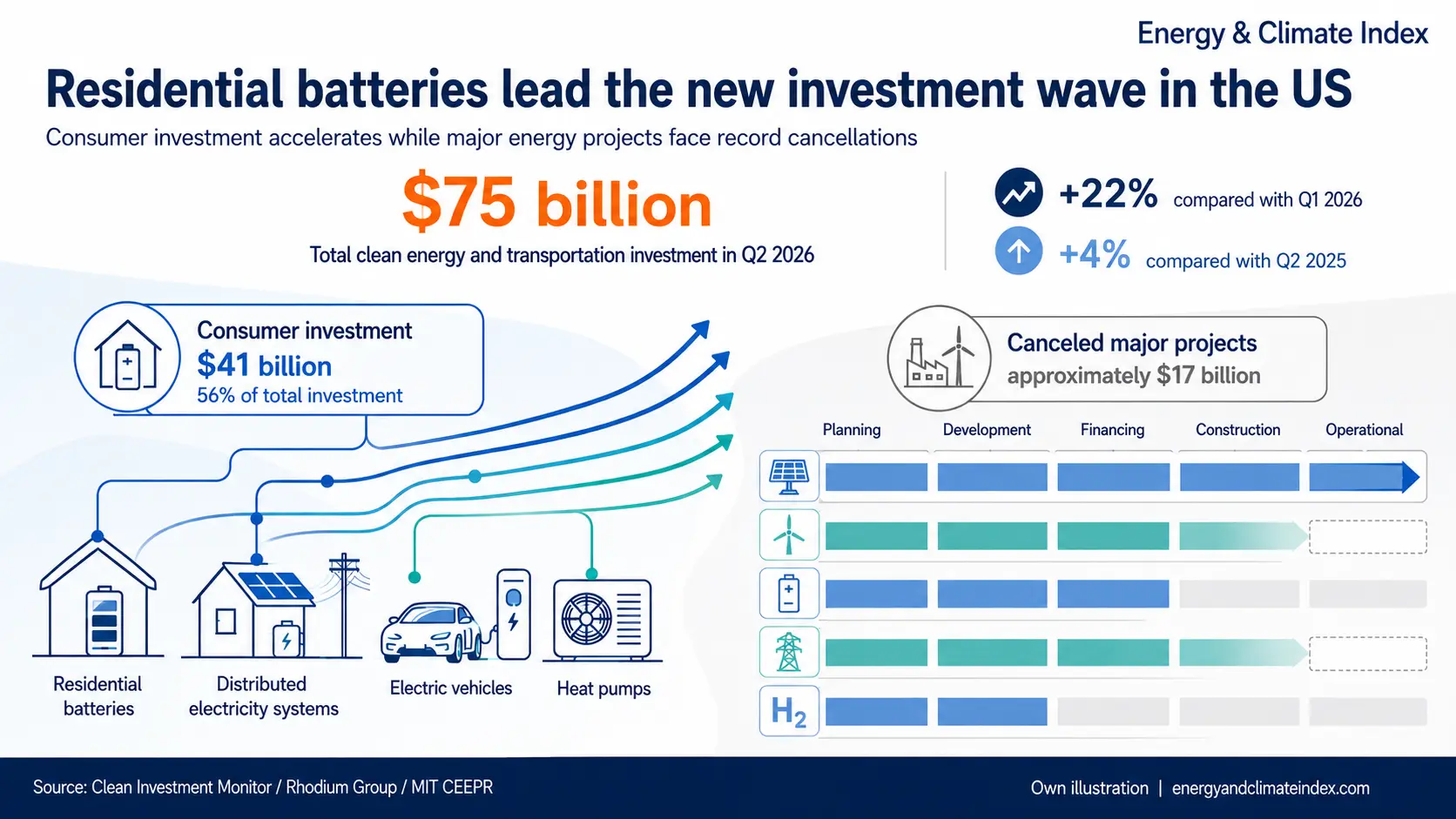
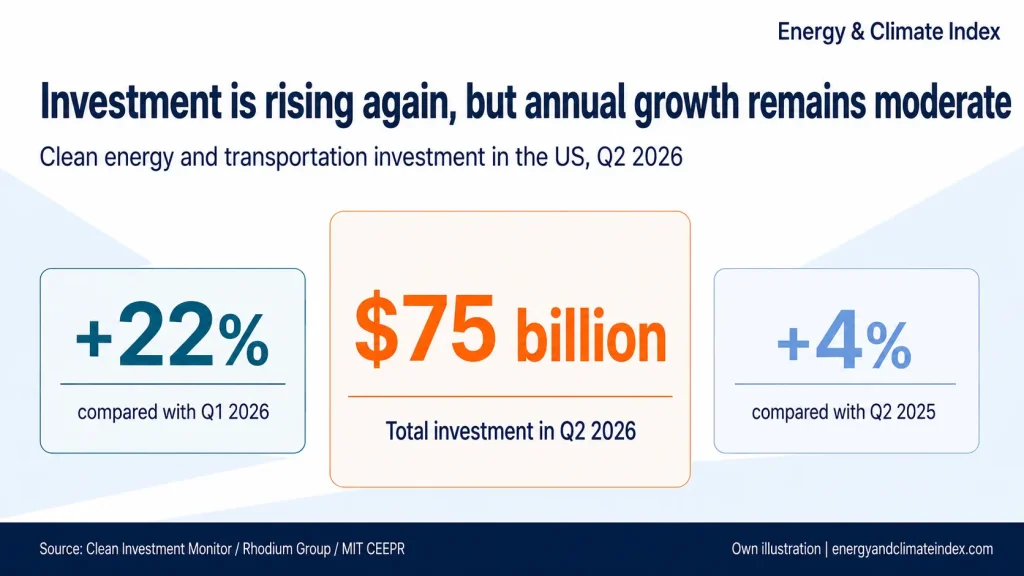
American households and businesses are becoming the main drivers of investment in clean technologies. In the second quarter of 2026, total US investment in clean energy and transportation reached $75 billion, with most of the growth coming from electric vehicles, residential batteries and heat pumps.
Data from the Clean Investment Monitor, a joint project of Rhodium Group and MIT, show that total investment was 22% higher than in the first quarter. Compared with the same period in 2025, however, the increase was only 4%.
This indicates a strong quarterly rebound rather than an even acceleration across all parts of the US energy transition.


Consumers account for more than half of total investment
Investment by households and businesses reached $41 billion, accounting for 56% of the total. This segment expanded by 45% compared with the previous quarter and by 21% year on year.
Zero-emission vehicles represented the largest individual category, attracting around $23 billion. This category includes battery-electric vehicles, plug-in hybrids and fuel-cell vehicles. Heat pump purchases and installations attracted another $7 billion.
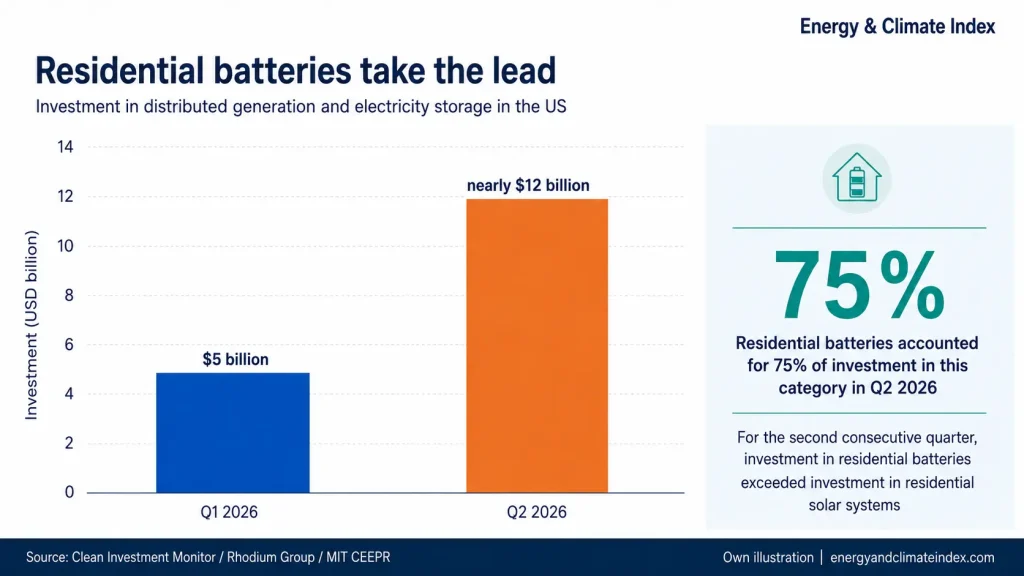
The strongest momentum was recorded in distributed electricity generation and storage. Investment in this category rose from $5 billion to nearly $12 billion in just one quarter.
Residential battery systems accounted for 75% of this amount and, for a second consecutive quarter, attracted more investment than residential solar installations. This suggests that the US market is gradually moving beyond simply producing solar electricity towards storing it and using it when it is most needed.
Large projects are not keeping pace with consumer growth
In contrast to strong consumer spending, investment in clean energy production and industrial decarbonisation remained at $25 billion. This was virtually unchanged from the previous quarter and 5% lower than a year earlier.
Utility-scale solar and battery storage projects attracted $19 billion, while investment in wind energy declined by 19% compared with the first quarter, falling to approximately $5 billion.
Investment in clean-technology manufacturing increased by 4% to $8 billion, ending a decline that had lasted for six consecutive quarters. Nevertheless, manufacturing investment remained 24% below the level recorded in the second quarter of 2025.
Growth accompanied by record project cancellations
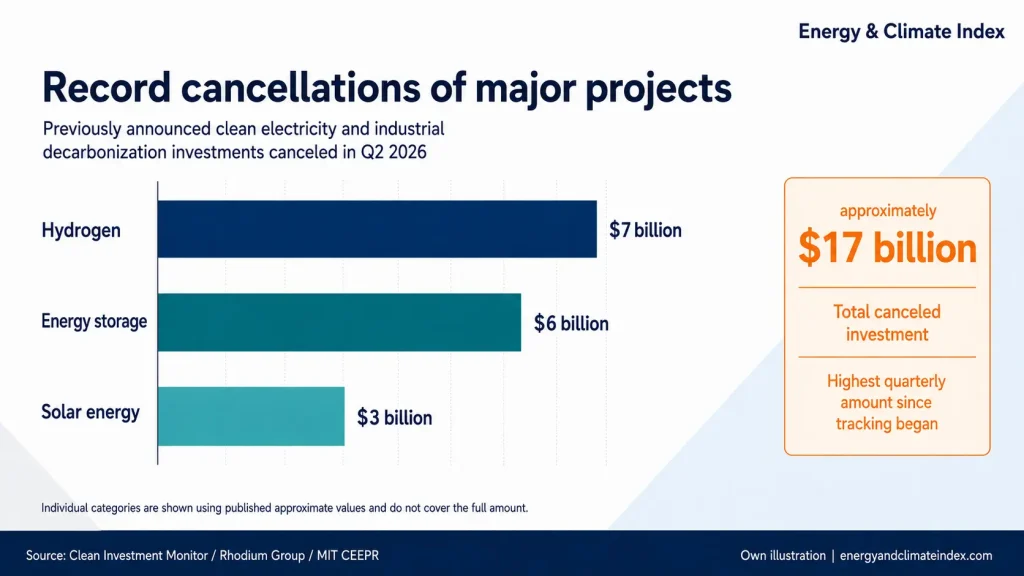
The clearest indication of continued uncertainty comes from projects that will not be implemented. During the quarter, developers cancelled approximately $17 billion in previously announced clean electricity and industrial decarbonization investments, the highest quarterly amount since the Clean Investment Monitor began tracking the data.
These cancellations included a hydrogen project worth $7 billion, energy storage projects worth $6 billion and solar projects valued at approximately $3 billion.
The figures reveal a US energy transition moving at two different speeds. The market for residential batteries, electric vehicles and heat pumps is expanding rapidly, while large-scale energy and industrial projects face weaker growth and significant cancellations.
The 22% quarterly increase therefore does not represent a broad-based investment acceleration. The more important shift is that the centre of growth is moving towards consumers and energy storage, while the outlook for large projects remains considerably more uncertain.
ECI