

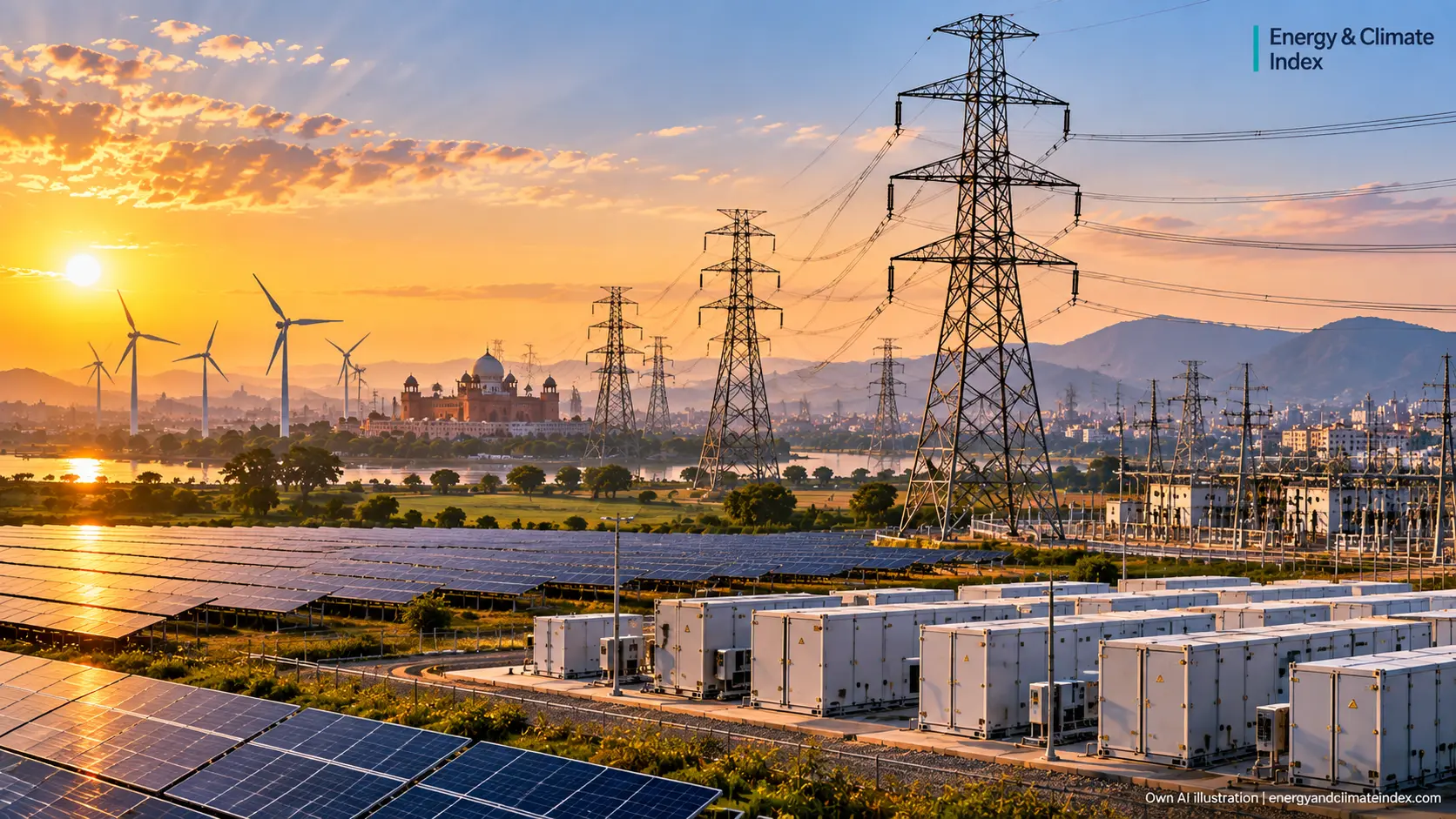
India has approved one of its largest programmes for modernising the electricity grid and integrating renewable energy, with a total investment of approximately $19.4 billion.
The government’s Green Energy Corridor Phase III (GEC-III) programme is designed to enable the integration and transmission of electricity from up to 135 GW of new renewable energy capacity, while also providing for the deployment of 50 GWh of battery energy storage systems (BESS).
The Indian government plans to complete the programme by the 2032–33 financial year.


Around $14.2 billion for grids and $5.2 billion for battery storage
The largest share of the investment, approximately $14.2 billion, will be directed towards developing and strengthening intra-state transmission systems across India.
An additional $5.2 billion is earmarked for the deployment of 50 GWh of battery energy storage capacity.
The central government will provide approximately $5.6 billion in financial support, aimed at reducing the cost of developing transmission infrastructure and limiting the impact of these investments on electricity tariffs.
Battery systems may be installed alongside renewable energy generation facilities or at other locations within the power system where additional flexibility is required.
Their role will extend beyond simply storing solar electricity. BESS will help manage variable renewable generation, transmission constraints, periods of surplus production and electricity supply during hours when solar and wind generation are lower.
From building renewables to integrating renewables
The scale of GEC-III illustrates the next phase of India’s energy transition. The focus is shifting from simply adding solar and wind capacity towards developing the infrastructure required to integrate increasingly large volumes of renewable electricity into the power system.
The two defining figures are therefore 135 GW of renewable energy integration capacity and 50 GWh of energy storage.
State Transmission Utilities will be primarily responsible for implementing the programme. New greenfield transmission projects are expected to be developed through competitive bidding mechanisms, while upgrades to existing infrastructure will be implemented through regulated frameworks.
With Green Energy Corridor Phase III, India is effectively linking the next major wave of renewable energy development with two infrastructure components that are becoming increasingly critical for power systems with high shares of renewables: transmission grids and energy storage.
ECI