

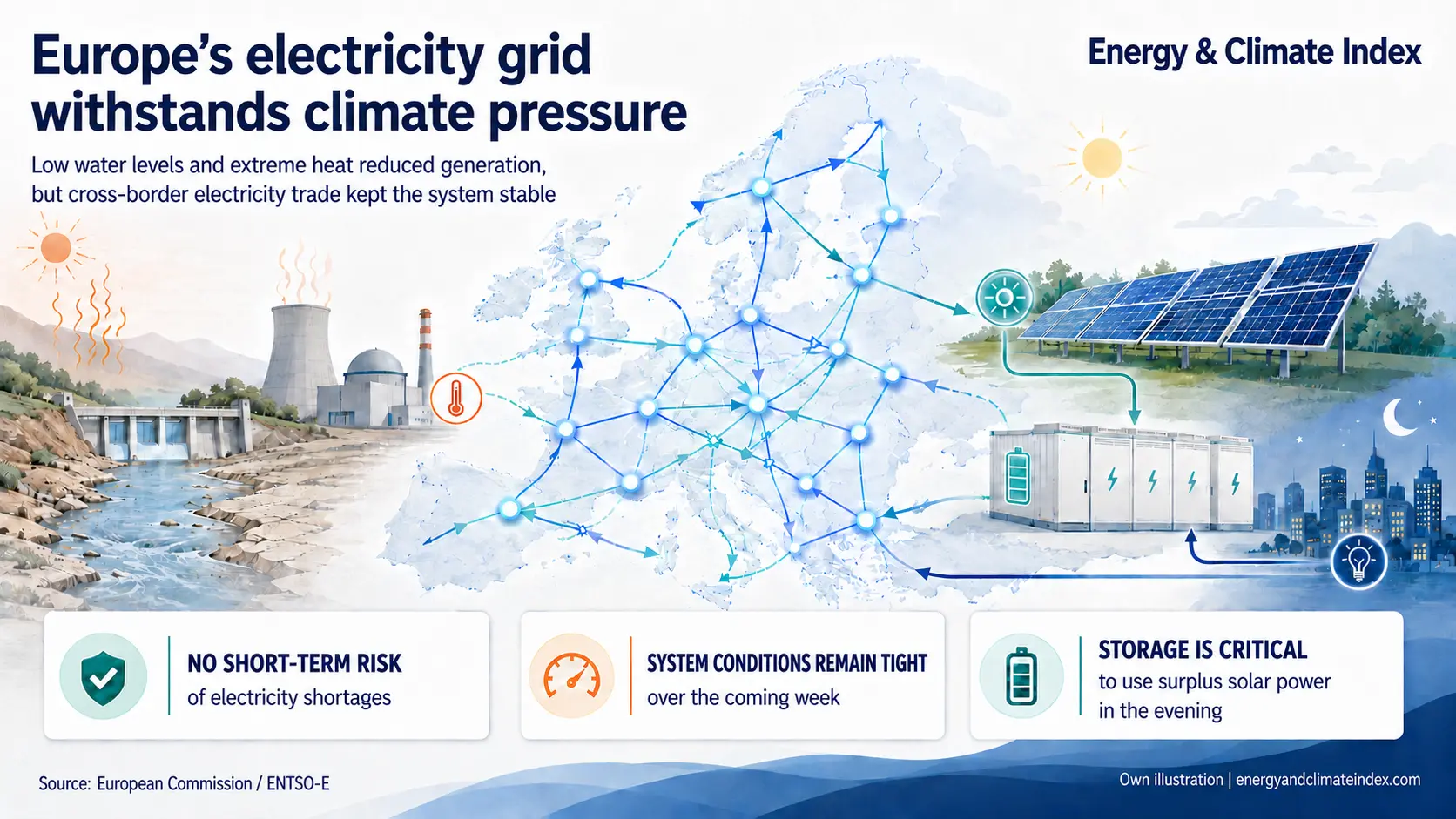
Europe’s electricity system currently faces no short-term adequacy risks, despite extreme temperatures and drought reducing power generation in several countries. However, conditions are expected to remain tight over the coming week, the European Commission announced.
The assessment followed an emergency meeting of the Electricity Coordination Group, attended by experts from the European Commission, EU member states, Ukraine, Moldova, the Energy Community Secretariat and the European Network of Transmission System Operators for Electricity, ENTSO-E.
The single electricity market is easing the pressure
Low water levels and high water temperatures have reduced electricity generation in parts of Europe. These conditions are affecting hydropower plants, as well as thermal and nuclear power stations that rely on water for cooling.


According to the European Commission, coordination between countries and the functioning of the single electricity market are enabling electricity to flow towards the regions where it is needed most.
Strong solar generation has significantly eased pressure on both the system and electricity prices during the middle of the day. However, the Commission stressed that accelerating the deployment of energy storage remains critical, allowing surplus solar generation to be used during evening demand peaks.
Hungary reduces demand as operators prepare for the eclipse
Voluntary demand-side measures introduced in several countries, particularly Hungary, have also helped during periods when the balance between electricity generation and demand was tight.
ENTSO-E also briefed the group on preparations by European transmission system operators for the solar eclipse on 12 August. Solar generation is expected to fall temporarily during the event, prompting operators to prepare measures to maintain system balance.
The European Commission said it would continue monitoring conditions across Europe and coordinating action with EU countries, ENTSO-E and the Energy Community Secretariat.
ECI