

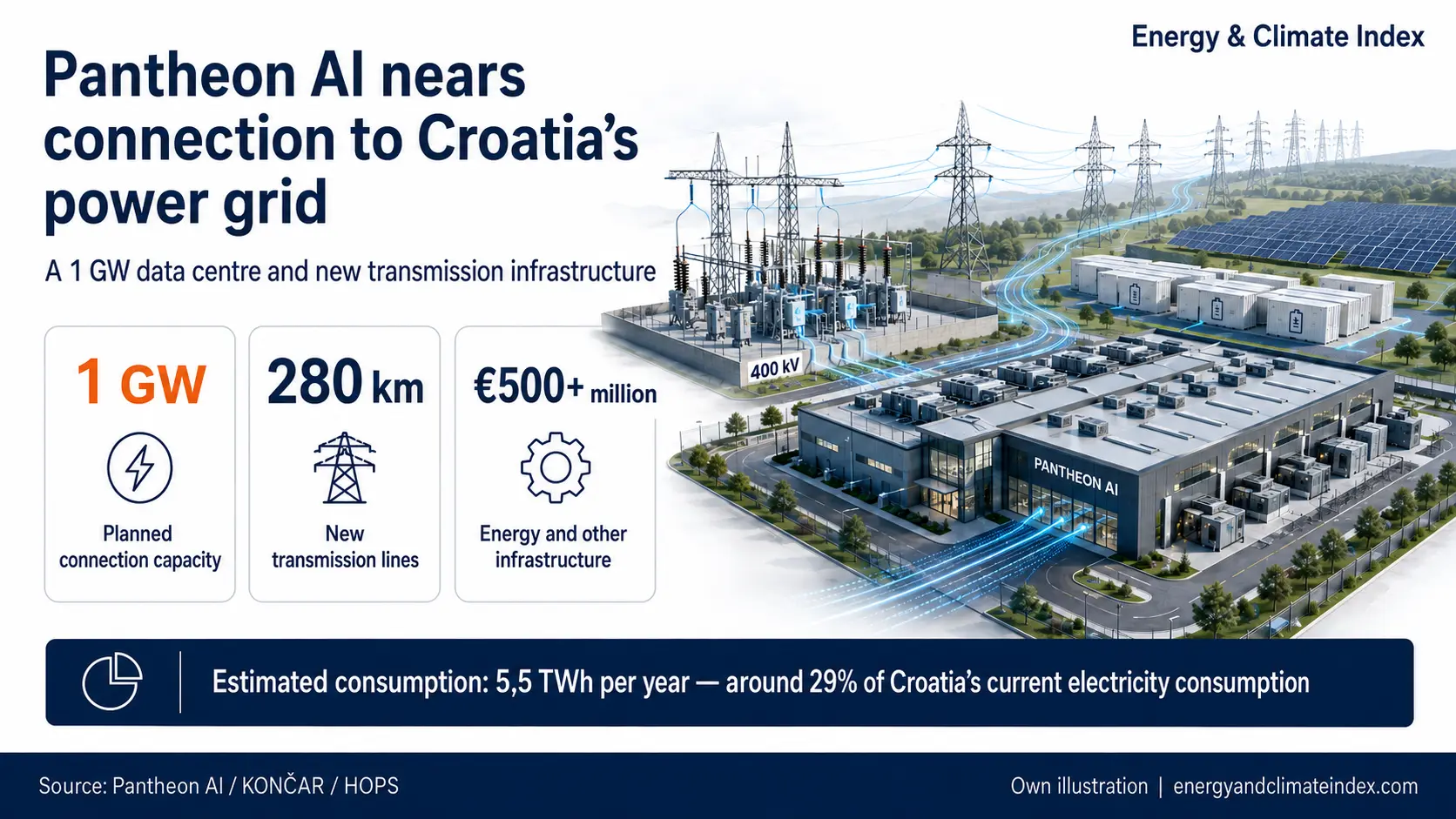
The Pantheon AI project, which plans to build an artificial intelligence data centre in Topusko, has taken an important step in the process of connecting to Croatia’s transmission network. The company announced that the Croatian Transmission System Operator, HOPS, has accepted the Optimal Technical Connection Solution Study, known as EOTRP.
The information was initially released by Pantheon AI and subsequently reported by Croatian and regional media. HOPS has not yet issued a separate public announcement regarding the acceptance of the study for this project.
According to Pantheon AI, the document confirms the technical feasibility of connecting the planned 1 GW data centre to the transmission network. The company also stated that the process of concluding a grid connection agreement with HOPS has begun.


Acceptance of the EOTRP is a significant but not final step. According to HOPS’s official procedure, the next stages include an offer and conclusion of a grid connection agreement, payment of the connection fee, issuance of electricity connection conditions, construction of the connection infrastructure and its eventual energisation.
New transmission infrastructure is planned
Pantheon AI plans to build a new 400 kV substation in Topusko, approximately 280 kilometres of transmission lines, fibre-optic connections and road infrastructure. The value of these infrastructure investments is estimated at more than €500 million.
According to the company, the new infrastructure would supply the data centre while also strengthening Croatia’s transmission network. Once completed, the electricity infrastructure would be transferred to the Croatian state for permanent operation.
The company claims that the new transmission lines could enable the connection of more than 5 GW of renewable energy capacity currently constrained by insufficient grid capacity. HOPS has not published a separate analysis identifying the projects that could use this additional transmission capacity.
Croatian industrial group KONČAR is also involved in the development of the project’s energy segment. In April 2026, KONČAR signed a letter of intent with US-based Pantheon Atlas LLC concerning its potential involvement in building the energy infrastructure and carrying out part of the construction works for the data centre.
According to KONČAR’s official announcement, the project includes a 1 GW data centre, a new substation and 280 kilometres of transmission infrastructure. The letter of intent provides a framework for further negotiations and does not represent a final construction contract.
Annual electricity consumption estimated at around 5.5 TWh
Pantheon AI is planned as an artificial intelligence and data-processing centre with a grid connection capacity of 1 GW. According to figures presented by the project developer, its annual electricity consumption would amount to approximately 5.5 TWh.
This would be equivalent to around 29% of Croatia’s current annual electricity consumption. The scale of the facility has therefore raised questions about its potential impact on the transmission network, regional electricity flows and market prices.
The project also includes plans for a 500 MW solar power plant and a large battery storage system. However, the solar facility could not independently provide continuous electricity to a data centre requiring up to 1 GW, meaning that grid supply, energy storage and backup sources would also be necessary.
The total value of Pantheon AI has been estimated at more than €50 billion. KONČAR included this estimate in its official announcement about the letter of intent. Construction is scheduled to begin in 2027, with the centre expected to start operating in 2029.
Debate in Croatia focuses on electricity prices and the grid
The planned capacity has sparked debate in Croatia over how such a large consumer could affect the national electricity system. A 1 GW data centre would operate continuously and create electricity demand on a scale not currently associated with any single consumer in the country.
Supporters argue that the investment could accelerate the modernisation of Croatia’s transmission network, create additional capacity for renewable energy projects and bring new infrastructure and employment to Topusko and the surrounding region.
Critics warn that the increase in demand could affect electricity prices, particularly during periods of high consumption and limited domestic generation. Questions have also been raised about whether the announced infrastructure will be financed entirely by the investor and under what conditions it would be transferred to the state.
The estimated value of more than €50 billion has also attracted scrutiny, as it would make Pantheon AI the largest individual investment in Croatian history. A complete financing structure and final agreements with the data centre’s future users have not yet been publicly presented.
Water use for cooling remains a sensitive issue
Large data centres require substantial quantities of electricity, but they may also require water to cool their server infrastructure. The issue is particularly sensitive in Topusko, an area known for its thermal springs and complex hydrogeological conditions.
The investor plans to use its own wells and a water recirculation system without connecting to the existing water supply and sewerage networks. However, the potential impact on groundwater and thermal water resources will need to be assessed through detailed hydrogeological studies and environmental impact assessment procedures.
The accepted study indicates that the project is advancing through the grid connection process. The next key steps will be concluding the agreement with HOPS, securing financing and permits, and constructing the infrastructure required to supply the planned 1 GW data centre.
ECI