

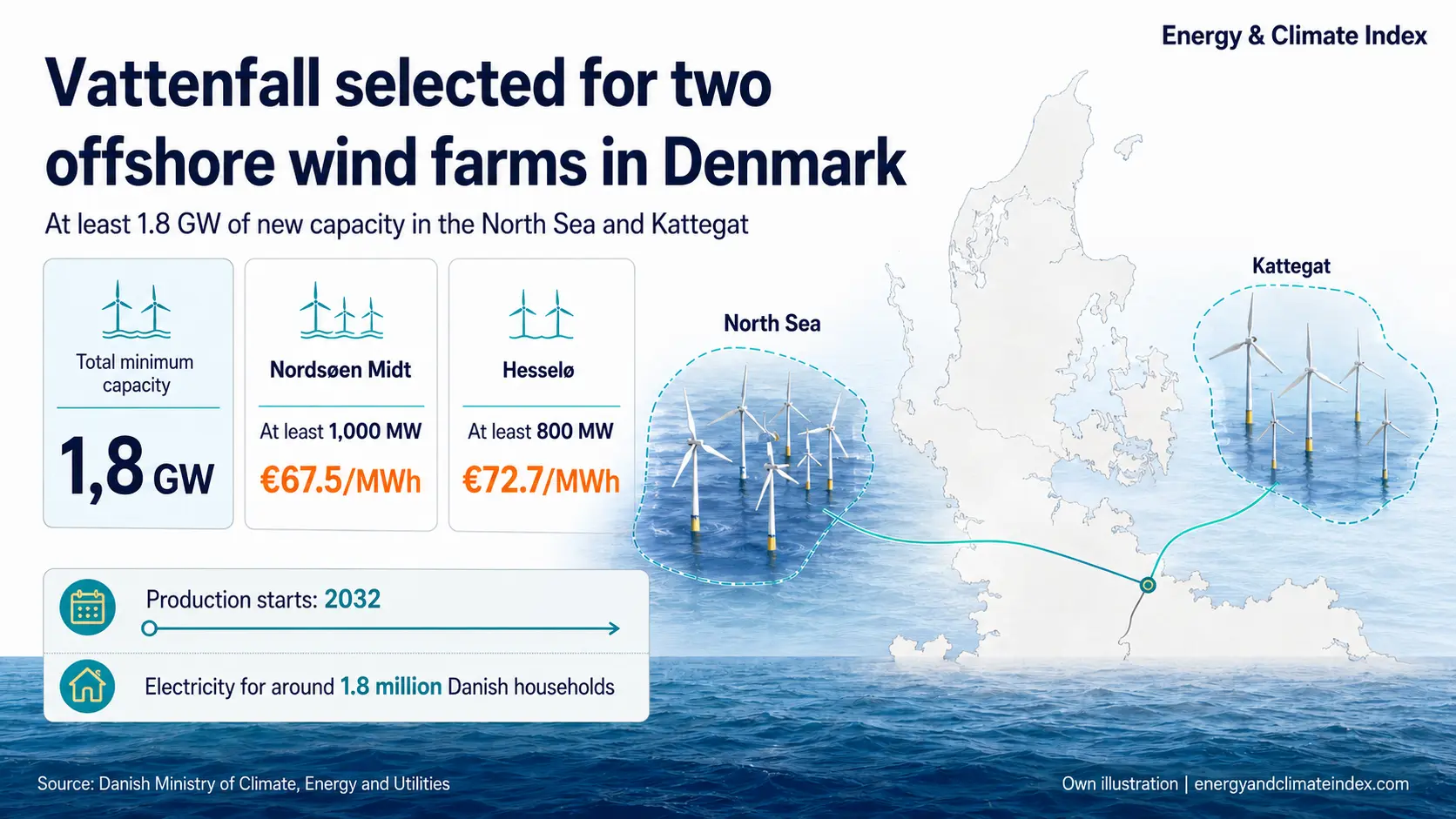
The Danish Energy Agency selected Vattenfall to build the Nordsøen Midt and Hesselø offshore wind farms, with a combined minimum capacity of 1.8 GW. The two projects will generate electricity equivalent to the consumption of around 1.8 million Danish households.
The agency conducted the tender procedures under Denmark’s new offshore wind development model, which allows state support. Vattenfall won with the lowest bids, offering approximately €67.5/MWh for Nordsøen Midt and €72.7/MWh for Hesselø.
At least 1 GW in the North Sea
Nordsøen Midt will be built in the North Sea, around 20 kilometres off the west coast of Jutland. The offshore wind farm will have a minimum installed capacity of 1,000 MW, and the tender attracted two bids.


Hesselø will be located in the Kattegat, around 30 kilometres off the northern coast of Zealand. The project will have a minimum capacity of 800 MW, while its final installed capacity could reach 1.2 GW. The tender for this offshore wind farm attracted five bids.
Grid connection capacity has been reserved for both projects. Their onshore connection points will be located approximately 50 kilometres inland.
Electricity production expected to begin in 2032
The next step includes verifying the documentation and confirming that Vattenfall meets all legal and tender requirements. Once these formalities are completed, the relevant authorities will sign the contracts with the company.
Both offshore wind farms are expected to begin generating electricity in 2032. The permits will be valid for 30 years, with the possibility of a further ten-year extension.
Vattenfall Vindkraft A/S secured both contracts together with two subsidiaries. The company is wholly owned by the Swedish energy group Vattenfall AB.
New model restores investor interest
Denmark launched the tenders in November 2025, based on a political agreement to develop 3 GW of new offshore wind capacity. The new framework followed an earlier tender without state support that failed to attract any bids amid higher investment costs, rising interest rates and supply-chain challenges.
The tender model allows state support through a reference-price mechanism. The actual financial impact on the state will depend on electricity market prices during the support period.
Vattenfall already operates five offshore wind farms in Denmark with a combined capacity of approximately 1.5 GW. They generate around 6.5 TWh of electricity annually, enough to supply approximately 1.5 million households.
ECI