

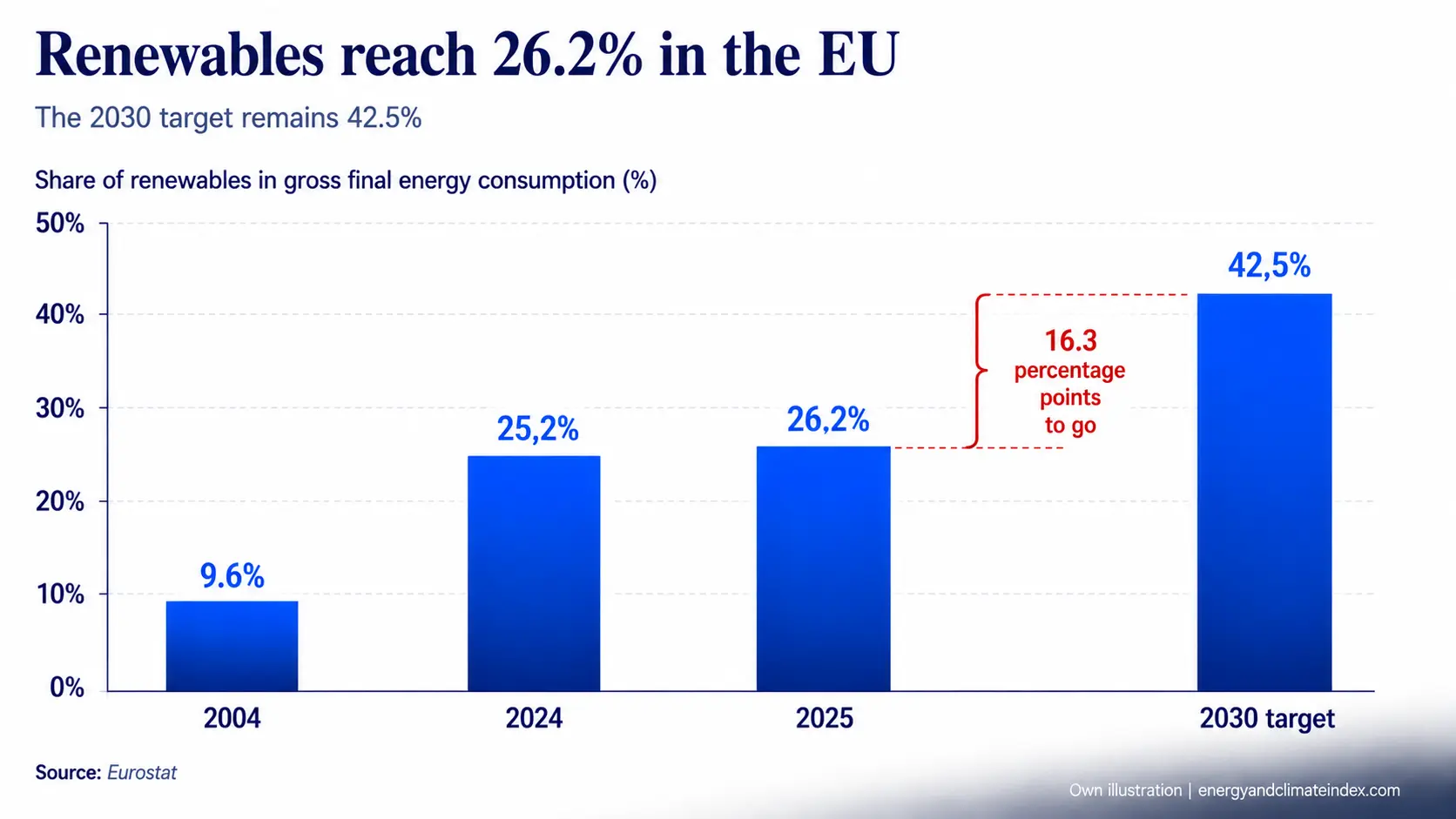
Renewable energy accounted for 26.2% of total final energy consumption in the European Union in 2025, according to preliminary data published by Eurostat.
This represents an increase of one percentage point compared with 2024, when renewables had a share of 25.2%. Compared with 2004, when the time series began and the share stood at only 9.6%, the contribution of renewable energy has almost tripled.
However, the current pace is not sufficient for the European Union to reach its 2030 target.


The EU is 16.3 percentage points short of its target
The European Union has set a target for renewable energy to account for at least 42.5% of total final energy consumption by 2030.
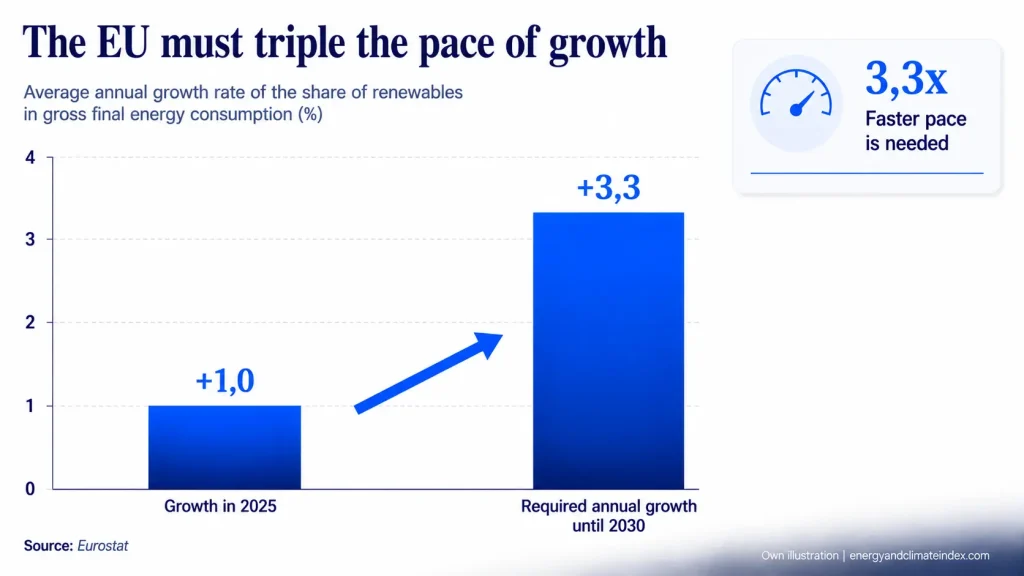
The gap between the 26.2% share recorded in 2025 and the 2030 target amounts to 16.3 percentage points. According to Eurostat’s calculation, the share of renewable energy will need to increase by an average of 3.3 percentage points per year between 2026 and 2030.
This is more than three times faster than the one-percentage-point increase registered in 2025.
Sweden and Finland are already above the EU target
Sweden recorded the highest share of renewable energy in total final consumption among EU member states, at 65.4%. The country relied mainly on solid biomass, hydropower and wind energy.
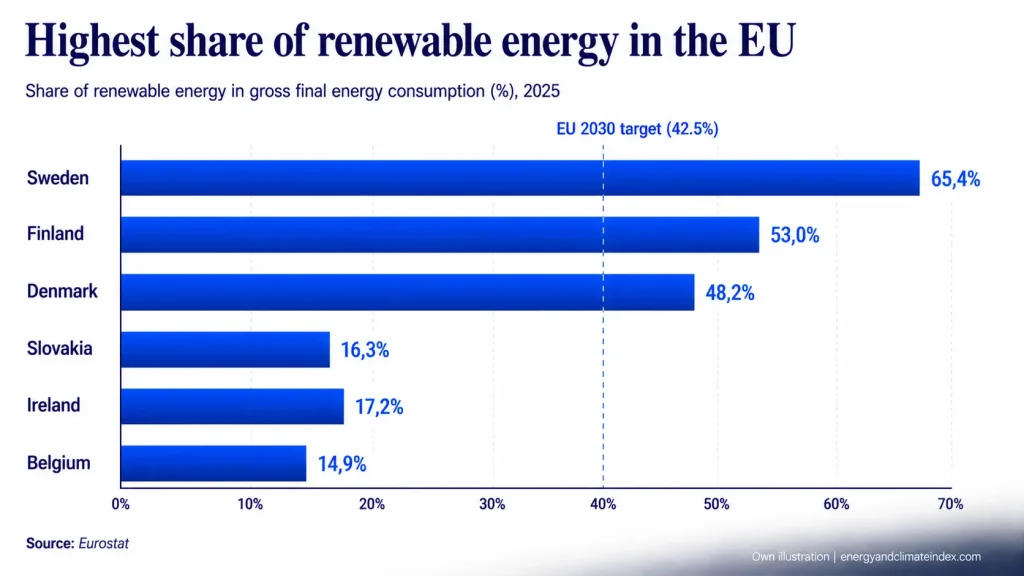
The gap between Sweden and Belgium exceeded 50 percentage points, highlighting the significant differences in the progress of the energy transition across EU member states.
Half of the EU’s electricity comes from renewable sources
The strongest progress was recorded in the electricity sector. Renewable sources supplied 49.9% of gross electricity consumption in the EU in 2025.
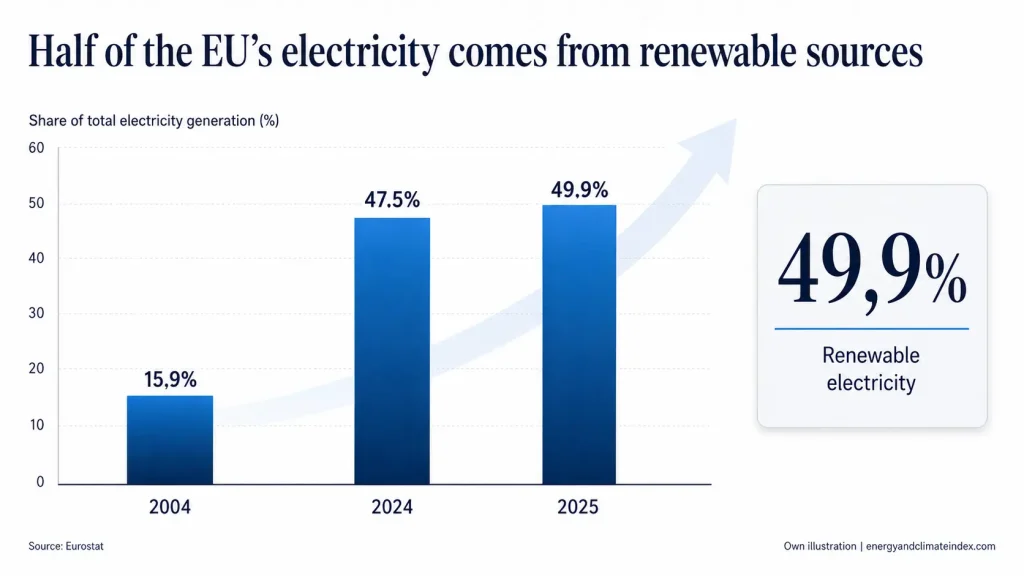
The share increased by 2.4 percentage points compared with 2024. In 2004, renewable energy accounted for only 15.9% of European electricity consumption.
This means that over slightly more than two decades, the share increased by 34 percentage points, bringing the EU close to the point where every second megawatt-hour of electricity consumed comes from renewable sources.
Austria and Sweden have almost fully renewable electricity systems
Renewable sources supplied 90.8% of gross electricity consumption in Austria and 89.2% in Sweden.
High shares were also recorded in Denmark at 77.7%, Portugal at 65.6%, Greece at 60.9% and Spain at 60.7%.
At the other end of the ranking, Malta had the lowest share, at only 11.2%. It was followed by Czechia at 19.2%, Luxembourg at 23.3%, Slovakia at 24.1% and Cyprus at 27.5%.
The figures show that the electricity sector is progressing significantly faster than the overall energy system, which also includes transport, heating, cooling and other forms of final energy consumption.
Heating and cooling are progressing more slowly
Renewable sources reached a 27.4% share of the energy used for heating and cooling in 2025. This was the highest level recorded since measurements began in 2004, when the share stood at 11.7%.
Compared with 2024, when the share was 26.7%, the increase amounted to only 0.7 percentage points.
This growth was slightly below the average annual increase of 0.75 percentage points recorded between 2004 and 2025.
Eurostat’s data indicate that although the EU is very close to achieving a majority share of renewables in electricity consumption, the decarbonization of the broader energy system is progressing much more slowly. Reaching the 42.5% target by 2030 will require a substantially faster expansion of renewable energy beyond the electricity sector.
Source: Eurostat, preliminary data for 2025.
ECI