

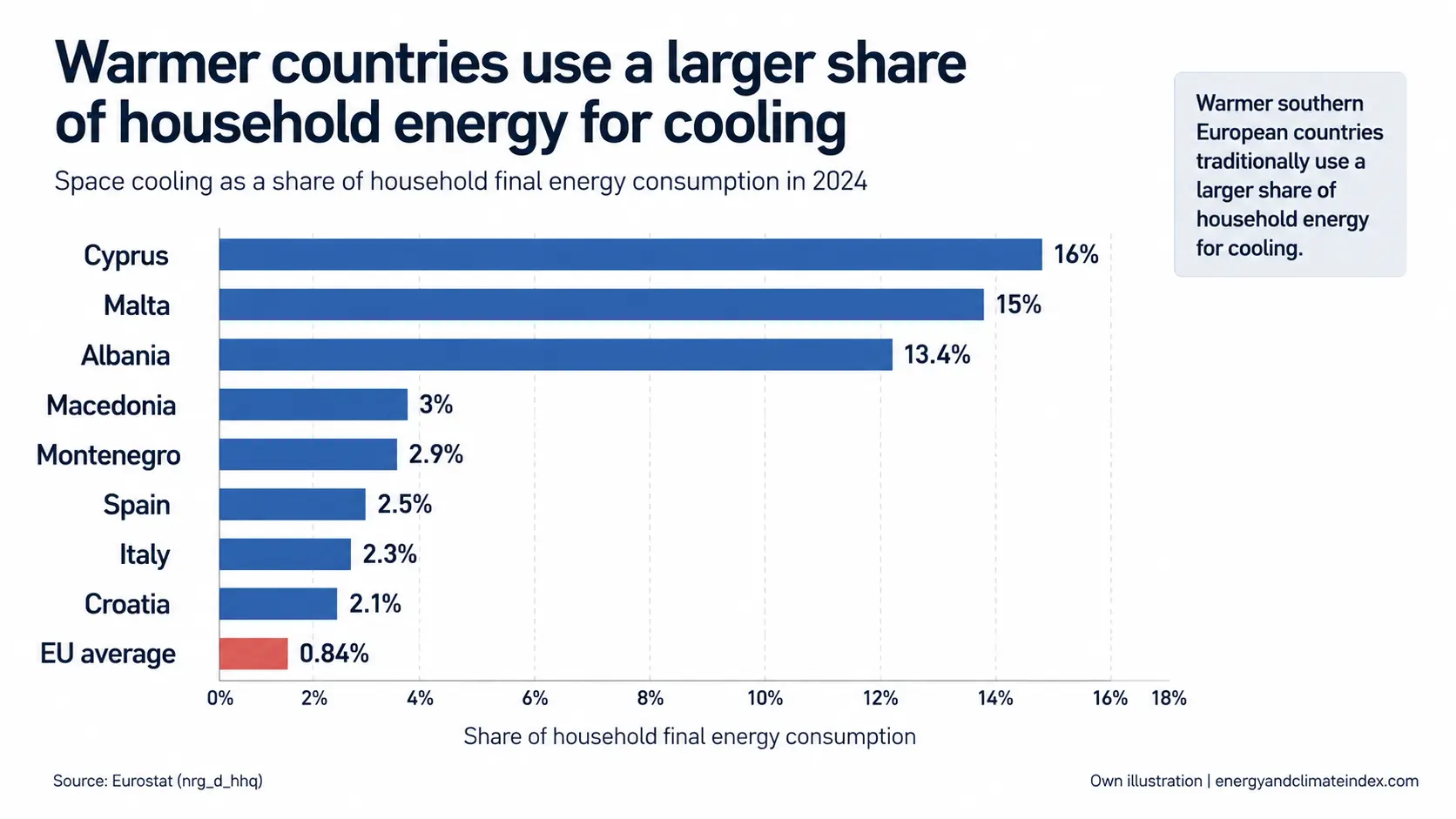
Household energy consumption for cooling in the EU increased by 99% between 2018 and 2024, while compared with 2010 the rise reached 420%, according to an analysis by Euronews based on Eurostat data.
In 2018, EU households consumed around 40,500 terajoules of energy for cooling. By 2024, consumption had reached 80,400 terajoules, representing an increase of nearly 100%.
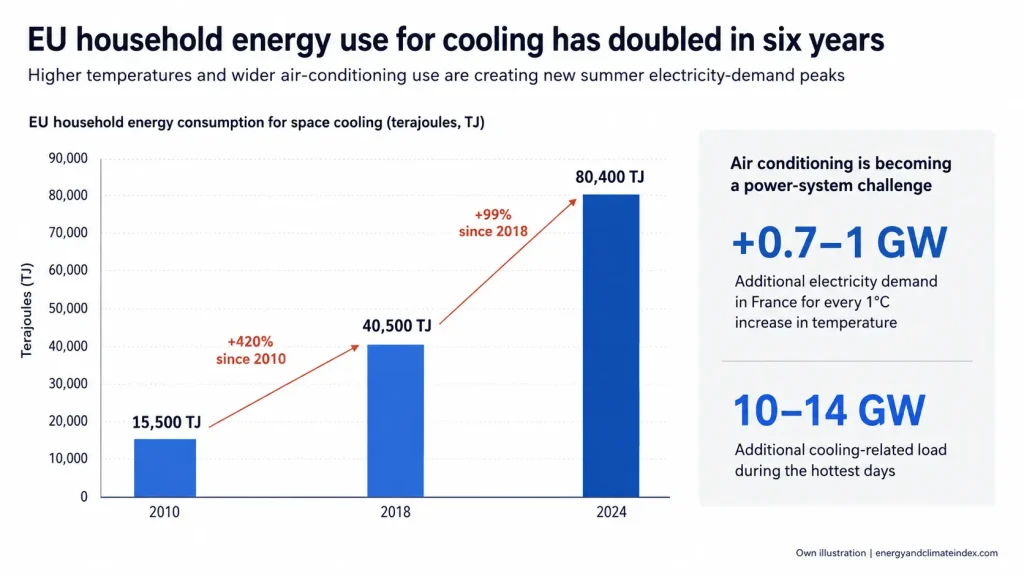
Compared with 2010, when energy consumption for cooling stood at around 15,500 terajoules, the increase amounts to approximately 420%.


Austria recorded one of the largest increases between 2018 and 2024, with cooling-related energy consumption rising from 22 to 253 terajoules, an increase of more than 1,000%, albeit from a very low starting point.
Consumption increased by 244% in Czechia, 193% in Italy, 171% in Hungary, 163% in Finland, 127% in Spain, 114% in Slovenia and 103% in Greece.
Warmer countries traditionally use a larger share of energy for cooling
Despite the rapid increase, cooling still accounts for a relatively small share of total household final energy consumption in the EU. The EU average stood at 0.84% in 2024.
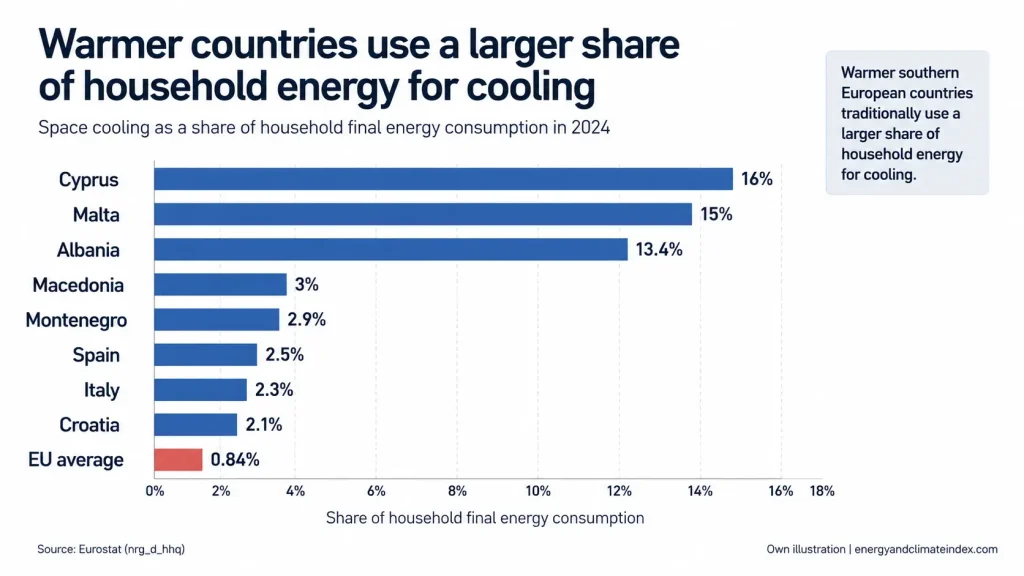
However, the share is significantly higher in warmer southern European countries. In Cyprus, cooling accounts for 16% of household final energy consumption, while in Malta the share is 15%.
Albania also records a high share of 13.4%, while in Macedonia around 3% of household final energy consumption is used for cooling. The share stands at 2.9% in Montenegro, 2.5% in Spain, 2.3% in Italy and 2.1% in Croatia.
Differences between countries are mainly linked to climatic conditions, the duration of the cooling season and the penetration of air-conditioning and other cooling systems.
Air conditioning is becoming a new challenge for power systems
The growing use of air conditioning creates additional electricity demand during the hottest periods, when power systems are already under greater strain.
According to French transmission system operator RTE, every one-degree Celsius increase in temperature can raise electricity demand in France by approximately 0.7 to 1 GW.
On the hottest days, cooling systems can add between 10 and 14 GW of additional electricity demand.
At the same time, high temperatures can also constrain electricity generation, particularly at nuclear power plants that rely on river water for cooling.
The rapid increase in energy use for air conditioning shows that summer electricity demand is becoming an increasingly important factor in European energy planning. Countries will need to secure sufficient generation capacity, stronger power grids and greater system flexibility to meet future peak demand.
ECI